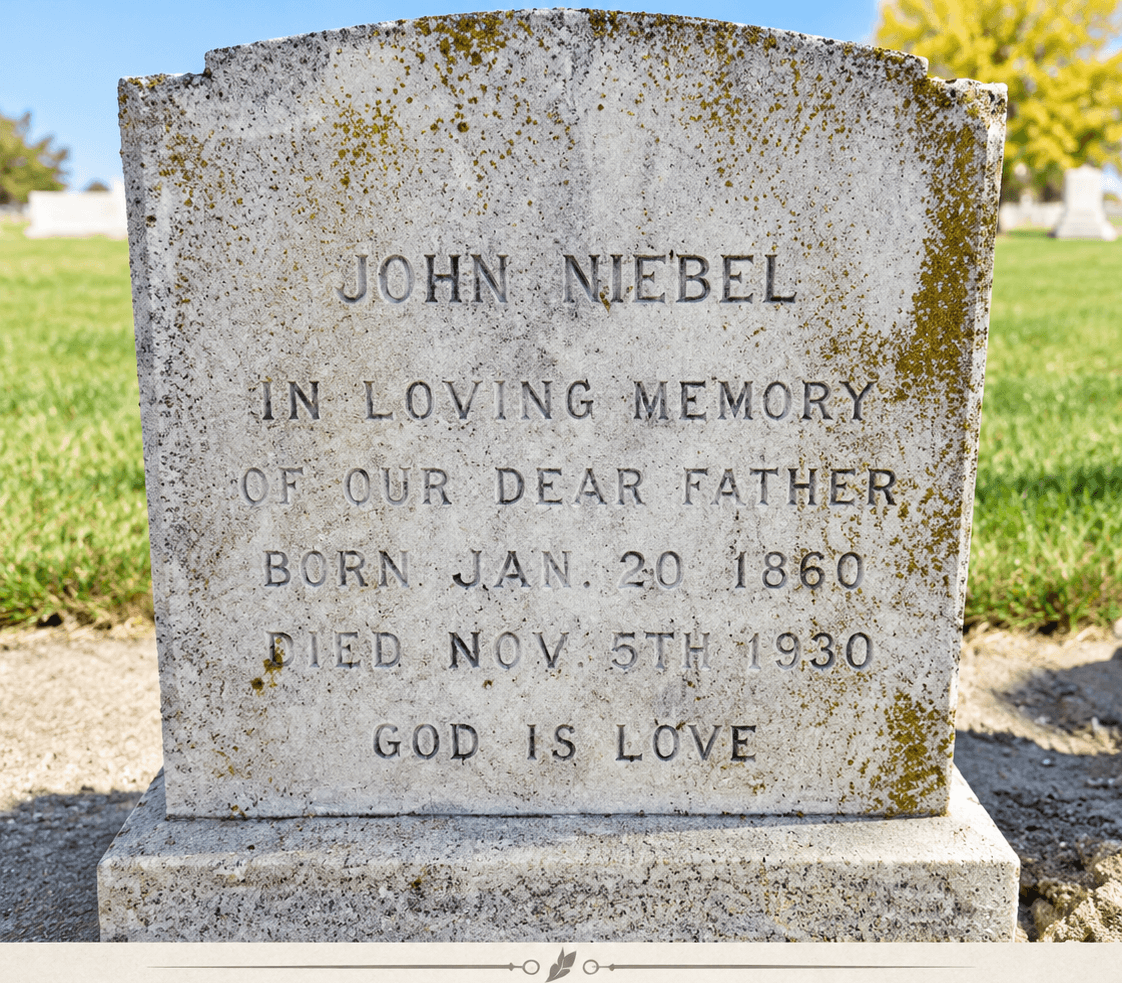
Johann Niebel and Rosina Suess, who went by Rosa and sometimes Rose, were German farming people from the Bessarabian colonies north of the Danube delta. In 1902 they crossed the Atlantic with six children and filed on a quarter section of prairie near Yorkton, Saskatchewan. Johann was born at Friedensthal on 20 January 1861 according to the church record, though the stone over his grave says 1860. Rosa was born on 17 February 1858. They spent their last years in Melville, the town where Catherine raised her family, and in 1916 they were living on the same street as her.
Bessarabia
Bessarabia belonged to the Ottoman Empire until Russia took it in 1812 and invited German farmers to settle the empty steppe. Between 1814 and 1842 about nine thousand came, mostly from Württemberg, Baden and Prussia, many of them by way of the Duchy of Warsaw, and they founded twenty five mother colonies that grew into more than a hundred and fifty villages. Friedensthal was founded in 1834. Arzis was founded in 1816 and named for the French town of Arcis sur Aube, where the Russian army won a battle in 1814, as many of the new villages on the Black Sea steppe were named for Napoleonic victories.
Johann's family had been in Russia for a generation before he was born. His grandfather Johannes Niebel was born in 1779 at Rottweil in Württemberg and died in 1839 at Güldendorf, one of the German colonies near Odessa. His father Michael married Christina Kosanke at Rohrbach, another of the Odessa colonies, in 1836, and by the time Johann was baptised in 1861 the family was at Friedensthal. Rosa's family name, Suess, was an old one in the Bessarabian colonies. She and Johann were married at Arzis on 26 January 1884, when he was twenty three and she twenty five.
Their first child, Catherine, was born at Friedensthal on 7 June 1885 and baptised two days later. Five more followed: Michael, Mary, John, Rose and Regina. By the time the younger ones were born the family was recorded in Romania. When Johann filed for his Canadian homestead in 1902 the clerk wrote that he was a German farmer from Roumania with a family of eight, and later census takers entered Rose and Regina's birthplace as Romania. That fits a pattern among Bessarabian German families, many of whom moved south into the Dobruja, the Black Sea province Romania took over in 1878, where German colonists had been settling since the 1840s and from which families began leaving for western Canada in 1885.
Leaving, 1902
Around 1902 came the largest wave of Bessarabian Germans to North America, part of roughly eleven thousand who left for the United States and Canada. On 21 November 1902 Johann filed at Yorkton for the northwest quarter of Section 32, Township 24, Range 5 west of the Second Meridian, near the Otthon post office, and on the same day applied to become a British subject.
They built a log house in February 1903, twenty four feet by twelve, and moved in on the first of March. They broke fifteen acres that year and twenty five in each of the next two, and had sixty five acres in crop by 1905, with eight cattle and seven horses, a granary thirty two feet by eighteen and a well. In January 1906 two neighbours, Adam Aeichele and Gottlieb Fink, swore that the family had lived on the land continuously since they arrived. The patent was issued on 23 November 1906 to Johann Niebel at Otthon. The census taker who came through on 15 August 1906 found eight people in the household.
Catherine was twenty when she married John Goebel on 28 March 1905, at his father's house at Neudorf. By 1911 the Niebels were counted in the Saltcoats census district, still on the township 24 land, with their son John and the two youngest girls at home.
Melville
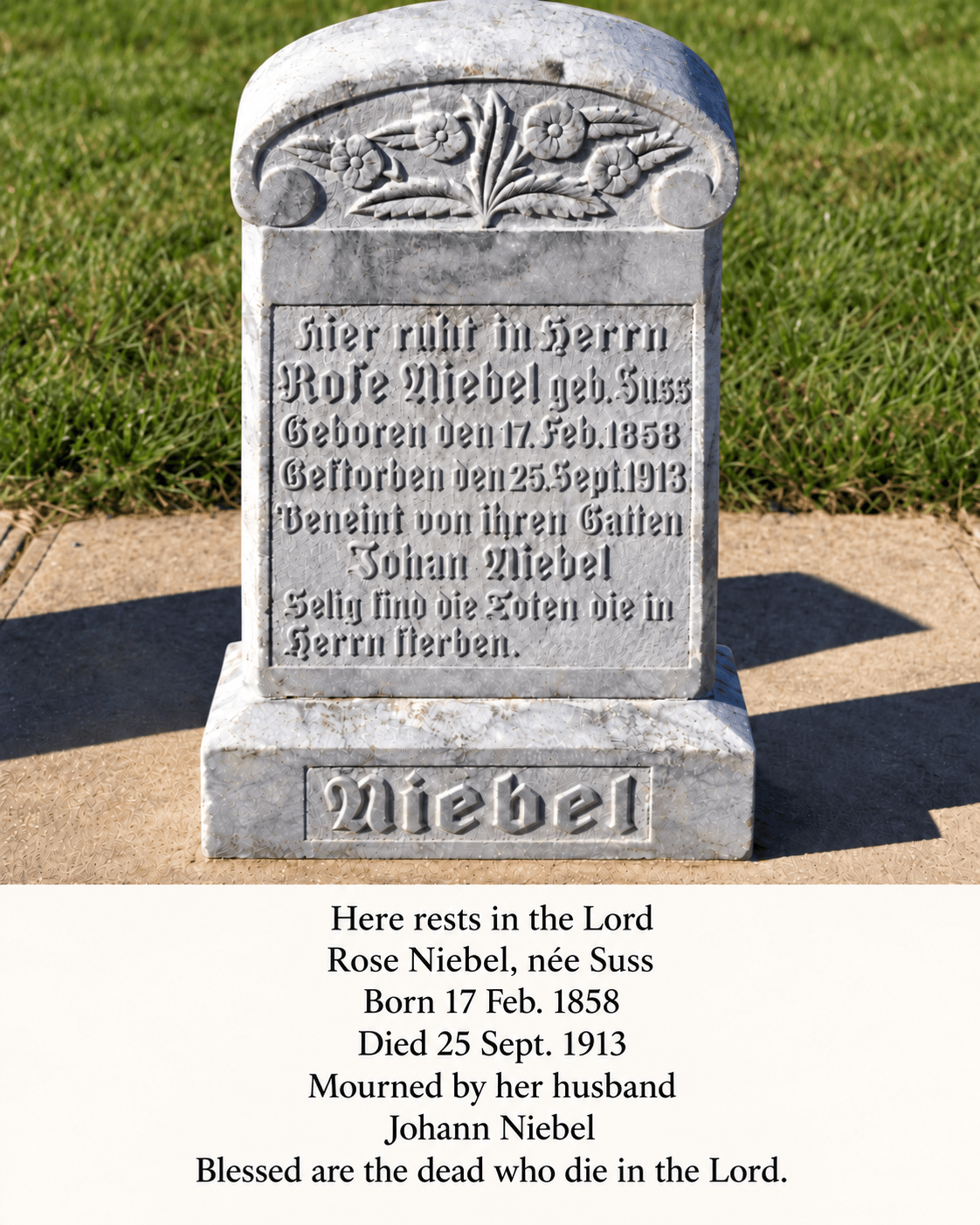
By 1916 they had left the farm. The census that June finds Johann, fifty five, on 4th Avenue in Melville, the same street as Catherine and John Goebel, working as a labourer at odd jobs. Rosa had died on 23 September 1915 and was buried in St. Paul's Lutheran Cemetery. Her stone is cut in German and reads, Here rests in the Lord, Rose Niebel, born Suess, born the 17th of February 1858, died the 23rd of September 1915, from her husband Johan Niebel, and below it, Blessed are the dead who die in the Lord.
Johann married again within the year. The 1916 census lists his wife as Louise, fifty five, who had come to Canada in 1891, and his two youngest daughters, Rosina, sixteen, and Regina, fifteen, still at home.
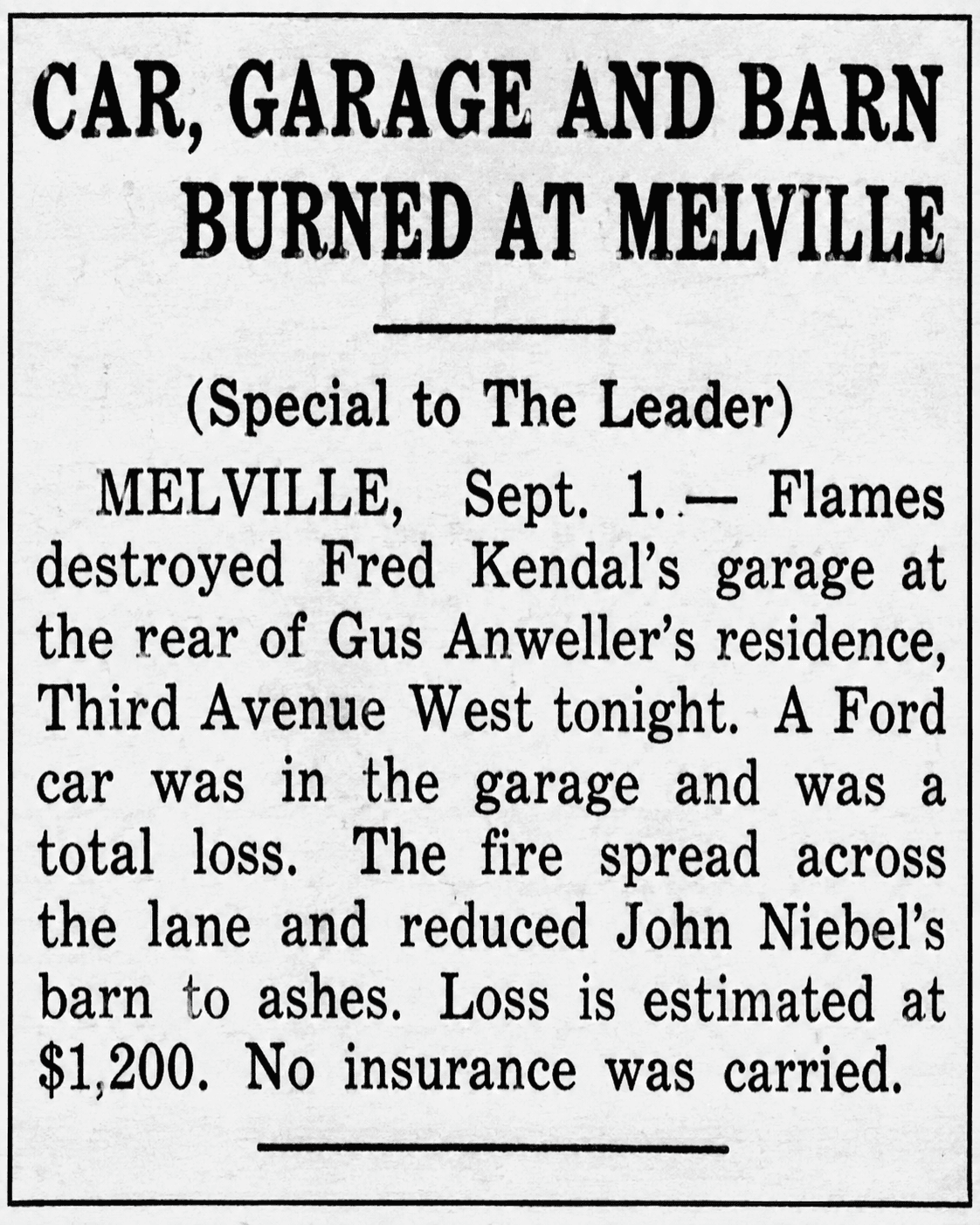
On the night of 1 September 1924 a fire that began in Fred Kendal's garage on Third Avenue West spread across the lane and burned John Niebel's barn to ashes. The Leader put the loss at twelve hundred dollars and said he carried no insurance.
Johann died at Melville on Wednesday, 5 November 1930. The Star Phoenix's Melville notes called him an old timer in the district, held in high esteem, and said the funeral would be held at the Evangelical Church on Sunday. He was buried in St. Paul's Lutheran Cemetery, where Rosa lay. His stone is in English not German.