Vital Stats
Born
Hereford, England, 1862
Died
London, Ontario, September 1955, age about 93
Married
William Aquila Vincent, September 16, 1883, Swansea, Wales
Children
Six
Emigrated
Permanently to Canada in 1923
Emma Jones Vincent was born in Hereford, England, in 1862, and died in London, Ontario in September 1955, at about age 93. She married a widowed Swansea cordwainer twelve years her senior in 1883, was widowed herself just fourteen years later with six children still at home, and spent the next several decades supporting her family through the same kind of domestic work — charwoman, domestic servant, housekeeper — in Bristol. At sixty she crossed the Atlantic to see what her children had built in Canada, went home again, and then, a year later, crossed it a second time for good. She kept working into her late sixties in London, Ontario, and outlived her husband by nearly sixty years. She is buried at Mount Pleasant Cemetery in London.
Emma Jones was born in Hereford, England, in 1862, the daughter of William Jones and Matilda. Her father was a journeyman shoemaker — trained, but working for wages rather than as an independent master craftsman. It was an ordinary working household of the period, one where children went out to earn as soon as they were able, and a skilled trade didn't necessarily mean security.
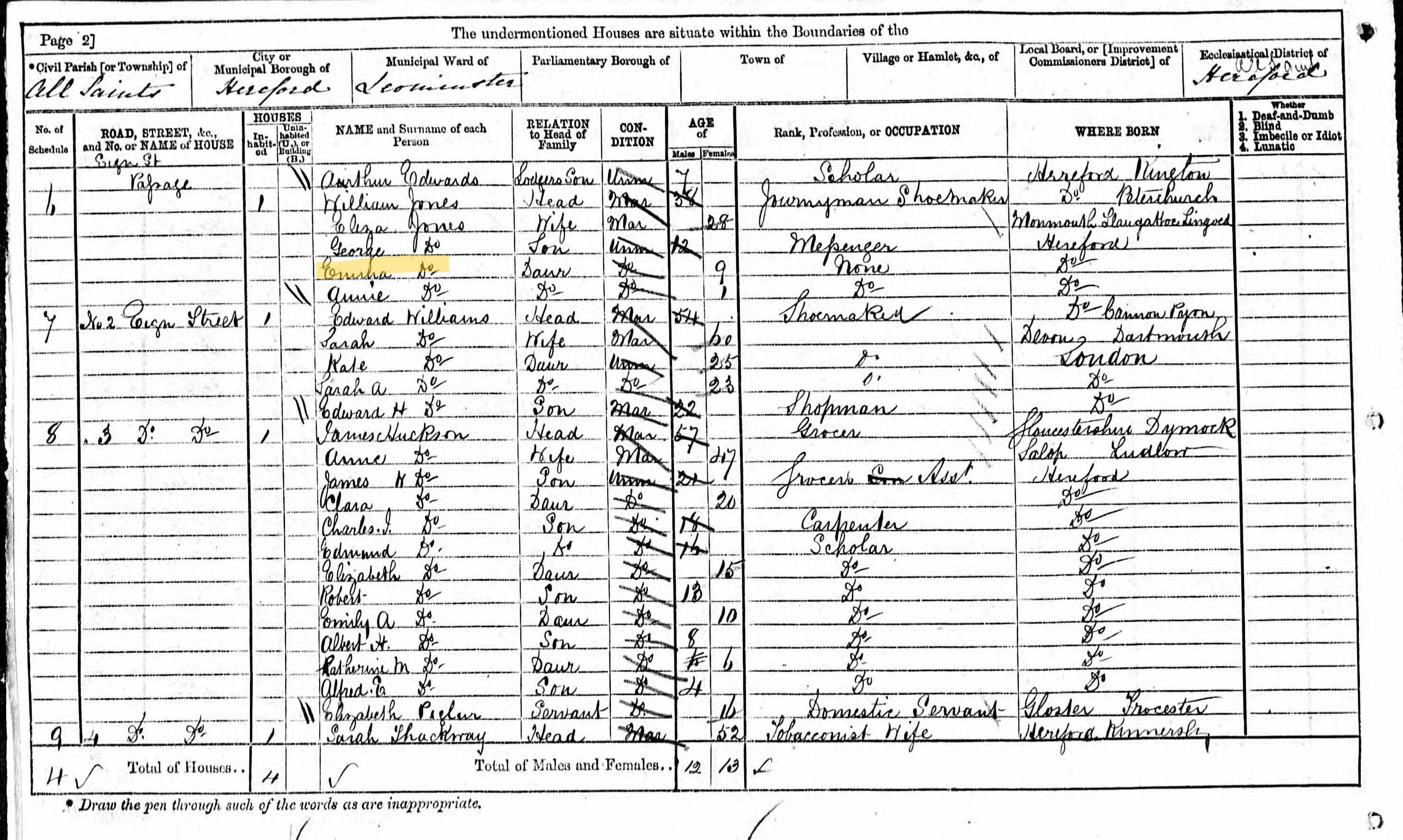
By 1883, Emma had left Hereford for Swansea, Glamorgan — a booming industrial port city, its population past 65,000, built on copper, iron, coal, and the docks. On September 16, 1883, at 21, she married William Aquila Vincent, a 33-year-old widower and cordwainer, at the parish church in Swansea.
The marriage register records Emma as a spinster of Belgrave Terrace, daughter of William Jones, cordwainer; and William as a widower and cordwainer of Garn Street, son of Robert Vincent, also a cordwainer. Three men across the two families — Emma's father, William, and William's father — were all shoemakers by trade, which makes it likely the marriage happened within a small, interconnected trade community rather than between strangers. Emma signed her own name in the register, evidence she was at least sufficiently literate to do so — something later confirmed on her 1922 Canadian travel papers, where she's recorded as able to read English.
William was twelve years older than Emma and had already been married once; his first wife, Eliza, had died sometime before 1883. Emma became his second wife, and the mother of his second family.
Emma and William's daughter Rosella Victoria Vincent — Rose — was born about 1884, not long after the wedding, and a son, William George Vincent, later "Uncle Bill" of family lore, followed around 1885. By the time the family was settled in Bristol, four more children had arrived: Ethel, Emily, Lottie, and Frederick, the youngest. A baptismal record for another daughter, Edith, in January 1894 at St Nicholas, Bristol, gives the family's address as Crow Lane and again records William's occupation as shoemaker — the trade continuing to define the household on both sides, Emma's and William's, for another generation.
William Aquila Vincent died in Bristol in 1897. Emma was about 35, with six children, some of them still very young. She would remain a widow for the rest of her life — very nearly six decades. There was no widow's pension and no functioning social safety net; a working-class widow in this period relied on some combination of her own labour, her children's wages as they came of working age, and, often, a lodger's rent. Emma's household, over the years that followed, shows most of those patterns at once.
The 1901 census finds Emma at 11 Webb Street, Bristol, recorded plainly as head of household and widow. It's one of the first records to show her running the family alone. Rose, sixteen, was already working in the boot-and-shoe trade; the younger children — including Frederick, still small — were at home. It was in this same household, not long afterward, that a teenage cycle mechanic named William Charles Rowley took a room as a boarder — the ordinary, unromantic way he and Rose came to meet and, in 1905, marry.
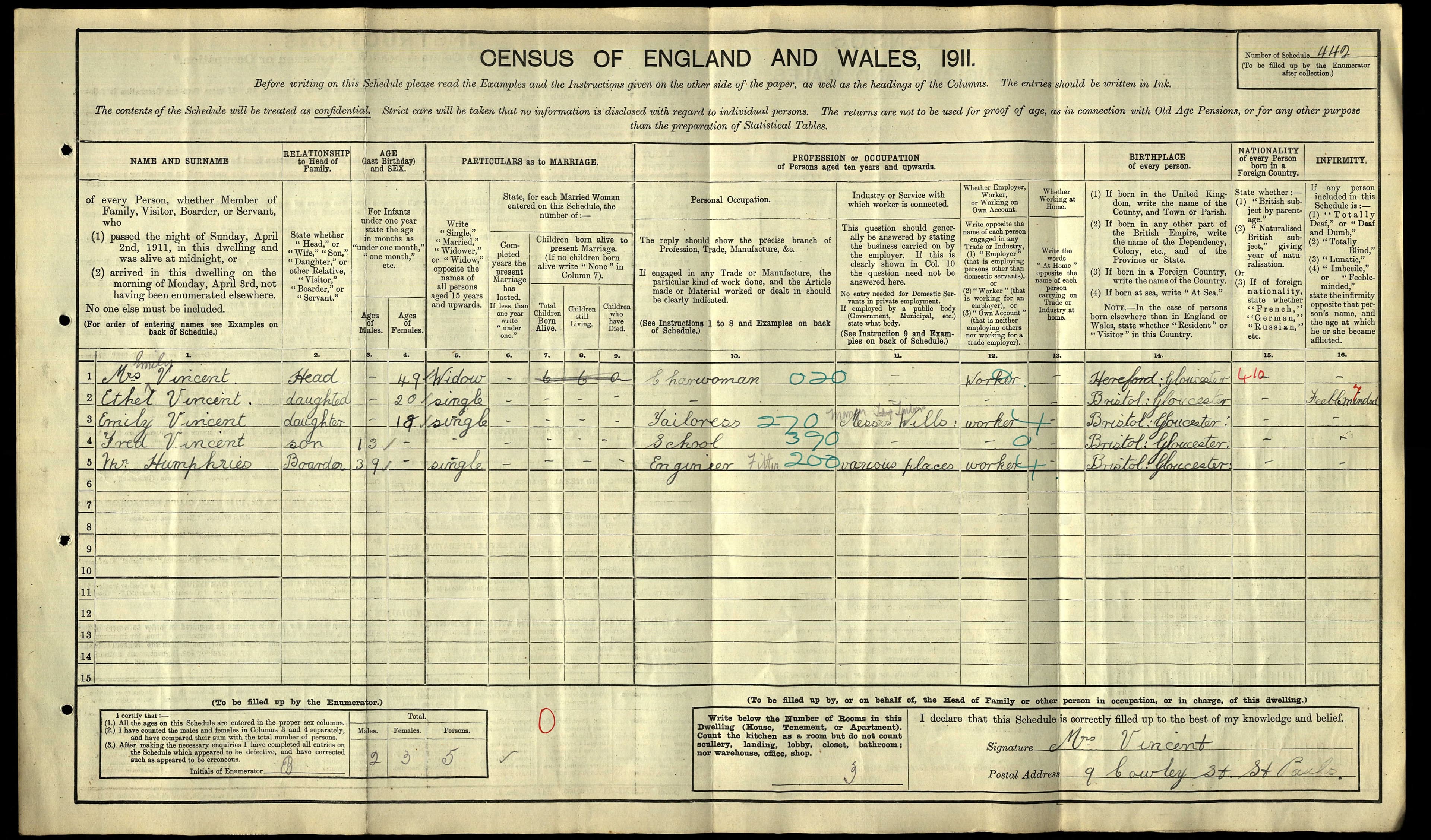
By the 1911 census Emma, about 49, was living at 9 Cowley Street, St Agnes, Bristol, still a widow. The census records something remarkable in its own dry way: six children born, and all six still living — no infant or childhood losses in a family of that size, in that era, a small mercy. Her own occupation was recorded as charwoman — hired domestic cleaning work, usually by the day, physically hard and among the largest categories of paid work open to women with no formal training. Three children were still at home: Ethel, about 20; Emily, 19, already working as a tailoress; and Frederick, 13. A male boarder lived with them too, another income strategy familiar from Emma's own upbringing.
One detail from this census is worth handling carefully. Ethel carries no disability description in the earlier census, but by 1911 she was recorded under the period's infirmity column with the term "feeble-minded" — vague, non-medical language that Edwardian census-takers applied inconsistently, and which shouldn't be read as anything like a modern diagnosis. What it may reasonably suggest is that Emma, in addition to earning a wage and raising five other children, was also caring for an adult daughter who needed more support than the record can specify.
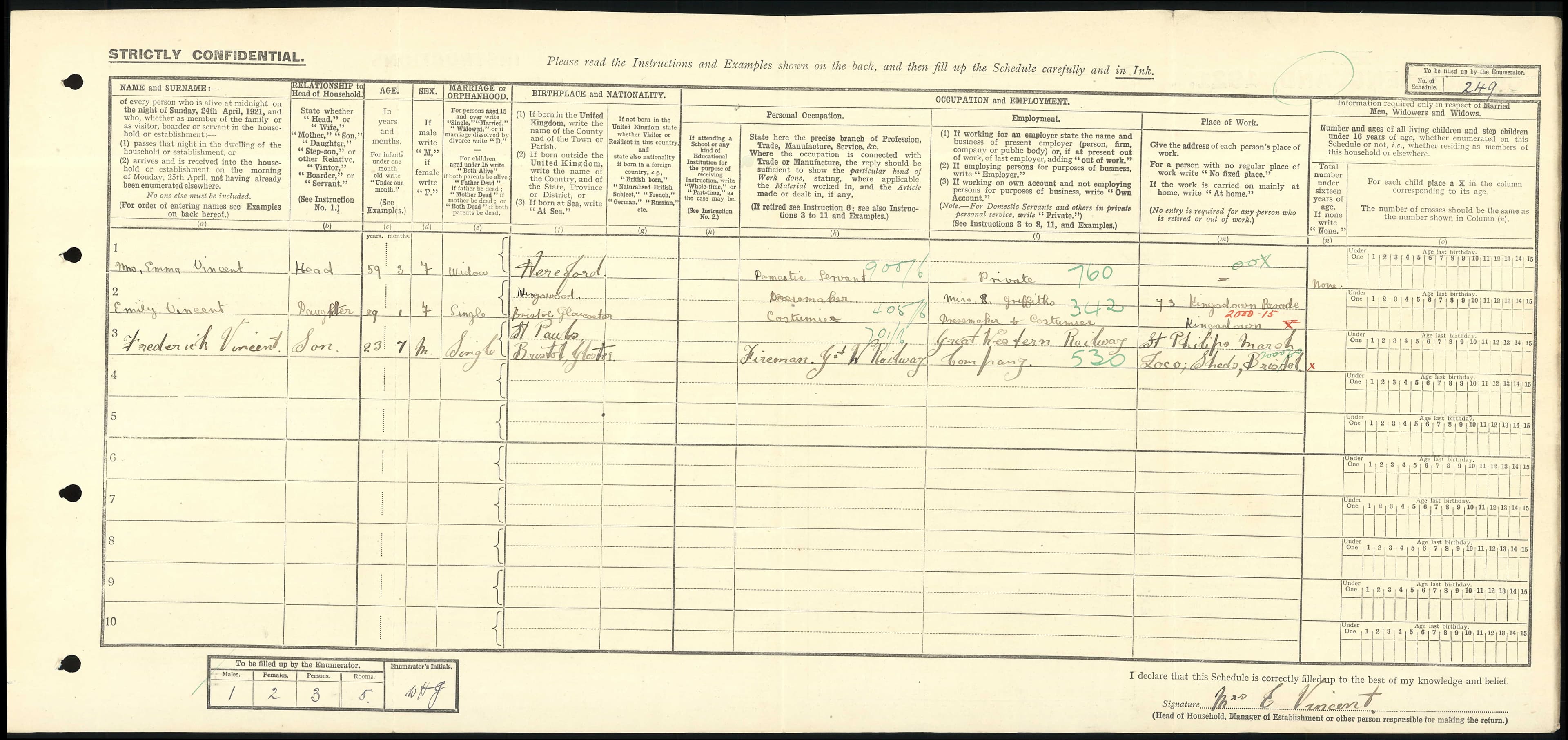
By 1921, Emma — now recorded with unusual precision as 59 years and 3 months old, which lines up neatly with an 1862 birth — was still in Bristol and still working, this time as a domestic servant for a private household. Her daughter Emily, 29, was a dressmaker and costumier; her son Frederick, 23, had become a fireman with the Great Western Railway, working out of the St Philip's Marsh locomotive shed — physically demanding, skilled work tending a steam engine's fire and boiler, and usually a step on the way to becoming a driver.
Frederick is a recurring presence in Emma's later life. He was a small child when his father died, grew up in her household, was still living with her as a young man in 1921 and would be beside her again two years later, when she left England for good.
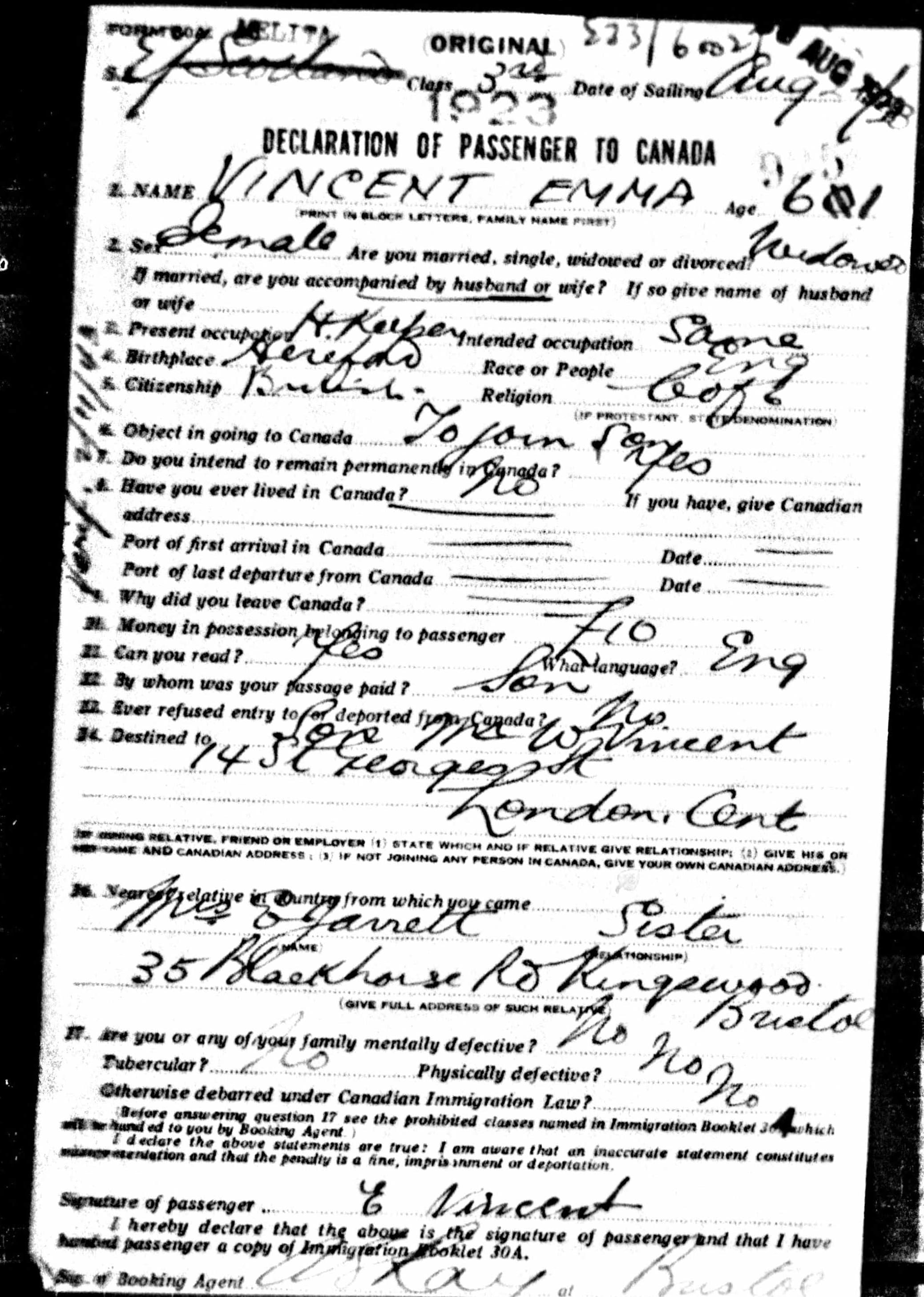
By the early 1920s, Emma's children were already building lives in London, Ontario, and in 1922, at sixty, she decided to see it for herself. Her Declaration of Passenger to Canada records her as a widow, Church of England, present occupation "housekeeper travelling to join son," her passage paid by that son, £10 in her possession, able to read English. Asked directly whether she intended to remain permanently in Canada, Emma answered no. She had never lived there before.
It was a visit, not an emigration — and the distinction matters for what came next.
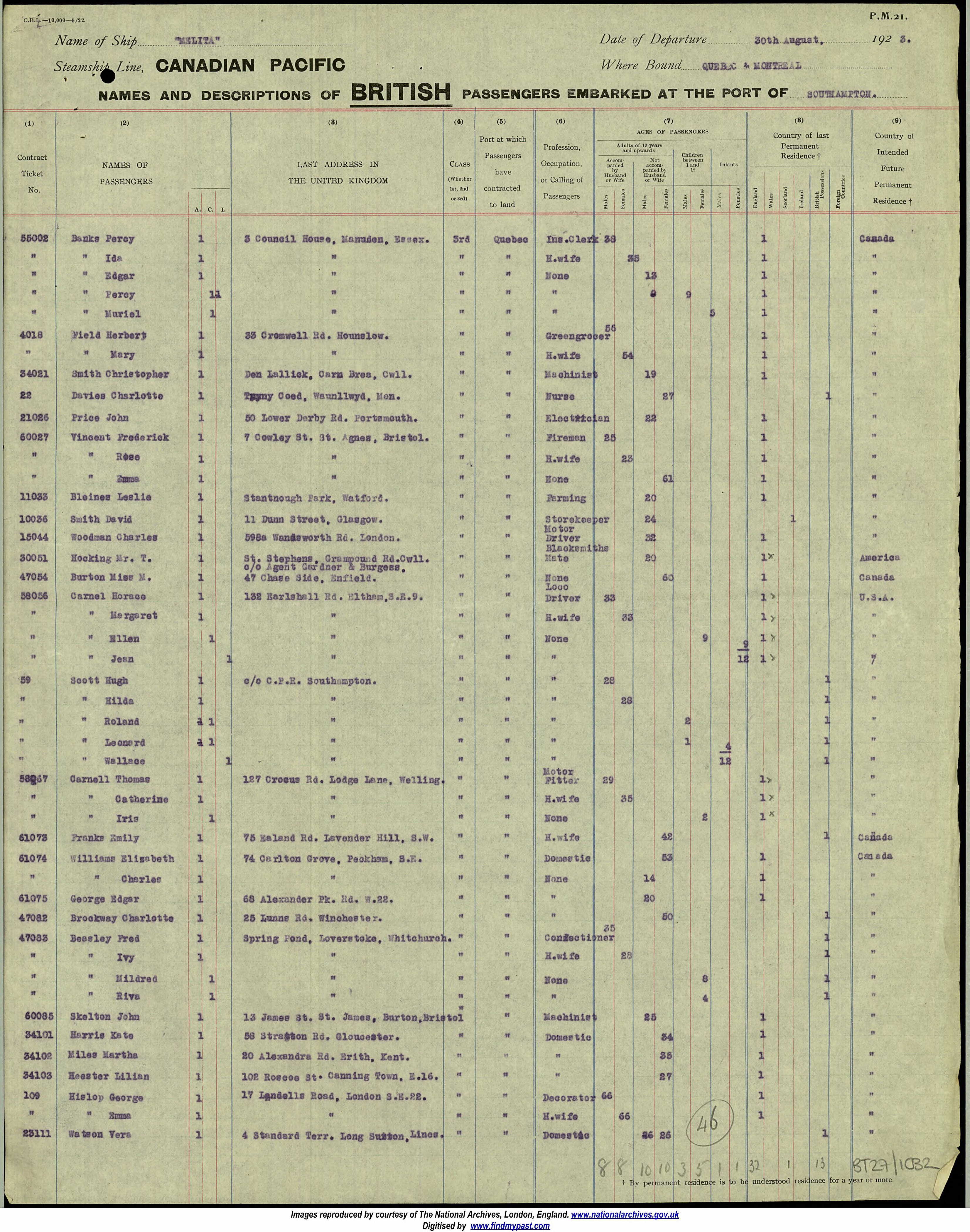
One year later, Emma made a different choice. On August 30, 1923, she boarded the Canadian Pacific steamship Melita at Southampton, bound for Quebec and Montreal, travelling third class. She was 61. This time she wasn't alone: travelling with her were her son Frederick Vincent, 25, a fireman, and his wife — also named Rose, not to be confused with Emma's daughter Rosella "Rose" Vincent Rowley — 23. All three gave the same last British address, 7 Cowley Street, St Agnes, Bristol. Unlike the 1922 form, this manifest lists Canada as the intended country of permanent residence.
Read together, the two documents tell an unusually clear story: in 1921 Emma is still working in Bristol; in 1922 she visits Canada and says plainly she isn't staying; in 1923 she goes again, this time to stay, with her son and daughter-in-law alongside her. At 61, this doesn't look like a woman swept passively into emigration — it looks like a decision made after she'd actually seen the place for herself.
Emma arrived into a family network that was already established. Her children had been settling in London, Ontario through the early 1920s, and London itself — an industrial, railway-connected city with a substantial English-born population and well-established Anglican congregations — would have offered real cultural familiarity to a British widow in her sixties. She wasn't arriving alone into a foreign place; she was joining a household and a community her own children had already built.
Only months after Emma's move, on November 10, 1923, her daughter Emily married Arthur James Knowles in London, Ontario — the marriage record again naming Emma and William as her parents, and Edith Rowley (Hilda's sister), Emma's granddaughter, among the witnesses. The Vincent family hadn't simply scattered across an ocean; it reassembled itself, piece by piece, in the same Ontario city.
Family memory — recorded from Rose Rowley's daughter Doreen — holds that Emma worked as a housekeeper in London, Ontario for a man remembered as Mr. Harper. That detail fits the documentary record unusually well: Emma is a charwoman in 1911, a domestic servant in 1921, a self-described housekeeper on her 1922 travel papers, and still recorded in domestic service in the 1931 Canadian census — the same kind of work, on both sides of the Atlantic, for at least twenty years. The 1931 census entry gives an employer's surname that reads close to "Hoper," near enough to "Harper" that the two may well be the same man, distorted somewhere along the way by handwriting, an enumerator's ear, or four or five decades of family memory.
The 1931 Canadian census finds Emma in London, Ontario, about 69, her year of immigration recorded as 1923 — an independent confirmation that the Melita crossing really was the permanent move. She was still working in domestic service. Canada's first old-age pension had only just begun in 1927, means-tested and limited, so a recently arrived widow in her late sixties had little reason to expect it would simply replace a working income. Domestic service, historically one of the most poorly paid categories of women's work even as it remained one of the largest, was still what Emma knew, and still what she did.
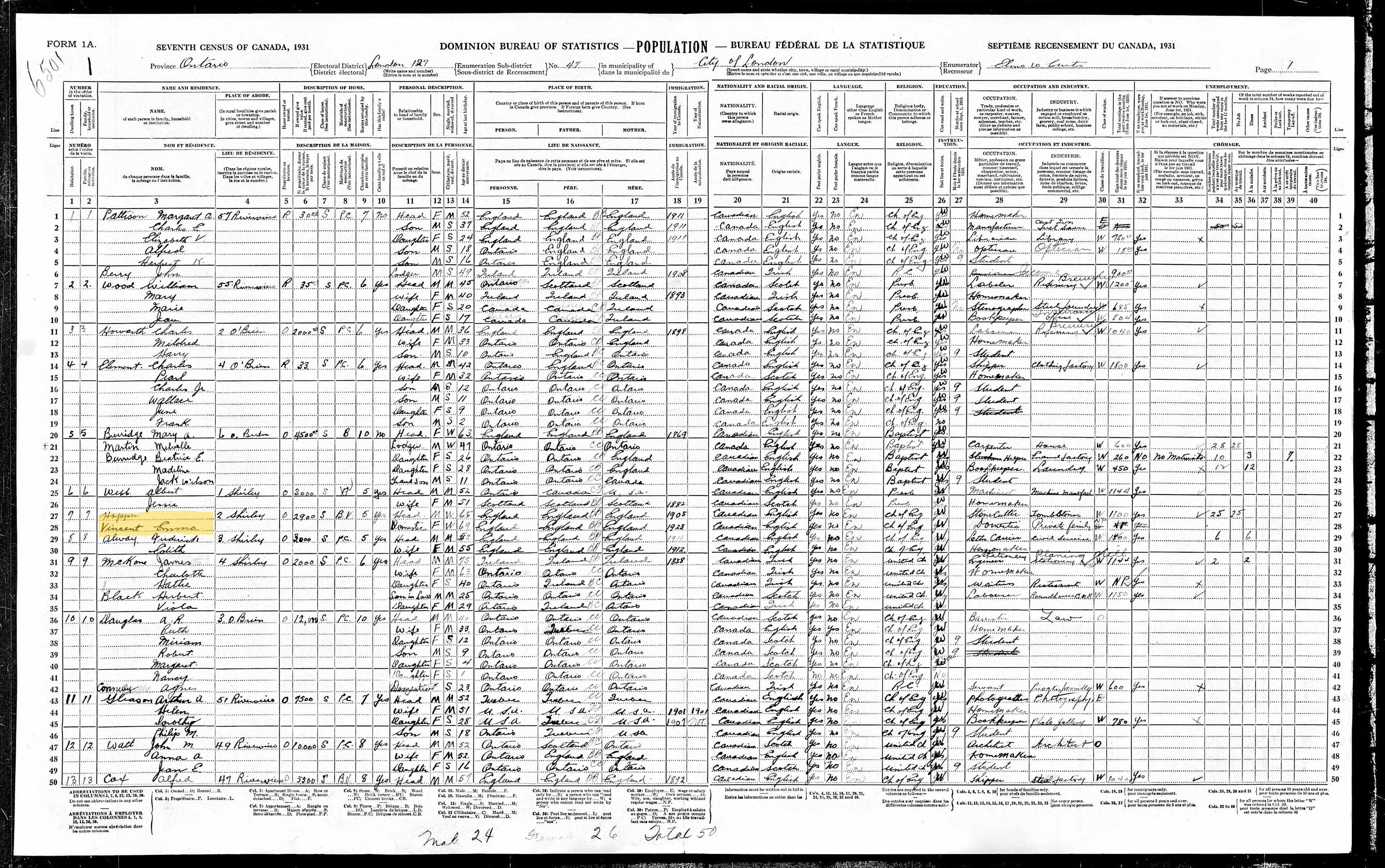
In 1931, 69-year-old Emma Vincent was living at 2 Shirley Street, very close to the Thames River off Wharncliffe, in the home of Mr. Harper, a 65-year-old widower who worked as a stonecutter in the tombstone trade. Emma, herself widowed, was recorded as his domestic, but the two had strikingly similar backgrounds: both were born in England, were close in age, and had lost their spouses. The census cannot tell us the nature of their relationship, but it is difficult not to wonder whether, alongside the practical arrangement, Emma may also have found a measure of companionship — or perhaps even a little late-in-life affection — in that Shirley Street household.
William Aquila Vincent died in 1897; Emma lived until 1955 — outliving him by close to fifty-eight years. She had been his wife for only about fourteen years, and a widow for nearly four times that long: raising six children alone, watching them marry and scatter and then regroup in Canada, testing that new country for herself at sixty before committing to it at sixty-one, and still doing paid housework in her late sixties in a city she'd chosen deliberately rather than simply landed in.
Emma died in London, Ontario, in September 1955, at about 93. Her exact date of death hasn't yet been located, though it's possible it was in September that year. She is buried at Mount Pleasant Cemetery in London — the same cemetery where her daughter Rose and the Rowley family are buried — under a gravestone that reads simply:
VINCENT
EMMA VINCENT
1862 – 1955
At Rest
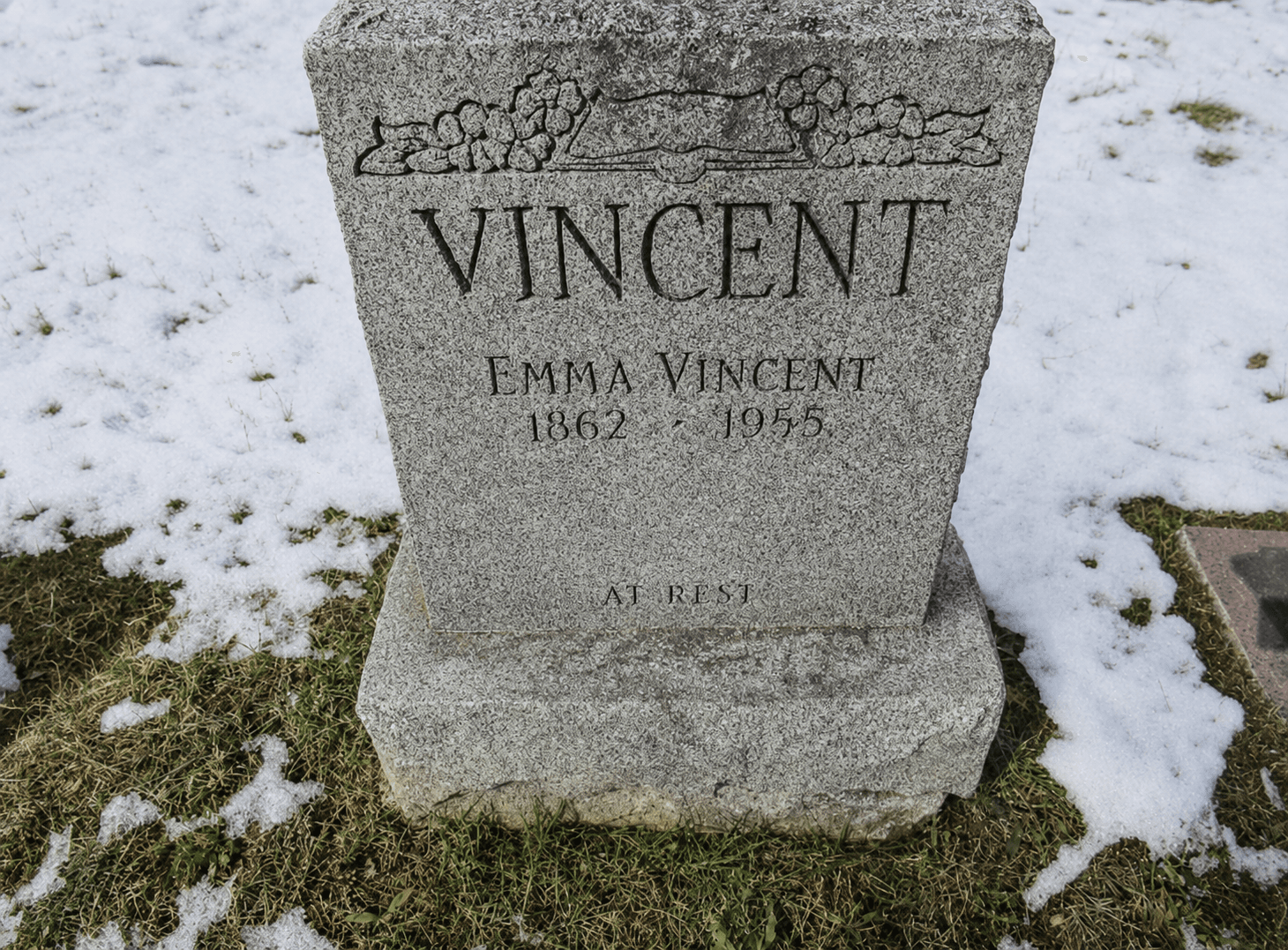
Two dates, and nothing about the ocean she crossed twice after sixty, or the forty years she spent cleaning other people's houses to help keep her own family fed.