William Aquila Vincent was born around 1844, most likely at Wells-next-the-Sea, a small Norfolk England harbour town, the son of a shoemaker and grandson, in effect, of the same trade — he was working in it himself by his teens. He moved with his family to Norwich, then struck out on his own for Hull, where by 1871 he was a cordwainer with a wife, Eliza, and young children. Eliza died sometime in the 1870s, most likely 1875; by 1883 William was a widower living in Swansea, Wales where he married Emma Jones — daughter of another cordwainer — and started a second family. Their daughter, Rosella Victoria Vincent, was born the following year. The family settled in Bristol, where William continued working in the boot and shoe trade until his death there on May 20, 1897, at about 50, when Rosella was only twelve or thirteen. He was buried at Greenbank Cemetery, Eastville, Bristol — a grave whose exact location within the cemetery has not yet been found.
Wells-next-the-Sea, and a family trade
William Aquila Vincent's unusual middle name is, oddly, one of the most useful things about him: it is distinctive enough to track him confidently across records that would otherwise belong to any of dozens of William Vincents. He appears to have been born in 1844 in the Walsingham registration district, and baptized at Wells-next-the-Sea, Norfolk, the son of Robert Vincent, a shoemaker, and Eliza Wasey. Wells was a modest but genuinely active harbour town, its economy built on coastal trade, fishing, and the farmland behind it — a working world of craftsmen, mariners, and shopkeepers, not gentry.
The 1851 census finds the family together in Wells: Robert and Eliza, and their children, among them a boy recorded simply as Aquila, about six years old, with siblings Priscilla, Jemima, David, and Albert. By 1861 the family had moved within Norfolk to Heigham, on the edge of Norwich, and Robert was still working as a shoemaker — but so, now, was his sixteen-year-old son, listed as William A. Vincent.
A young craftsman leaves Norfolk
By 1871, William had moved a considerable distance from home, to Kingston upon Hull, Yorkshire — a strong sign of just how mobile a skilled Victorian tradesman could be. The census there records a William A. Vincent, about 26, born at Wells, Norfolk, working as a cordwainer, married to Eliza J. Vincent, with young children including Albert and Ernest.
A cordwainer, properly speaking, was a maker of shoes rather than merely a repairer (known as a cobbler) — a genuine craft trade, and the same one William's father had followed in Norfolk. He was likely part of the cordwainer guild that still exists today.
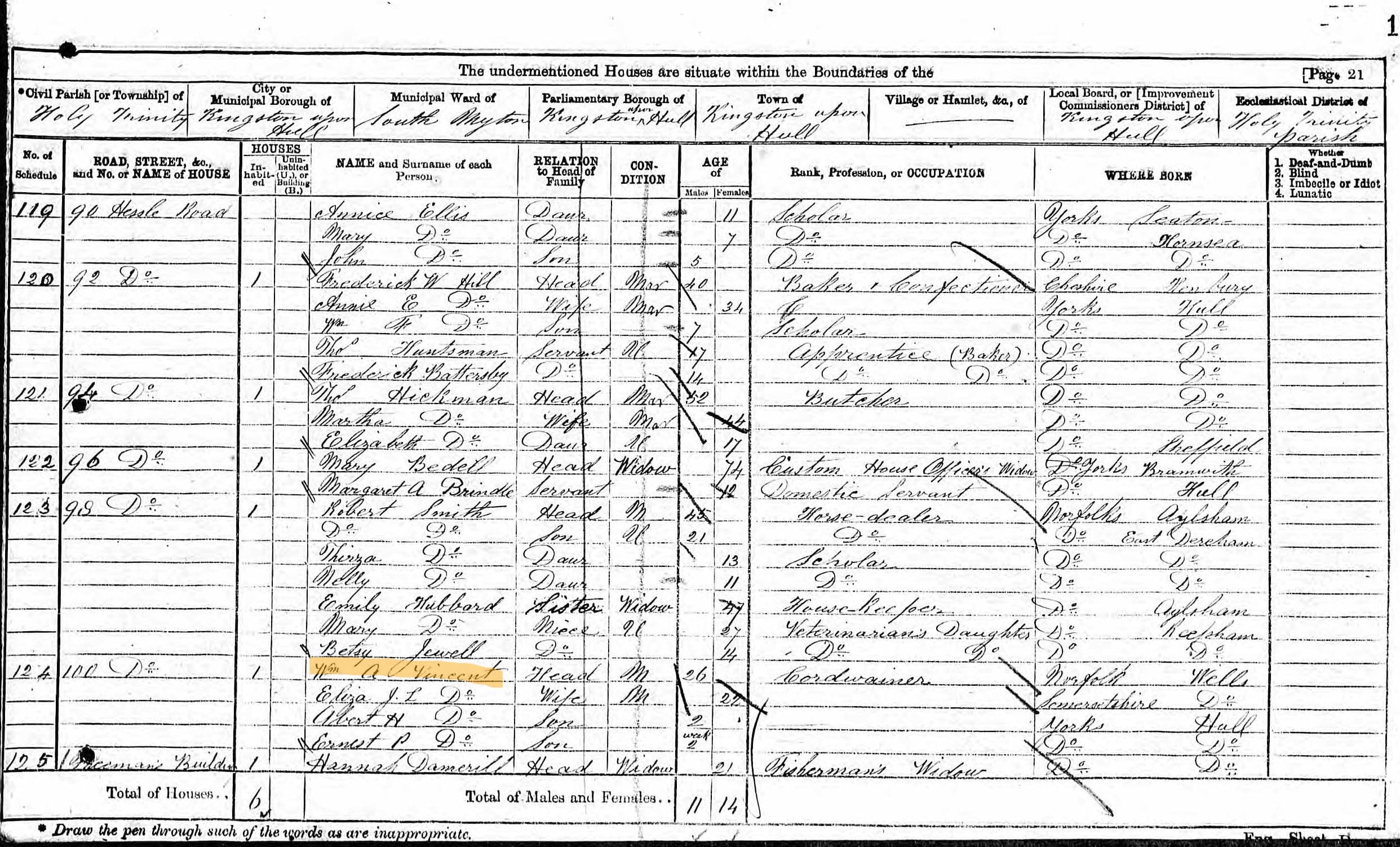
This record also settles something important for the family tree: Emma Jones, the woman later remembered as William's wife, was not his first. What became of Eliza is still unproven — a possible death for an "Eliza Jane" dated December 12, 1875 is a lead, not yet a confirmed match — but by 1883 William was describing himself, plainly, as a widower.
The Widower
A confirmed 1881 census entry for William changes the picture. It shows William living with just one of his two known sons, Albert — no wife, and no sign of the younger boy, Ernest, who had appeared with the family in 1871. Two things follow from this. First, Eliza's death (or at least her departure from the household) can now be placed sometime between the 1871 Hull census and 1881, rather than left as an open question, and is consistent with the possible "Eliza Jane" death of December 12, 1875 noted above, though that record still isn't formally tied to her.
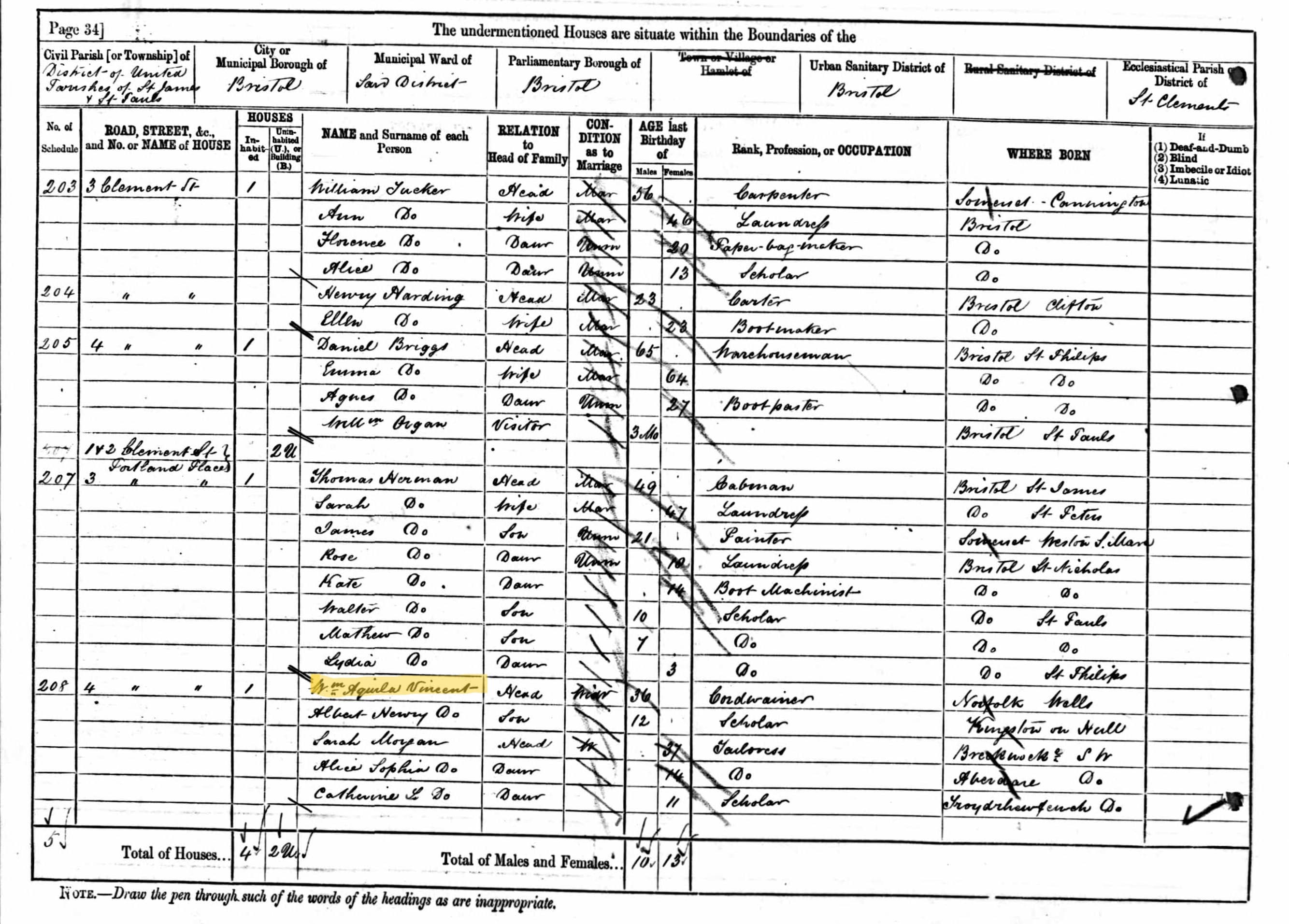
Second, Ernest's absence in 1881 is itself a new open question: whether he had died, was living with relatives, had been sent out to work or apprenticed elsewhere (common for boys his age in a household that had just lost its mother), or is simply misidentified in the 1871 record is not known.
Swansea: a second marriage, and Rosella
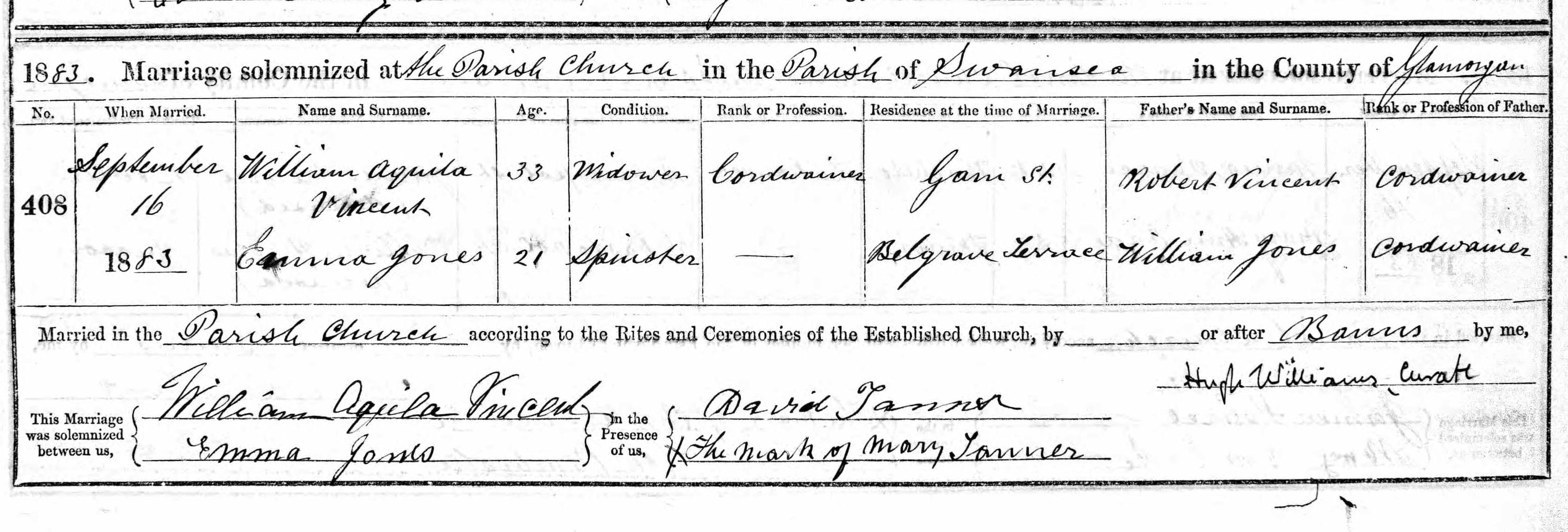
On September 16, 1883, William married Emma Jones at the parish church in Swansea, Glamorgan. The marriage register is one of the most informative documents in the family's collection: William, 33, a widower and cordwainer of Garn Street, son of Robert Vincent, cordwainer; Emma, 21, a spinster of Belgrave Terrace, daughter of William Jones, also a cordwainer. Three cordwainers in one register — William, his father, and his new father-in-law — suggests the marriage happened within a small trade community of people who already knew one another's families.
Swansea in 1883 was booming: its population had passed 65,000 by 1881, driven by copper, iron, coal, and the docks, and filled with migrants and tradespeople from across Britain and Wales. William, already a Norfolk-born veteran of a move to Yorkshire, would have fit right in.
William's stated age at this marriage — 33 — doesn't quite square with an 1844 birth (it implies closer to 1850), and his 1897 death record gives his age as 50 (implying 1846–47). Ages drift constantly across Victorian records.
William and Emma's daughter, Rosella Victoria Vincent — Rose — was born in 1884, not long after the wedding. A son, William George Vincent, later remembered in the family simply as "Uncle Bill," followed around 1885.
Bristol, and a household William didn't live to see change
By the turn of the century the family was settled in Bristol, where William continued to be identified by his trade. Bristol's own working world included tradesmen like John William Henry Wall, the city's "Shoemaker Poet" of the same period — a reminder that a skilled cordwainer in this era was respected but rarely prosperous, working a craft that industrial factory production was steadily squeezing.
William did not live to see what came next. He died before 1901, and it is his widow, Emma, who appears as head of the Bristol household in the 1901 census, with Rose and her siblings still at home — and, in the same household, a young boarder named William Charles Rowley, the cycle mechanic Rose would marry four years later. When Rose married William Charles Rowley on September 17, 1905, she named her father in the register as William Aquila Vincent, bootmaker — a quiet, formal echo of the man who wasn't there to walk her down the aisle. Her brother, William George Vincent, signed the register as a witness.
Death at Bristol, 1897
The civil death index records a William Aquila Vincent, age 50, dying in the Barton Regis registration district in the June quarter of 1897 — no competing candidate matching this family has turned up in searches of the period.
A Find a Grave memorial supplies an exact date, May 20, 1897, and a burial place: Greenbank Cemetery, Eastville, Bristol, a cemetery opened in 1871 specifically to serve Bristol's crowded St Philip & Jacob district and already enlarged once by the time William was buried there. No photograph of his individual gravestone has yet been found, and the exact grave or plot number is still unknown. William was about 50 when he died, and Rose — the daughter who would go on to cross the Atlantic in steerage with four children of her own — was only twelve or thirteen.
"Uncle Bill" and the family's other Atlantic crossing
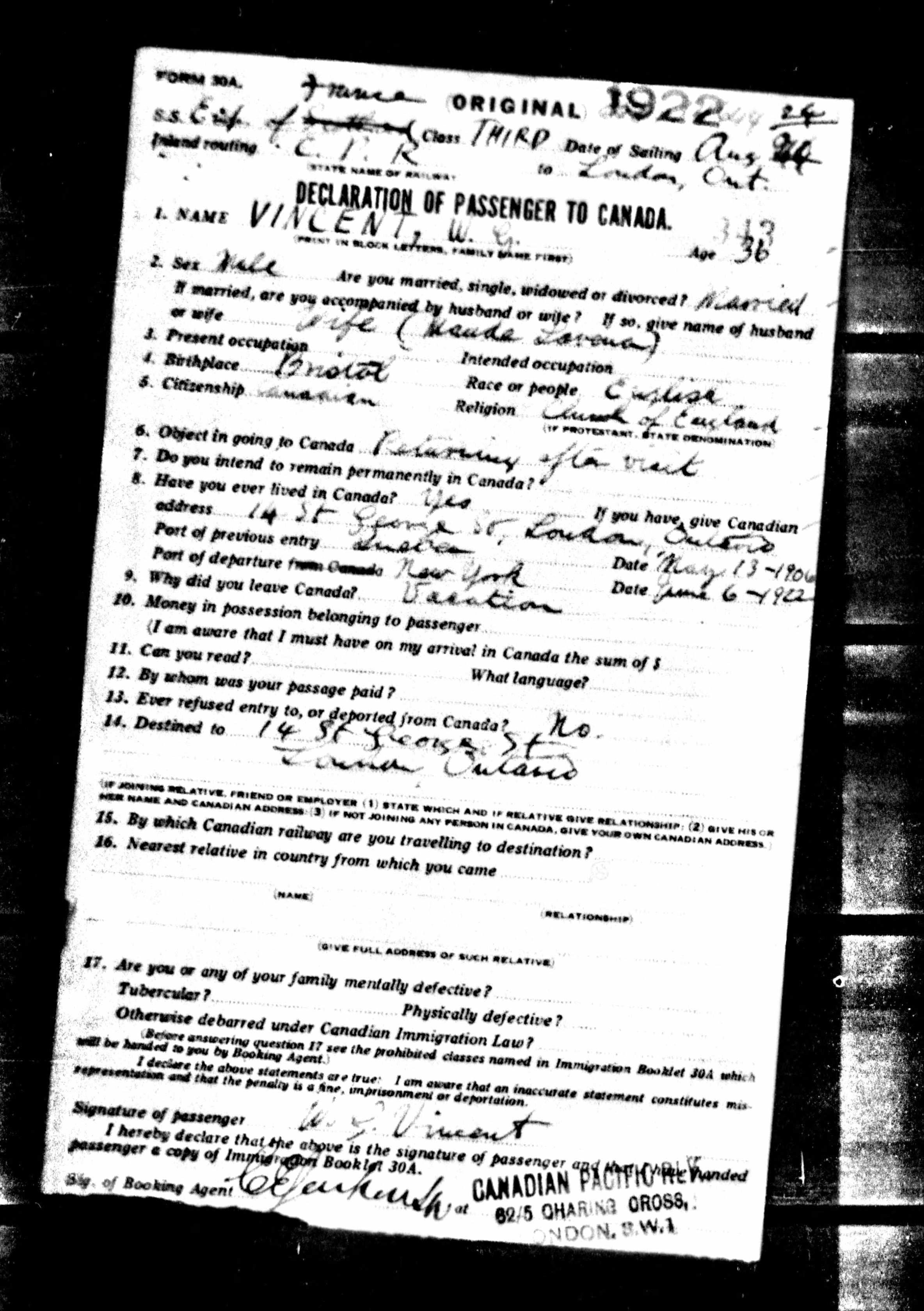
William Aquila's son William George Vincent (Rose's brother) became part of the family's story on this side of the ocean too. A 1922 Canadian passenger/customs declaration records a W. G. Vincent, about 38, born in Bristol, married to a woman named Maude, who had lived in Canada before, was returning via London, Ontario, and had travelled through Detroit — evidence of a man moving comfortably back and forth across the Canada–US border in an era when that was no small thing.
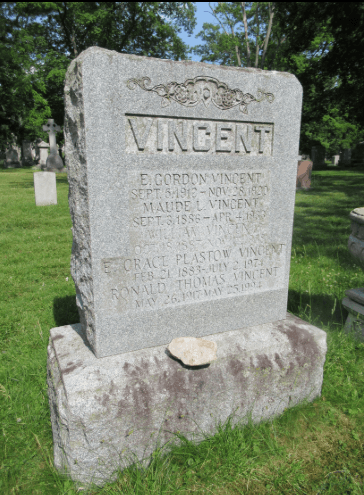
A Vincent family gravestone in London, Ontario — for William Vincent and Maude L. Vincent — is very likely the same couple. That cemetery sits directly across the road from the one where Rose and the Rowleys are buried: even in death, William Aquila's children and wife, on two different continents from where he was buried, ended up close together again.