Jacob, John, Philip, Ludwig, Katherine, Valentine, Christina, Henry and Margaret
0:00 / 0:00
Listen to Jacob and Sofia's storyRecorded account, approx. 22 min
Their Story
Jacob Goebel and Sofia Reichert were born five years apart in two German Lutheran villages in the Carpathian foothills of Austrian Galicia. They married in 1867, raised nine children in a third village, and in the spring of 1889, with Jacob nearly fifty, took the family across the world to a quarter section of unbroken prairie. Sofia lived another sixteen years and Jacob another twenty seven. They are buried side by side in a small country cemetery near Neudorf, Saskatchewan, and a large part of the Goebel name around Neudorf starts with their children.
Two villages
Jacob was born in Brigidau, the sixth of the twelve children of Jakob Goebel and Margaretha Heinrich. Brigidau was a Lutheran German colony, one of the settlements founded in the 1780s when the Habsburg crown invited Protestant farmers from the Palatinate and Württemberg to take up land in Galicia, and the Goebels had been there from nearly the start. Jacob's father died in 1873 and his mother in 1879 — neither saw what came next.
Sofia grew up in Josefsberg, a neighbouring colony settled by the same wave of families. Her father was Georg Peter Reichert and her mother Christina Sander, and the Reicherts had been in the village for at least four generations.
Two weddings
Sofia was married twice. In May 1864, at nineteen, she married Johann Heinrich Speidel, a young man from Brigidau, at Josefsberg. By 1867 she was a widow, and on 26 August of that year she married Jacob Goebel, then twenty eight, at Stryj. The register entry is indexed under both of her married names, Reichert and Speidel, which is how it can still be found.
The couple settled in Zawadow, a village the emigration papers spell Sawadow, and Jacob worked as a blacksmith. Their children came over twenty years. Jacob was born in January 1869, John in 1870, Philip in 1871, Ludwig in 1873, Katherine in 1877, Valentine in 1879, Christina in 1883, Henry in 1884 and Margaret in April 1888.
Hamburg, 14 April 1889
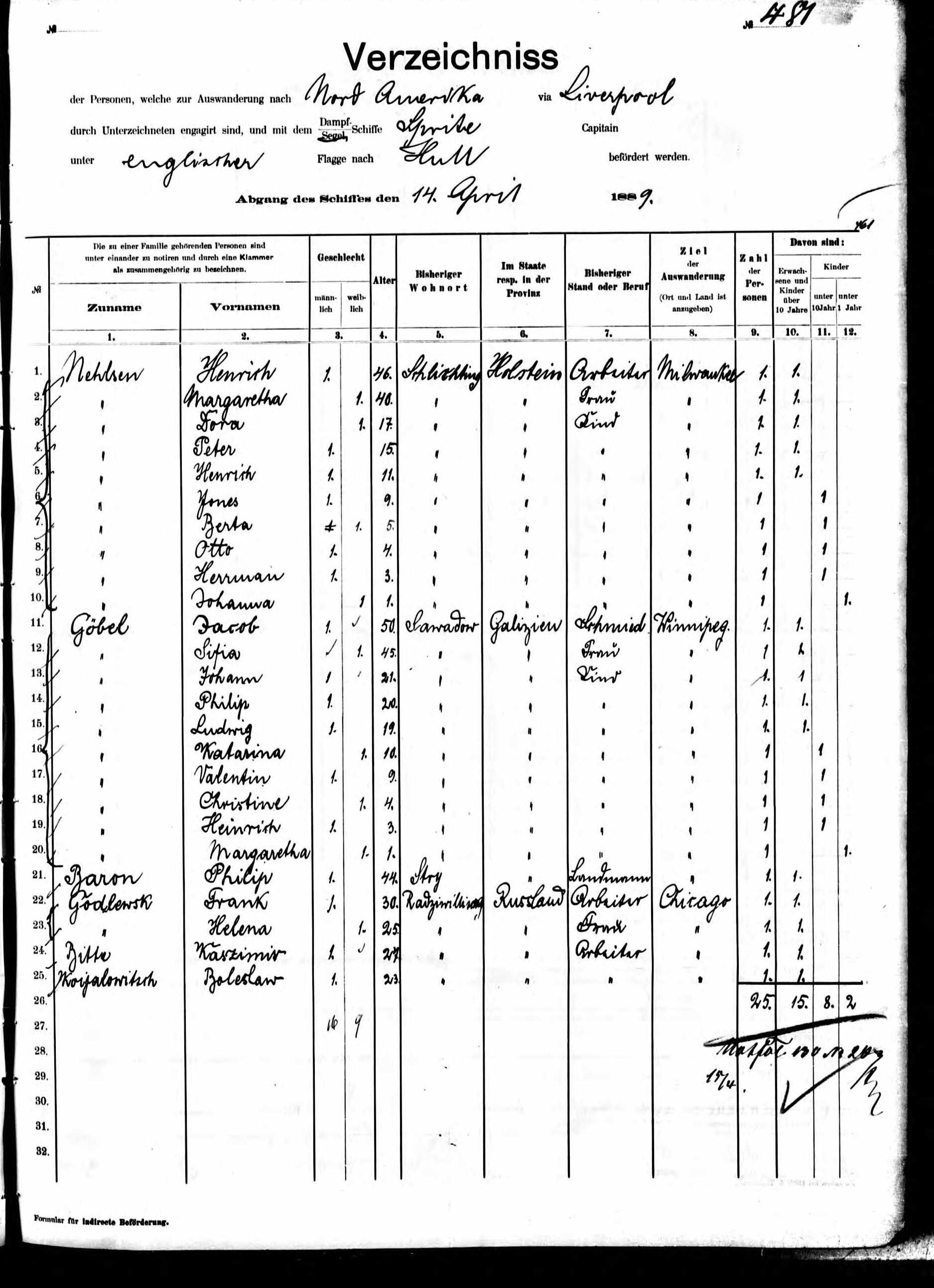
On 14 April 1889 a steamer under the English flag left Hamburg for Hull, with the route running on through Liverpool to North America. The passenger list, signed at Hamburg the day before, has the Goebels at entries eleven to twenty of twenty five names.
Jacob is entered as Schmied, a smith, with his home given as Sawadow in Galizien. The list gives his age as 50 and Sofia's as 45. Then come Johann, 21, Philip, 20, Ludwig, 19, Katarina, 10, Valentin, 9, Christine, 4, Heinrich, 3, and Margaretha, 1. Their destination is written as Winnipeg.
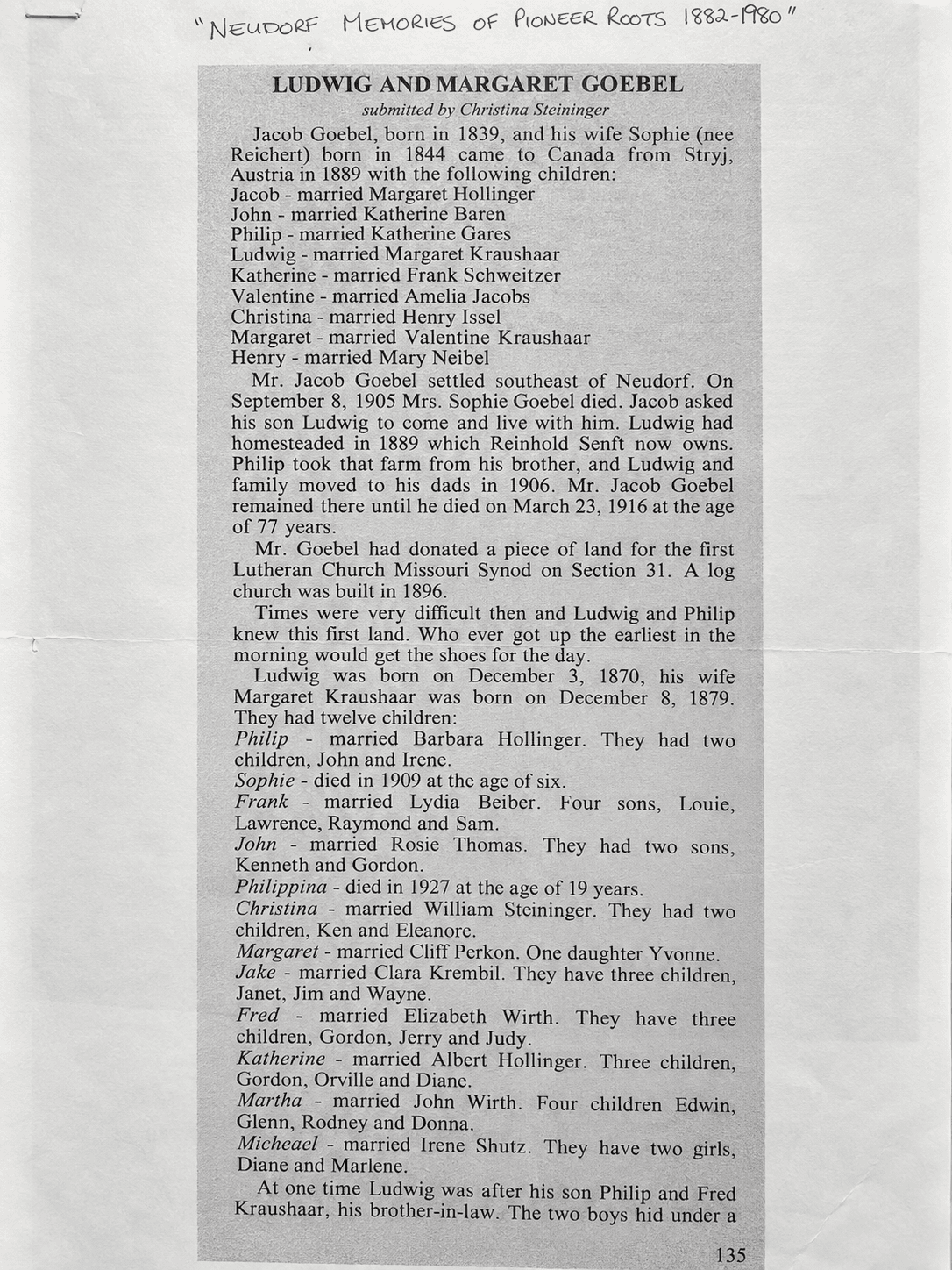
Jacob, the eldest, is not on the list. He had lost his left arm in a flour mill at about sixteen, and the family's account in the Neudorf history book says his parents left him behind in Europe and sent for him afterwards. By the census of April 1891 he is twenty two and living in his father's house.
Passenger manifest for the family
Section 36
By November 1890 Jacob had entered the northeast quarter of Section 36, Township 19, Range 8, west of the second meridian, in the Qu'Appelle district, a quarter section of 160 acres. He built a log house thirty one feet by sixteen, log stables and a granary. By the spring of 1895 he had twenty head of cattle and five horses, and the cropped land had grown from fifteen acres in 1892 to about eighty.
His sons took up land close by. Jacob Jr. had the southeast quarter of the same section, John a quarter in the same township, and Philip and Ludwig quarters on Section 16 in the township to the north. John had filed on a homestead near Dunmore in 1889 before joining them.
The agent who took the money
In February 1893 the farm nearly slipped away. Jacob sent his entry money through an interpreter at the Regina land office to a man named Chaffey, who was to act as his agent. No entry was ever filed. When the Regina agent was asked about the quarter, the books showed it entered by someone else, a Karl Bieber, and Chaffey had left the district with the money of Jacob and other settlers.
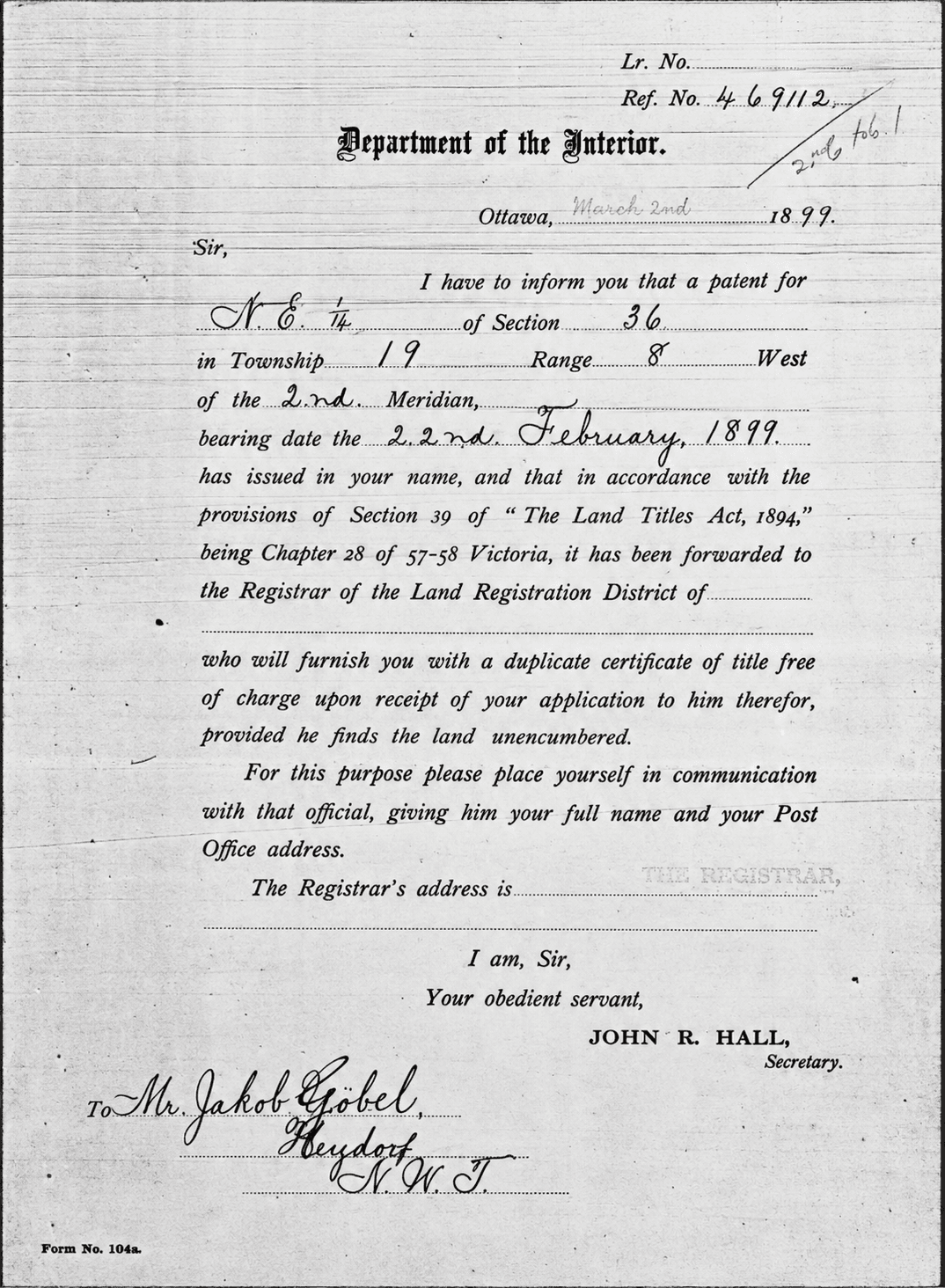
In June 1893 James P. Dill, the member for Wolseley, took up the case in a letter to the Dominion Lands Commissioner. He described Jacob as a first class settler who had ploughed fifty five acres, built a house, stables and a granary, and lived on the land without a break. The quarter stayed in the family. The patent was issued to Jacob Göbel of Hyde on 22 February 1899.
The granting of land to Jacob
The first Lutheran church
In 1896 a log church went up on land Jacob gave from his own farm, on Section 31. It was the first church of the Lutheran Church Missouri Synod in the district, built seven years after the family arrived.
The census of 31 March 1901 finds Jacob, 61, and Sofia, 56, farming at Hyde, with Valentin, Christina, Henry and Margaretha still at home. Ludwig's household and Jacob Jr.'s are on the same page, a few lines from theirs. All of them are recorded as having come to Canada in 1889.
A description of life from Ludwig
A wedding in the house
On 28 March 1905, in Jacob's house at Neudorf, their son John, a widower, married Catherine Niebel, a young woman from Yorkton. Pastor W. Willing performed the ceremony and John's brothers Valentin and Ludwig were the witnesses. Catherine was twenty.
Sofia
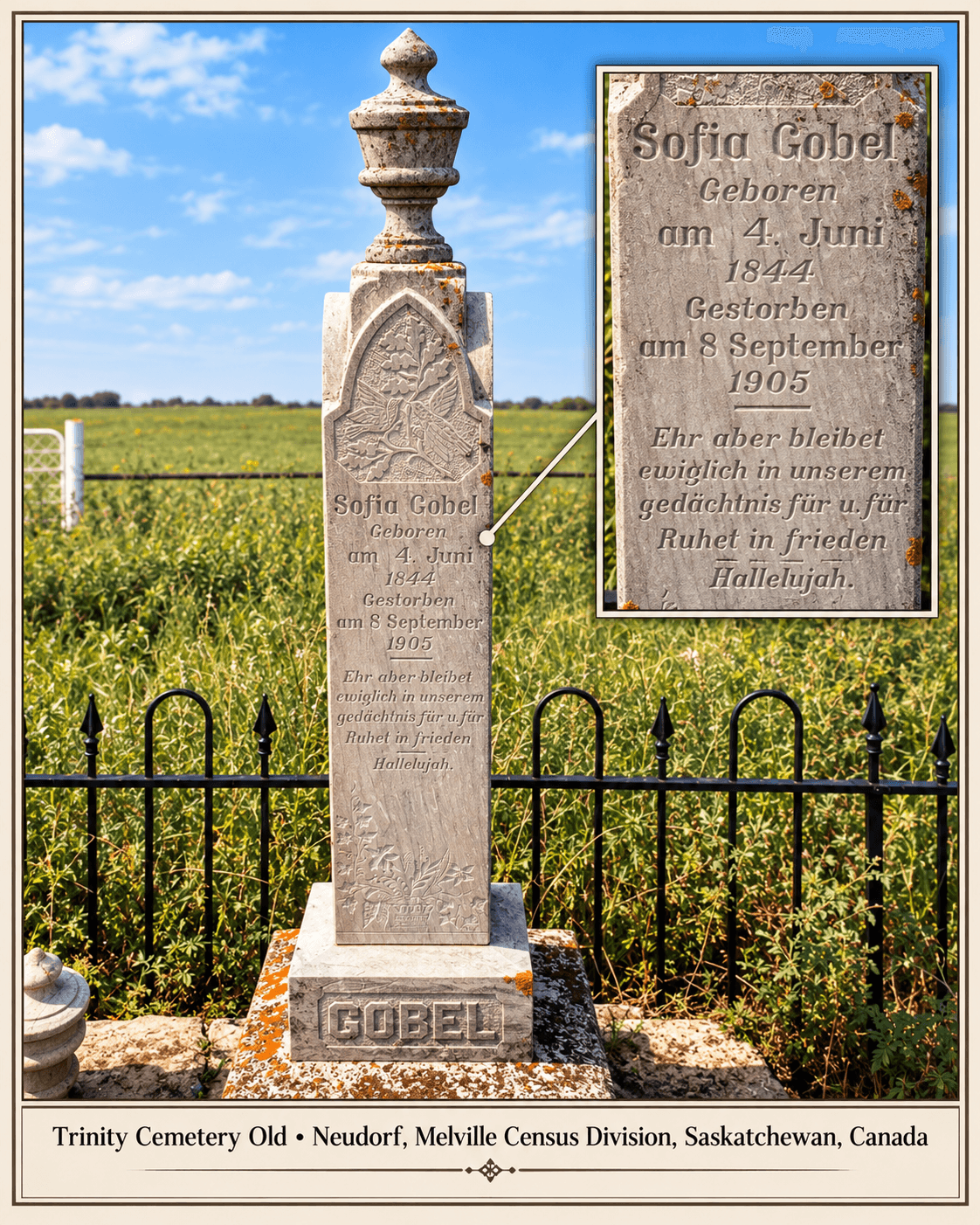
Six months after that wedding, on 8 September 1905, Sofia died at Neudorf, aged sixty one. She was among the earliest burials in Trinity Lutheran Cemetery, where the first grave had been dug only two years before.
Jacob
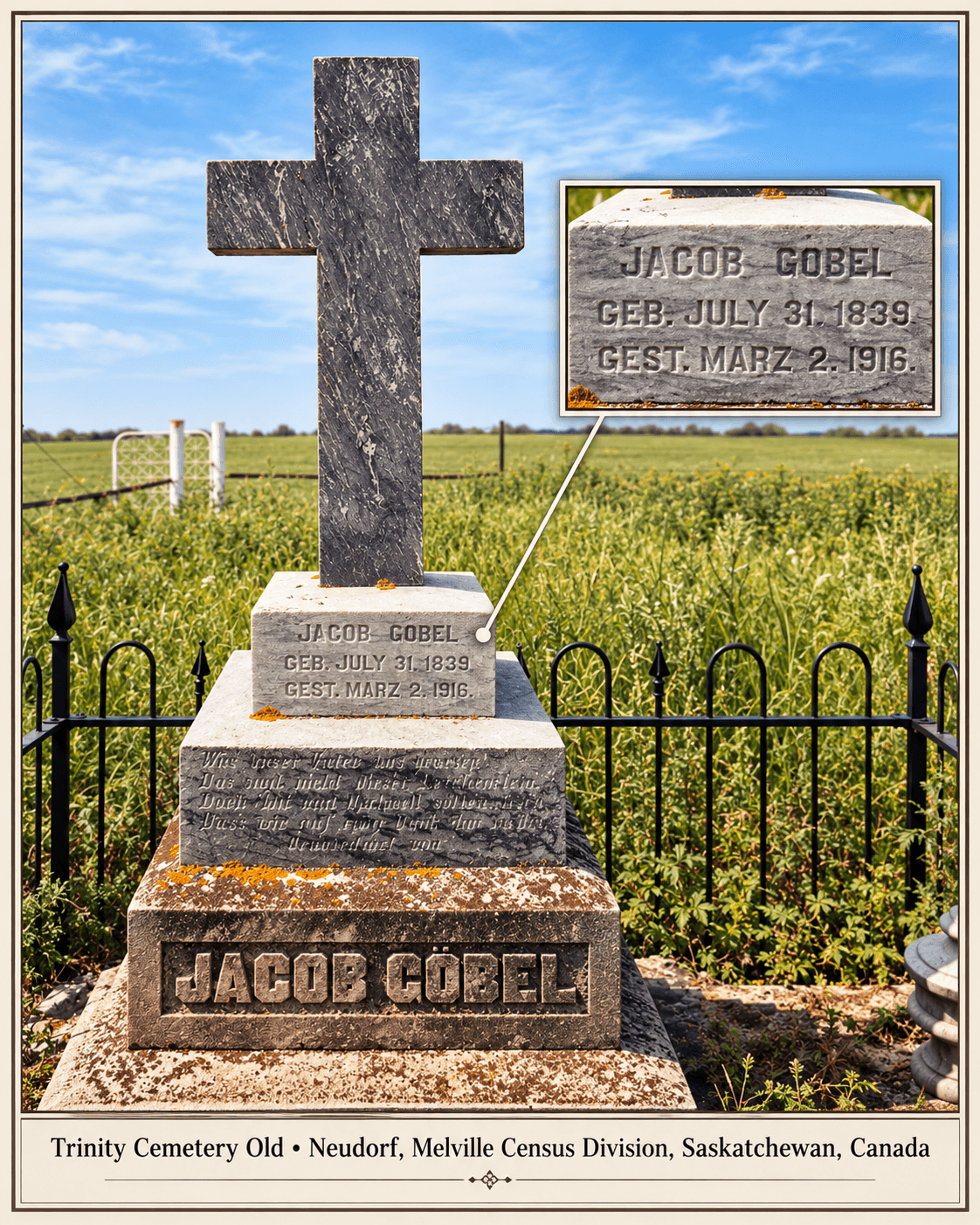
Jacob outlived her by ten years. After Sofia died he lived with his son Ludwig, who took over the home farm on Section 36, and he died there at Neudorf on 2 March 1916, aged seventy six. In 1917 his sons were still on the neighbouring quarters, writing to Ottawa about the naturalization papers they had received in 1896.
Their graves
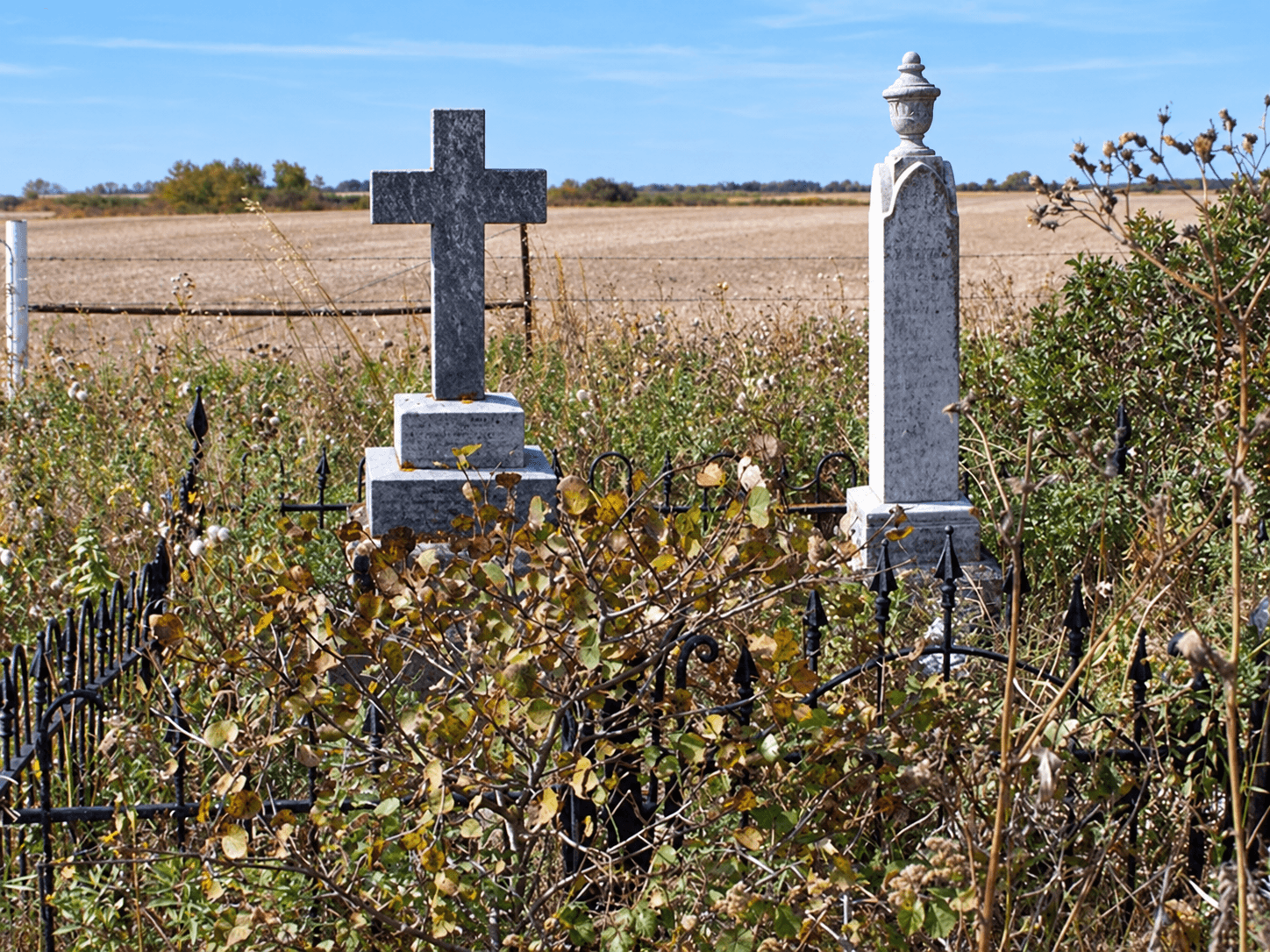
Jacob and Sofia lie in the old Trinity Lutheran cemetery, a small fenced plot at the edge of a crop field, with a stone cross for Jacob and a tall stele topped by an urn for Sofia. Jacob's stone is cut in German: Jacob Gobel, Geb. July 31 1839, Gest. Marz 2 1916. Sofia reads Geboren am 4 Juni 1844, Gestorben am 8 September 1905, with a verse promising that she will be remembered and rest in peace, and a closing Hallelujah.
Almost a century later Carol Mignon went to photograph the graves for Fred Goebel, she had to park by the clump of trees and walk in. The little cemetery was overgrown, and the field around it was peas as far as the eye could see.