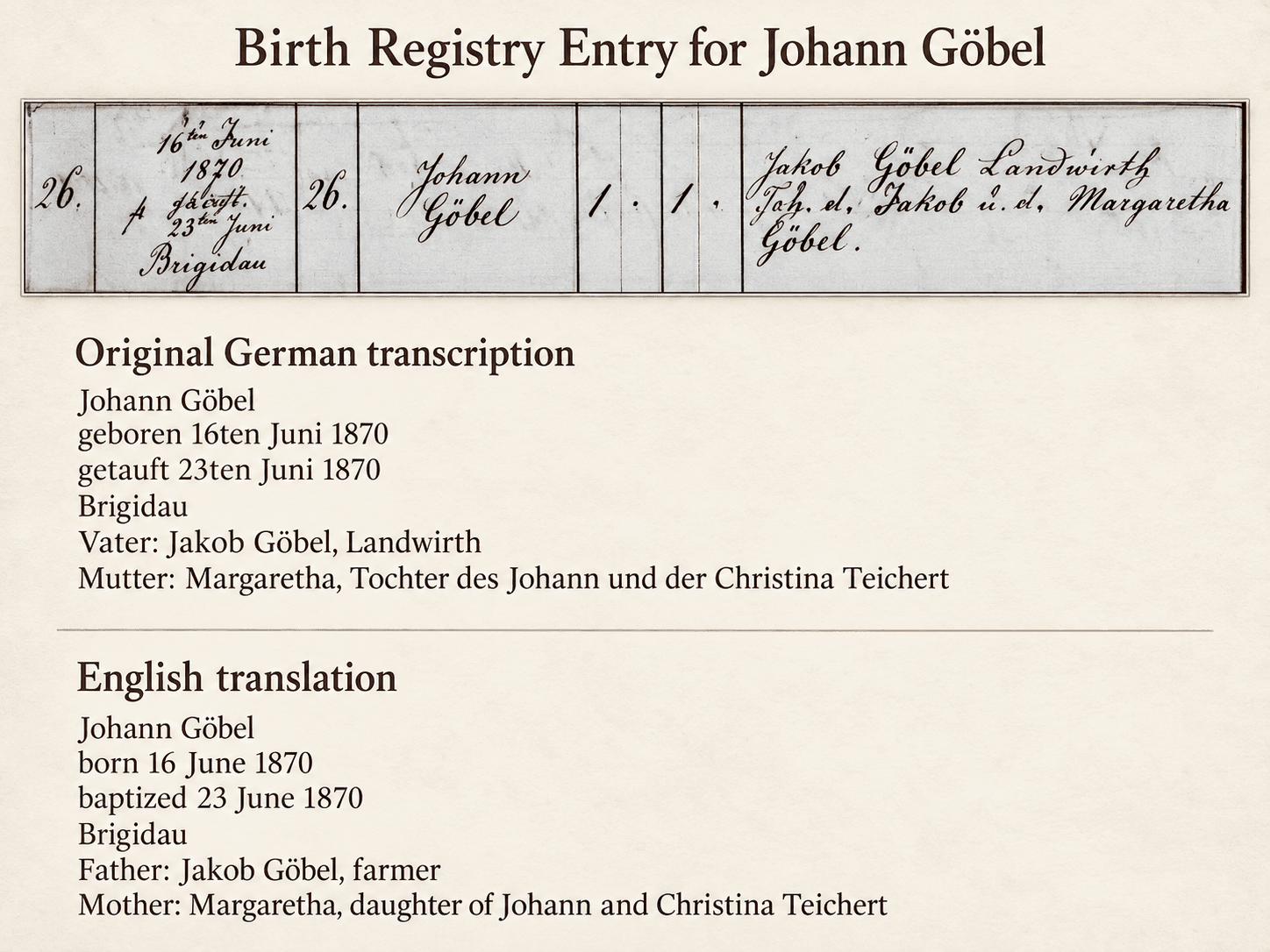
June 16, 1870, Zawadów, parish of Brigidau, Stryj district, Galicia
Immigrated
Sailed from Hamburg, April 14, 1889
Homesteaded
Dunmore, Alberta, then near Neudorf, Saskatchewan
Married
Catharina "Catherine" Niebel, March 28, 1905, Neudorf, Saskatchewan
Died
January 6, 1951, Coquitlam, British Columbia
Buried
Mountain View Cemetery, Vancouver
Children (first marriage)
John (1893), Louis Carl (1895), Philip (1897), Margaret (1899), Fred (1904)
Children (second marriage)
Emma Elizabeth (1906, died the same year), John Carl "Jack" Goebel (1907), Katharina (about 1909), Valentine (about 1911), Sofia (about 1915), Henry (1916), William (1921), Emma (1923), Evelyn (1925), Herbert (1928)
0:00 / 0:00
Listen to Johann's storyRecorded account, approx. 22 min
His Story
Johann Goebel was born on 16 June 1870 at Zawadów, a hamlet in the Lutheran parish of Brigidau in the Stryj district of Galicia (about 65 km south of Lviv and southwest of Kyiv, in western Ukraine), the son of Jacob Goebel and Sofia Reichert, whose families were Lutheran farmers from the old Palatine colonies. In April 1889 he sailed with his parents, brothers and sisters for Canada, and that same summer, as a young man with no capital, he entered for a quarter section of Alberta prairie near Dunmore. It failed, as nearly everything in that drought-hit settlement did in the late 1800s, and he started again in Saskatchewan, on land near Neudorf where his father had taken up a claim. He lost money to a crooked land agent, wrote to the Dominion Lands Branch in careful, humble English to ask for mercy, earned his naturalization, and finally got his patent. Along the way he raised a first family, buried a wife, married a second wife (our line), ran a hotel, a hardware store and the first car dealership (Chevrolet) in Melville, served as an elder of his Lutheran church, and ended his life in British Columbia at about eighty. He is the Goebel who made the move from the old country to the new, and most of what the family later became grew out of the choices he and his brothers made between 1889 and 1905.
Why they left
The Goebels were Palatine people. In 1781 the Emperor Joseph II invited German-speaking settlers to Galicia, the newly acquired Austrian province in what is now western Ukraine, and issued a Patent of Toleration that let Protestants have their own parishes. About fourteen thousand people came in the first wave, more than a third of them from the Palatinate, and roughly half were Lutheran. More than 170 colonies were planted across Galicia, with Brigidau and Josefsberg among the German ones. For a hundred years those villages held their language, their church and their farming ways in the middle of Polish and Ukrainian country.
By the 1880s the arrangement had run out of room. Historians of the migration point to overpopulation, hard economic times, restrictions on buying more land and political pressure as the common reasons for leaving the Austrian empire, and the farms of the old colonies were being divided among sons until the pieces were small. Military service is also named as a pressure on German families in eastern Europe in these years.
The pull from the other side was loud. Canada had opened the prairie under the Dominion Lands Act, which gave a man a quarter section of 160 acres for a ten dollar entry fee, and the government and the railways sent agents and pamphlets into Europe promising free land and a mild climate. Letters and scouts went back and forth between the Galician villages and relatives who had already gone. Close to a fifth of the German immigration into western Canada before the First World War came from the German parts of the Austrian and Russian empires, and Galicia supplied most of it.
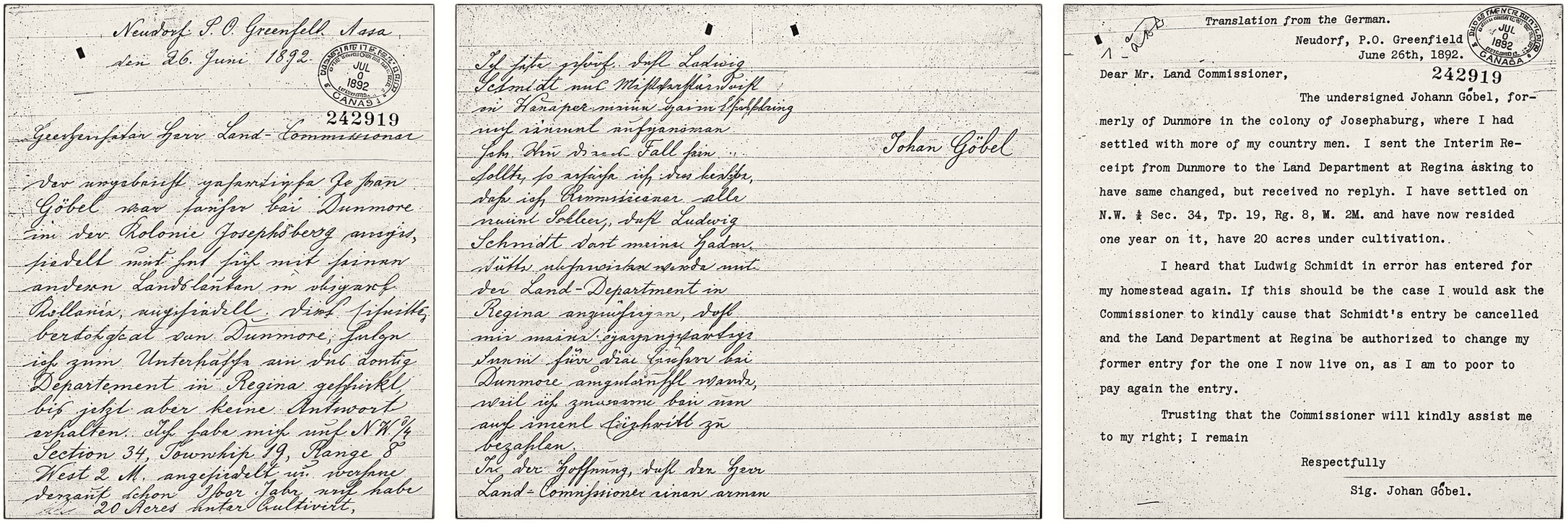
The Galician Germans who came were mostly Lutherans, traced to the districts of Stryj and Drohobycz, and their emigration began in the 1880s. The first Galician German settlements were founded in 1889, the year the Goebels arrived: Hoffnungstal in what is now Saskatchewan and Josefsberg in Alberta. Neudorf and Lemberg followed in 1890. The first group went to the Dunmore area near Medicine Hat, where the scouts had been told the climate was gentler than it was. After several drought years most of those colonies were abandoned and the survivors moved north to the Stony Plain and Spruce Grove district near Edmonton, or east to the Qu'Appelle country in Saskatchewan. Johann's own papers follow that path exactly. His homestead letter of 1892 introduces himself as formerly of Dunmore, "colony Josephsburg", and now on land near Neudorf.
The crossing, April 1889
The ship's list survives. The steamer Scribe sailed under the English flag from Hamburg on 14 April 1889 for North America by way of Hull and Liverpool. On the list are the Göbel family from Zawadów in Galicia: Jacob, fifty, a blacksmith, his wife Sofia, and eight of their children: Johann, Philip, Ludwig, Katarina, Valentin, Christine, Heinrich and Margaretha, the youngest only a year old. Their destination is written as Winnipeg. Ten people travelled on one booking, and the trade Jacob practised before the move may explain Johann's later work in hardware and the trades.
Dunmore, and the claim that did not hold
Johann entered for the northwest quarter of Section 28, Township 9, Range 2 west of the Fourth Meridian, in the Dunmore district, in the summer of 1889. He did not stay. An inspector's report of September 1892 records that he and his wife lived with his father on Section 36 from 15 June 1891 until 17 April 1892, with his wife the only one mentioned at that address, which suggests he was away, perhaps working for wages or looking for better land.
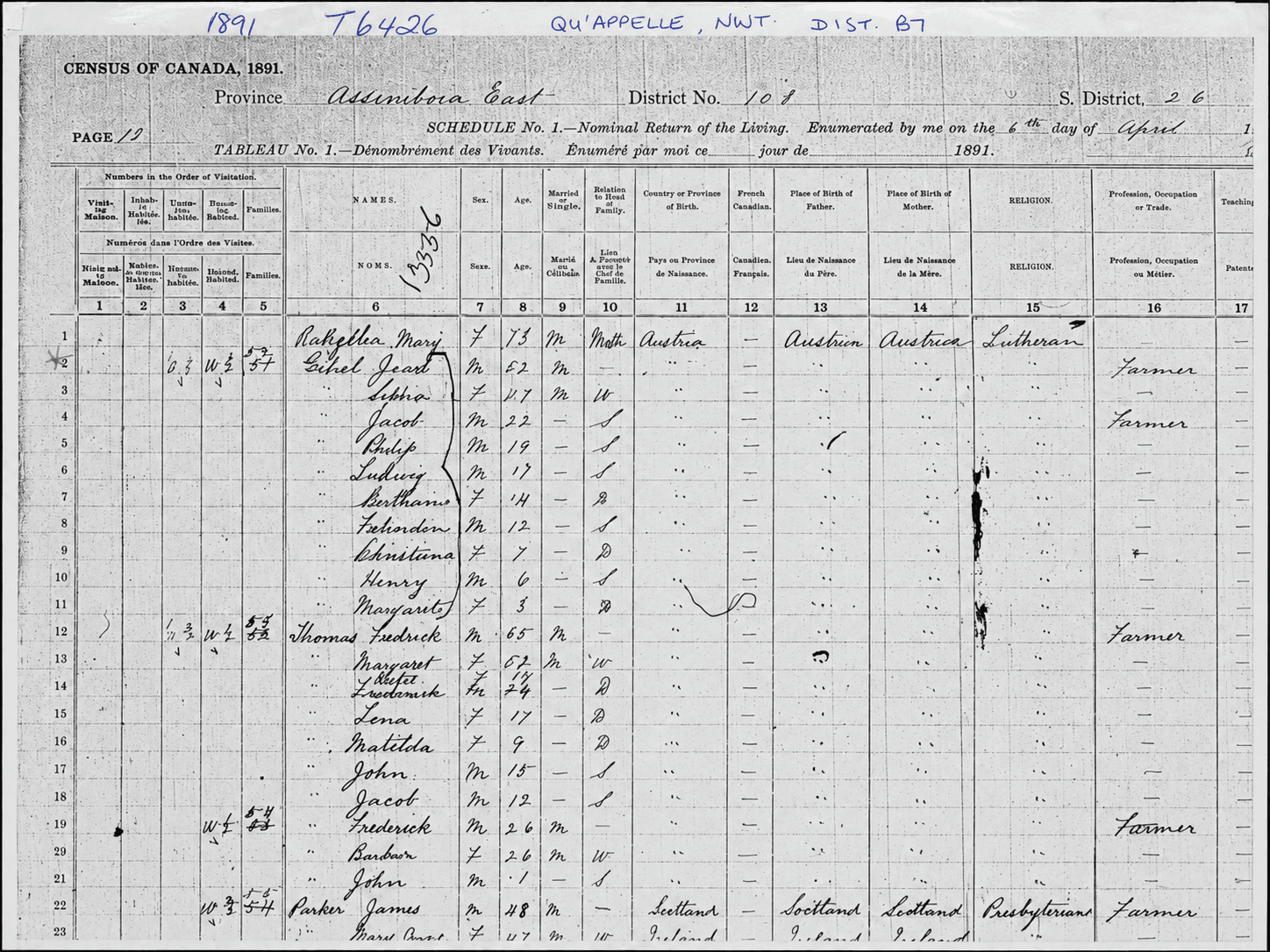
1891 Census
Neudorf, and a letter to Ottawa
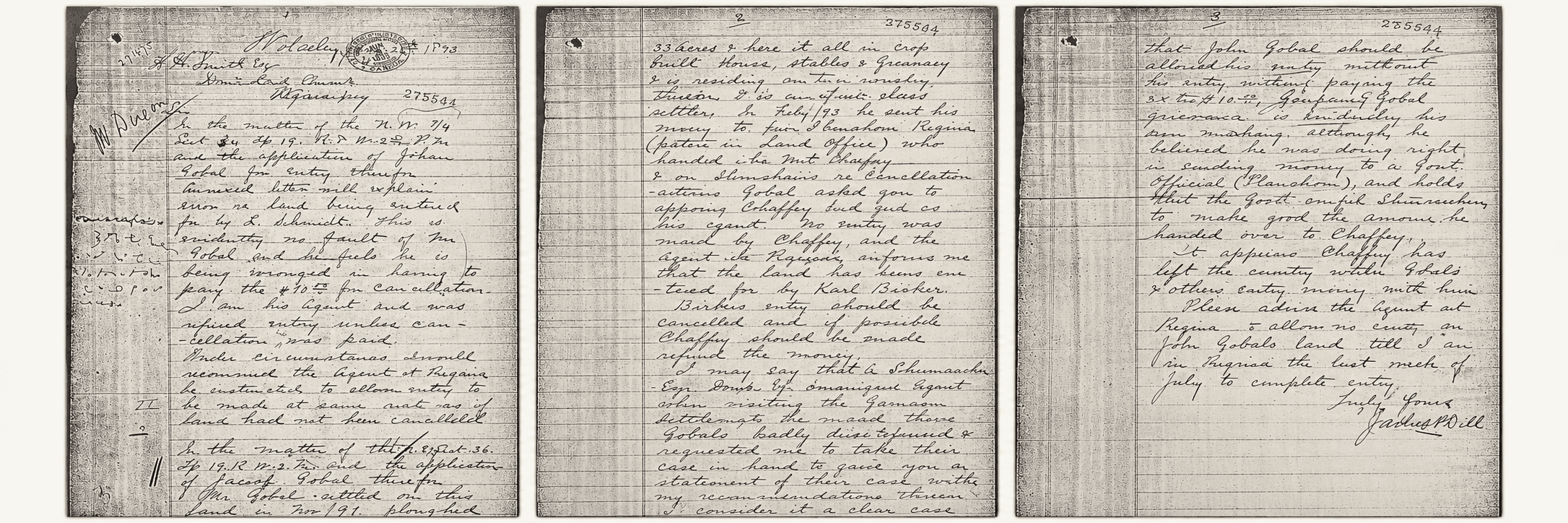
His father settled on the northeast quarter of Section 36 near Neudorf, Saskatchewan, in November 1891, according to a letter written for the family by James P. Dill, the member of the legislature for Wolseley. Johann took up the northwest quarter of Section 34, Township 19, Range 8 west of the Second Meridian, a short walk from his father's land and from the quarters of his brothers. Jakob had Section 36, Philip and Ludwig had adjoining quarters in Township 20, and Jacob Barron, who may have been his first father-in-law, farmed the next quarter over.
The paperwork is the richest part of Johann's file. In June 1892 he wrote to the department, in English that had to be written down for him, to say he was too poor to pay an entry fee a second time, that he already had twenty acres under cultivation, and that his entry had been recorded wrongly through no fault of his own.
Letter detailing the fraud
Letters followed in October 1892, April 1893 and December 1893. The cause of the trouble comes out in the Dill letter of June 1893: a land agent named Chaffey took entry fees from the Goebel family and left the district without filing them. Johann was told he would have to pay a cancellation fee and the department refused to waive it, though it did eventually allow him to enter the land in January 1894. Inspectors went out to look at what he had done in September 1892 and May 1895. In January 1896 he asked for his patent and supplied his own sworn statement of residence and cultivation, naming his naturalization on 26 November 1894. Neighbours Jacob Barron and Michael Gobel signed as witnesses.
Winnipeg in 1901, and the first family
The 1901 census finds Johann in Winnipeg, not Neudorf, listed as John Gable, a Lutheran from Austria. His wife Maggie was born on 19 October 1875, and the children with them were John, born 9 March 1893 in Winnipeg, Louis, Philip and a baby girl, Maggie. His first wife is recorded in other papers as Katherine Baren, and in 1904 Johann bought and ran a hotel at Fenwood, Saskatchewan. It was there, on 24 December 1904, that his wife died, leaving five children.
A second marriage, and Melville
Johann married again within four months. On 28 March 1905, by licence, at the home of his father at Neudorf, he married Catharina Niebel, twenty, of Yorkton, born in Russia, the daughter of Johann Niebel and Rosina. His brothers Valentin and Ludwig were the witnesses. Catherine's family had come from Roumania and Bessarabia and had entered a homestead near Yorkton only in 1902. Johann's mother Sofia died on 8 September 1905, not long after the wedding.
The family moved to Melville in 1908. He opened a hardware store on Third Avenue and became the only Chevrolet dealer in the district. The family home was on Fourth Avenue and the children went to East End School. He cleared a slough for the town children to skate on, kept a horse drawn sleigh that turned into a wagon in the summer, and took the family for rides in the touring car with hot bricks on the floor for warmth. He was an elder in St. Paul's Lutheran Church for many years and every Christmas supplied a huge tree for the church service on Christmas Eve. When the Spanish flu came through in 1918 and 1919 he gave everyone hot wine, believing it would protect them, and the family always said it did.
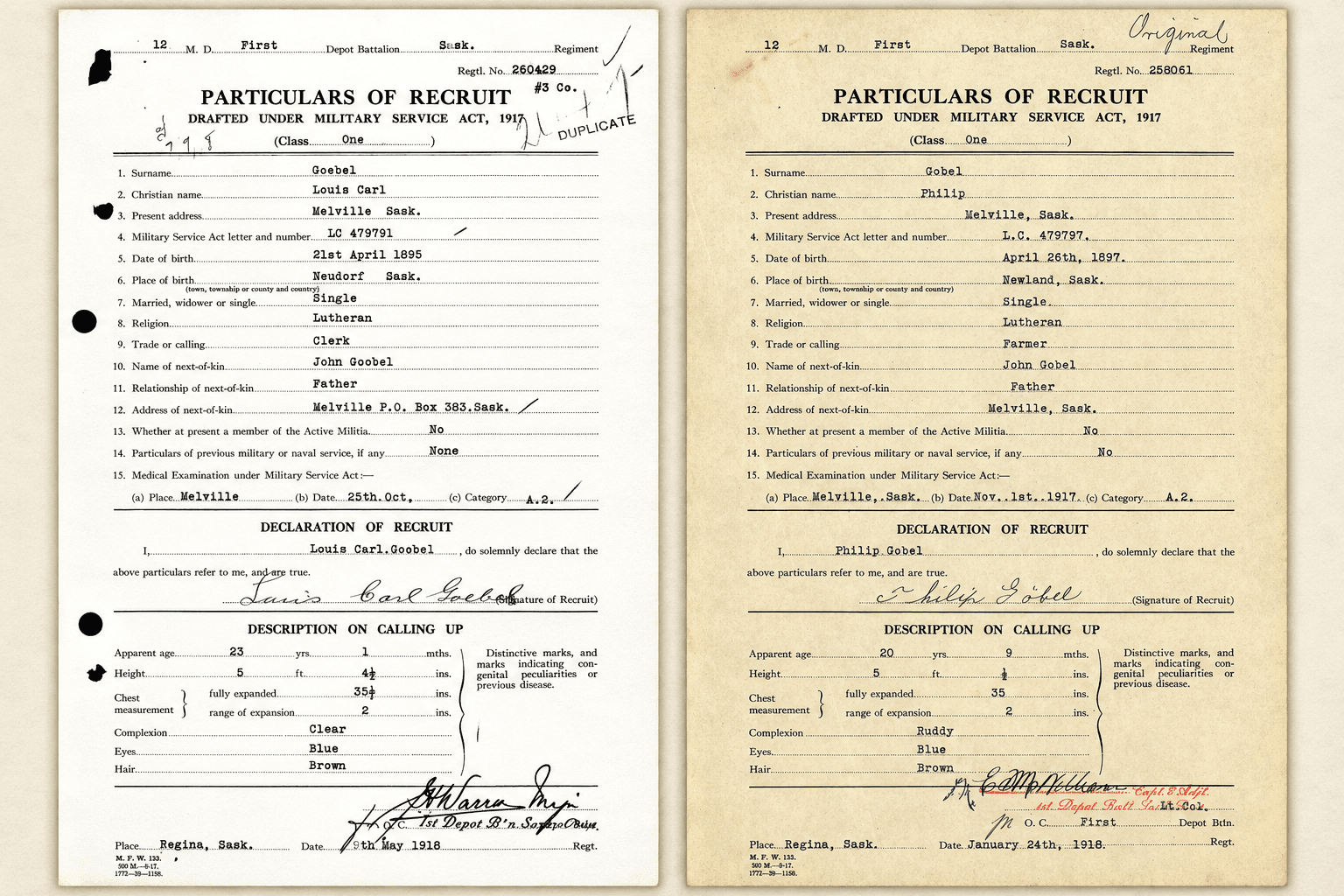
In 1917 two of his sons from the first marriage, Louis and Philip, were drafted under the Military Service Act and called up at Regina in 1918.
WW1 draft papers for Louis and Phillip
Windsor, Kamsack, Vancouver
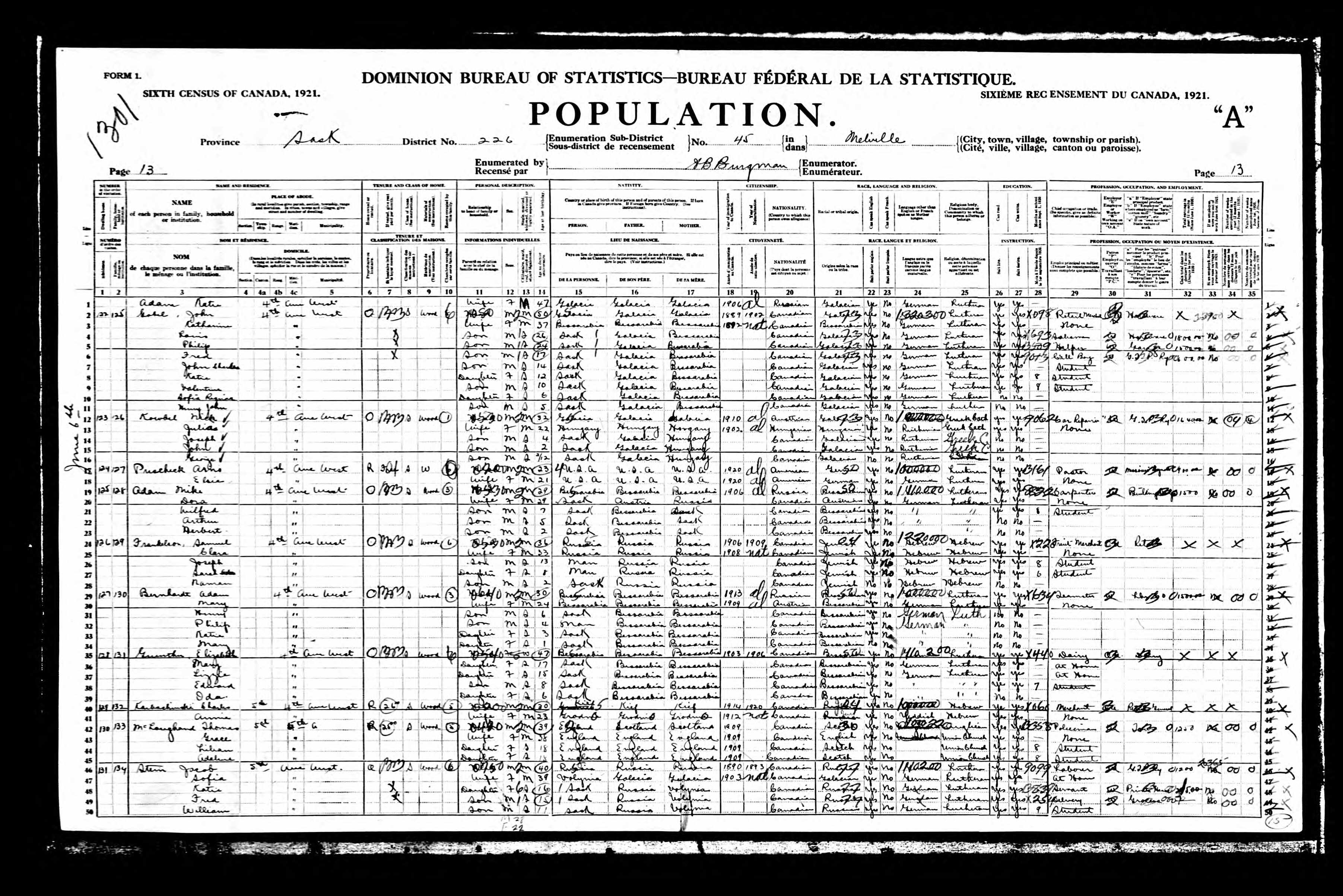
In late 1923 the two eldest sons opened a hardware store at Kamsack. The rest of the family followed to Windsor, Ontario, in 1924, where a daughter, Evelyn, was born in 1925. About a year later they went back to Kamsack and the following year on to Vancouver, where the youngest child, Herbert, was born in 1928. In the 1931 census Johann is a carpenter with Katherina and the youngest children at home.
1921 census
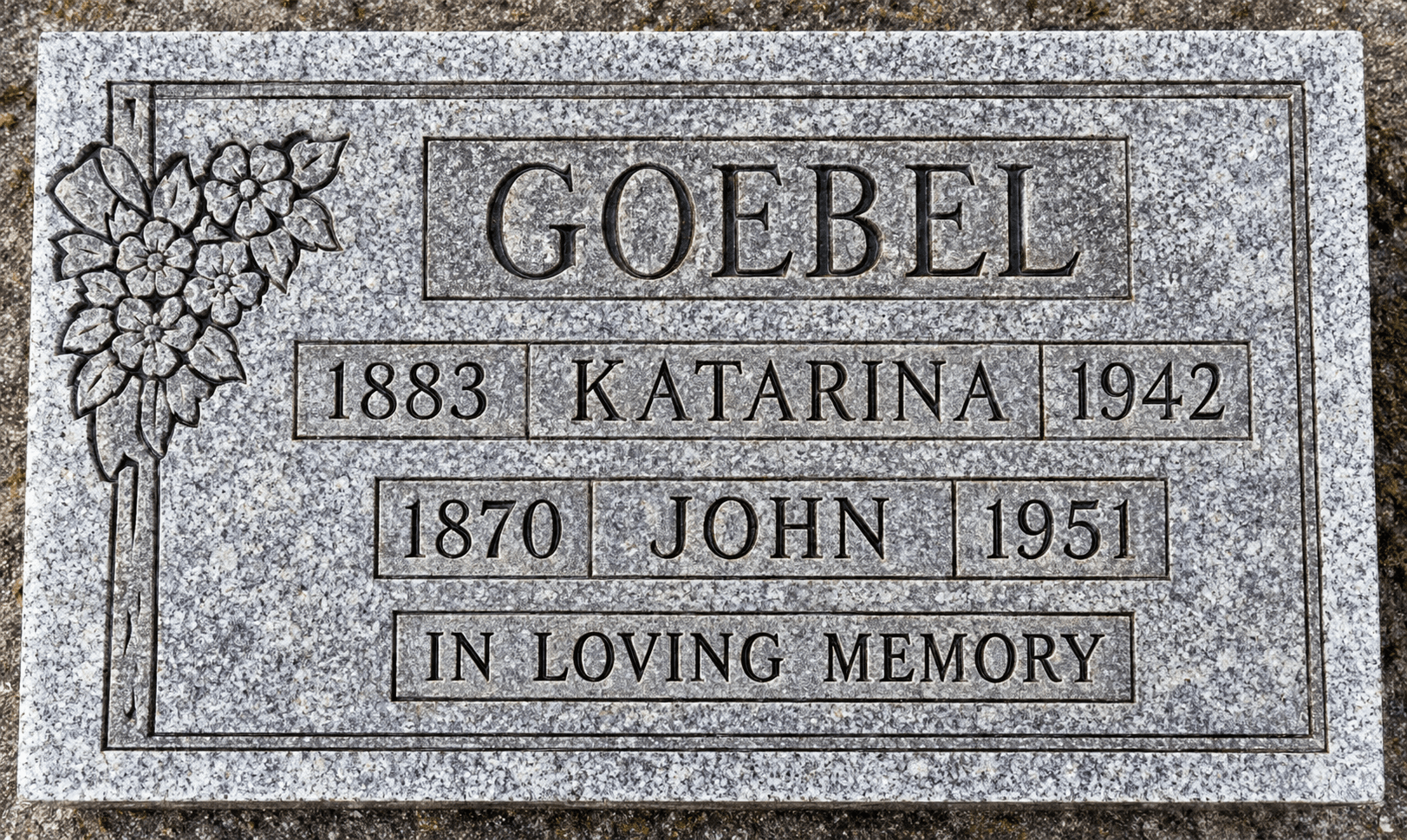
Catherine died in Vancouver on 27 June 1942. Johann died at Coquitlam in 1951. The headstone for both of them, in Mountain View Cemetery, Vancouver, reads Goebel, Katarina 1883 to 1942, John 1870 to 1951, in loving memory.