Section 34, Township 19, Range 8 W2, near Neudorf, Saskatchewan, August 31, 1907
Died
Cobourg, Ontario, September 3, 1964, age 57
Married (1)
Caroline Berryere, Windsor, Ontario, January 16, 1926; divorced Wayne County, Michigan, June 7, 1928
Married (2)
Violet Myrtle Martin, Regina, Saskatchewan, 1937
Service
Canadian Army active service, March 27, 1941 – July 3, 1946; Regular Army, January 30, 1947 – December 31, 1957
Buried
Cobourg Union Cemetery, September 5, 1964
0:00 / 0:00
Listen to Jack's storyRecorded account, approx. 20 min
His Story
John Carl "Jack" Goebel was born on a homestead quarter south of Neudorf, Saskatchewan on 31 August 1907, the son of a Galician immigrant who had come out to the prairie in 1889. He grew up on 4th Avenue in the railway town of Melville, one of a large second family in a district so thick with Goebels that six brothers of his father's generation farmed there at the same time. He was gone from Saskatchewan before he was nineteen: in January 1926, aged eighteen and working as a labourer in Windsor, Ontario. It was there he married Caroline Berryere, an eighteen year old from a homestead twenty five kilometres from his own. Two and a half years later she divorced him in Detroit. He surfaces again in Regina, marrying Violet Myrtle Martin of the Ituna district in August 1937, and joining the Regina Rifle Regiment in 1940. He went on active service on 27 March 1941. Served in Canada, the United Kingdom and Continental Europe, and was discharged a private on 3 July 1946 carrying two abdominal surgical scars. Seven months later he re-enlisted and served eleven more years in the Regular Army, as a corporal in the Royal Canadian Ordnance Corps, and was awarded the Canadian Forces Decoration in July 1954 for twelve years of service. The family settled at Cobourg, Ontario, where 26 Central Ordnance Depot was based. In November 1959, facing an operation at Sunnybrook he did not expect to survive, he sat down and wrote out his own will in longhand and signed it "Dad". He lived another five years and died at Cobourg General Hospital on 3 September 1964, aged fifty seven.
A Goebel among Goebels
Jack's grandparents were Jacob Goebel, born 1839, and Sophie Reichert, born 1844. They came to Canada from Stryj, in the Austrian crown land of Galicia, in 1889, and settled southeast of Neudorf with nine children. Jacob gave the land for the first Lutheran church in the district, a log building put up in 1896, and farmed there until he died in March 1916 at seventy seven.
Their sons Jacob, John, Philip, Ludwig, Valentine and Henry all farmed around Neudorf, and all drew their children's names from the same small pool. The Neudorf and Melville records of that generation therefore contain a great many men called John Goebel, and nothing can safely be attached to one of them without checking the parents.
Jack's father, John Goebel, arrived in 1889 as one of those nine children. He homesteaded, married Margarethe Baron, and lost her on Christmas Eve 1904; she was thirty, and she left him with young children. He married again, to Catherine Niebel, and it is that second marriage Jack belongs to. By 1921 John had left the land for 4th Avenue in Melville, where he owned his house and gave his occupation as a retired merchant.
Jack's own birth is recorded exactly. Saskatchewan registration 2788: John Carl Goebel, born 31 August 1907, at 34-19-8-W2, father John Goebel, mother Catherine Niebel.
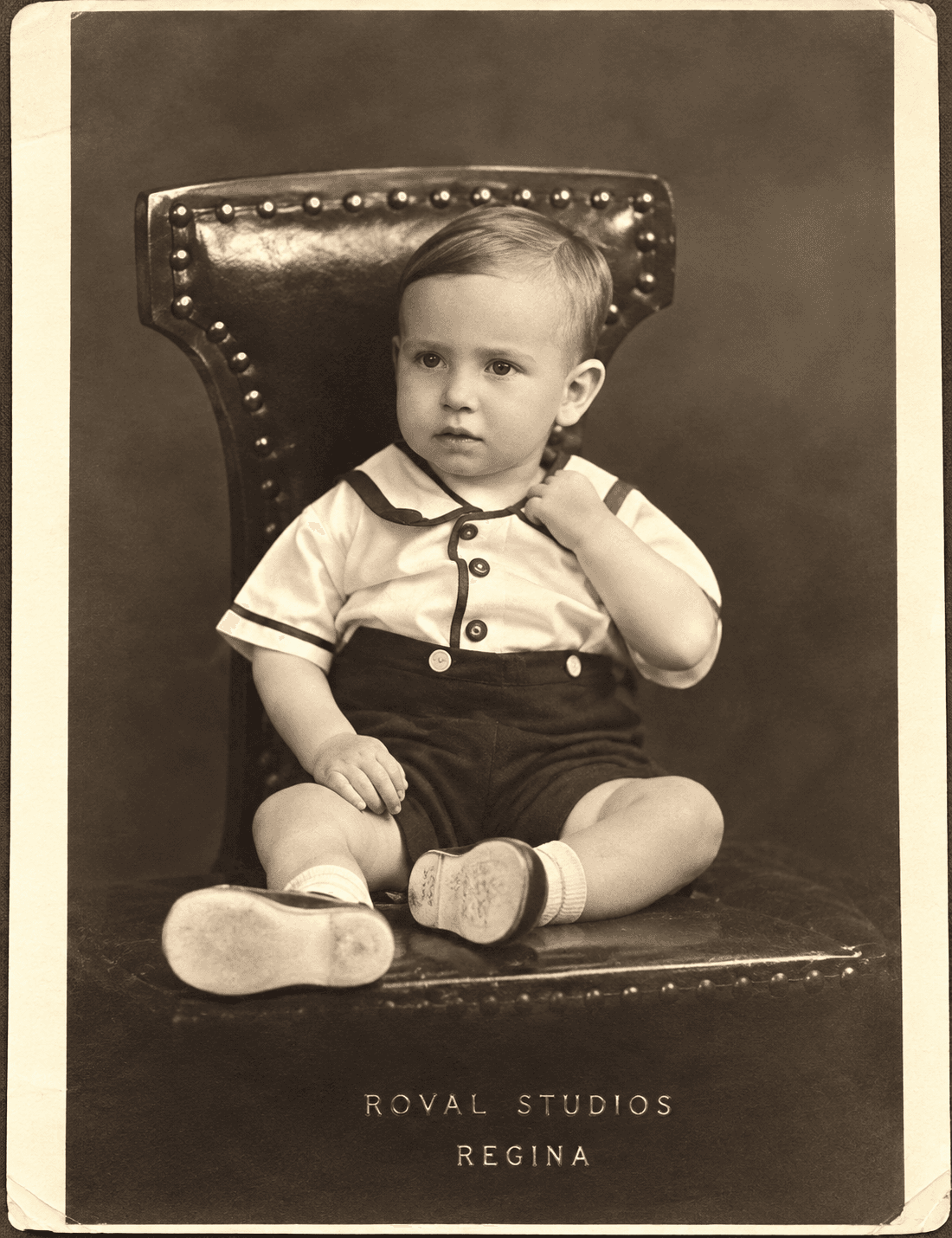
John Carl “Jack” Goebel, c. 1909–1910, Regina, Saskatchewan, approximately age 2.
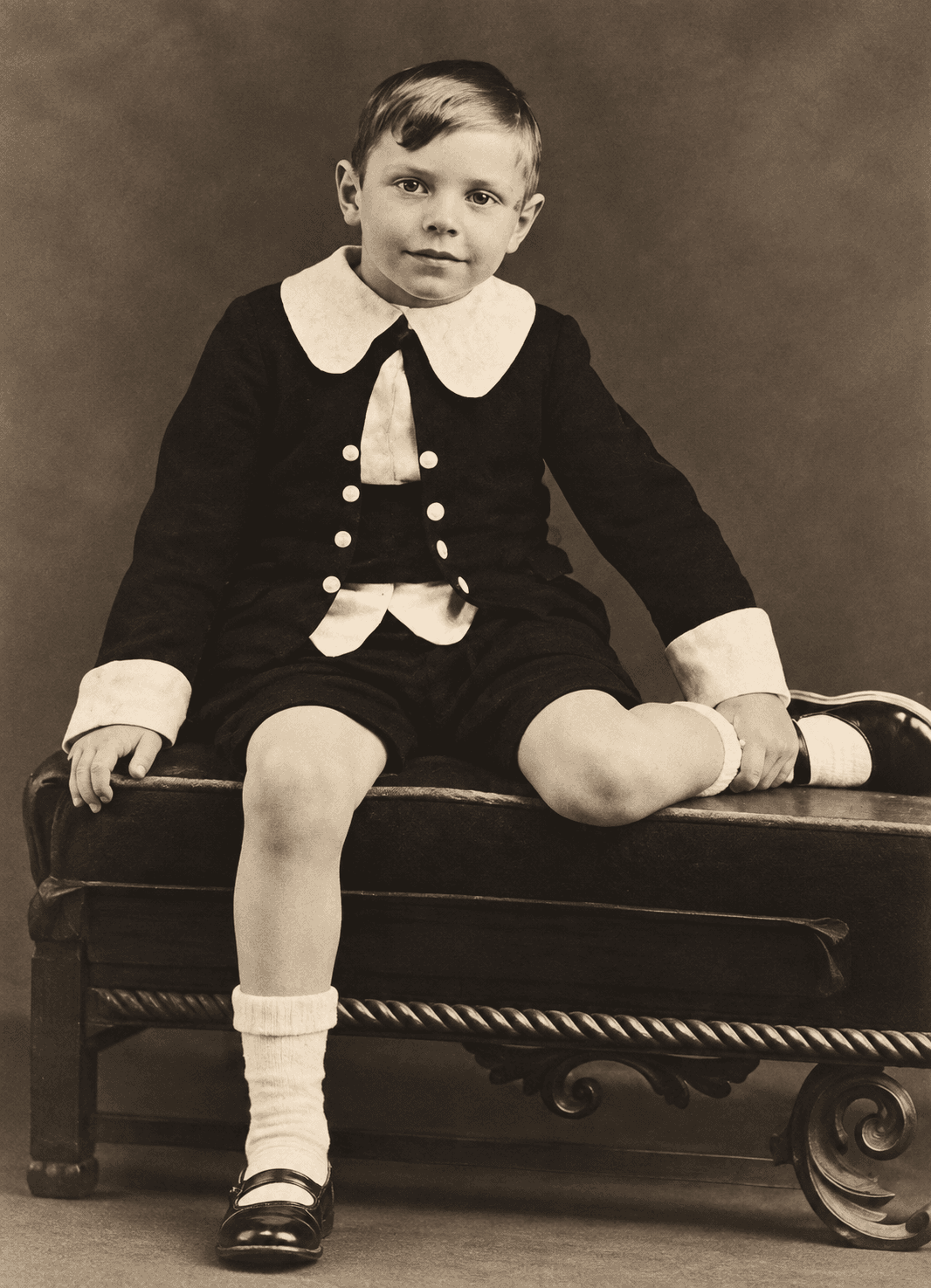
John Carl “Jack” Goebel, approximately age 4–5, Regina, Saskatchewan, c. 1912–1913
In the 1916 and 1921 censuses he is in the Melville house with half siblings and full siblings: Louis, Philip, Margaretta and Fred from the first marriage, and Katie, Valentine, Sofia Regina and Henry from the second. Lutheran, German spoken at home. The 1921 enumerator wrote the family down as Gabel.
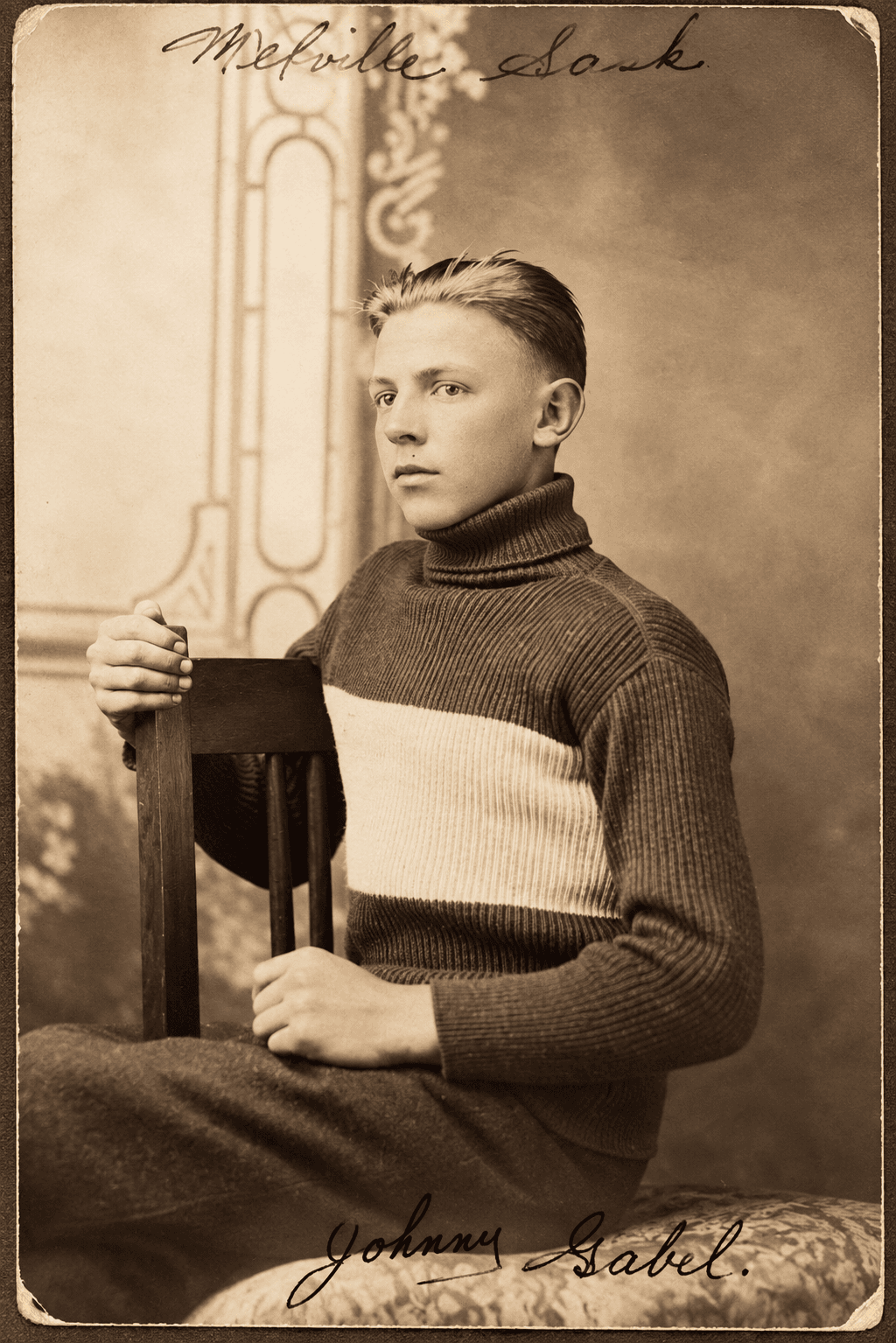
John Carl “Jack” Goebel c. 1921–1923, approximately age 14–15.
John and Catherine did not stay in Saskatchewan. Catherine died in Vancouver on 27 June 1942, aged 57. John died at Coquitlam, British Columbia, on 6 January 1951, aged 85.
A First Marriage, 1926
Something took Jack off the prairie while he was still a boy. That is lost to history. Was it an elopement? We may never know.
On 16 January 1926 he married at Windsor, Ontario. He was eighteen. He gave his name in full as Johann Karl Goebel, his occupation as labourer, his residence as Windsor, his religion as Lutheran, and at the foot of the affidavit he signed himself J. C. Goebel. The certificate names his father as John Goebel and his mother, in her maiden name, as Katherine Niebel, which is how we know beyond argument that this is him and not a cousin.
The bride was Caroline Berryere, also eighteen, also born in Saskatchewan, Roman Catholic, daughter of Edmund Berryere and Anna Glavish of the Killaly district, about twenty five to thirty kilometres from the quarter section where Jack was born. Two teenagers from neighbouring prairie districts married each other two and a half thousand kilometres from home. They almost certainly did not meet in Windsor.
Windsor in 1926 was the Border Cities auto boom, Ford and Chrysler pulling in labour from everywhere, and the American shore a ferry ride away. It lasted two years and five months. Caroline filed at Wayne County, Michigan, on 28 November 1927, and the decree came on 7 June 1928: absolute, uncontested, no alimony, no children. The cause recorded is extreme cruelty, which in Michigan at the time was the routine ground rather than a finding; the state had no no-fault divorce until 1972 and extreme cruelty accounted for more than seventy two per cent of its divorce suits by 1917. What the petition actually alleged is in a court file the family has not yet seen.
Jack returned to Saskatchewan
From June 1928 to August 1937 there was nothing. Nine years. Jack's obituary, written by the family in 1964, says he went to Regina in 1926. That cannot be squared with a January 1926 marriage in Windsor and a 1928 divorce in Detroit, and the most likely explanation is the simplest one: the obituary begins his adult life at the point where the family's knowledge of it began. Windsor and Detroit are not in it.
Violet
Violet Myrtle Martin was the daughter of Fred Martin and Jennie McBurney, who married in Northern Ireland and came out to Saskatchewan in 1906, to a homestead at SW 1/4 36-25-11 W2 near Ituna, where they lived at first in a sod shack. Jennie had been born at Banbridge, County Down, in 1877. Fred died in June 1915, leaving her with five children.
Violet's older sister Maggie married and settled in Melville, which is the likeliest bridge between an Ituna girl and a Melville boy. Jack and Violet were married by 17 August 1937, when the Regina Leader-Post carried the report under the headline "Miss Martin, J. Goebel Are Wedding Principals". She was his second wife.
The Regina Rifles and WWII
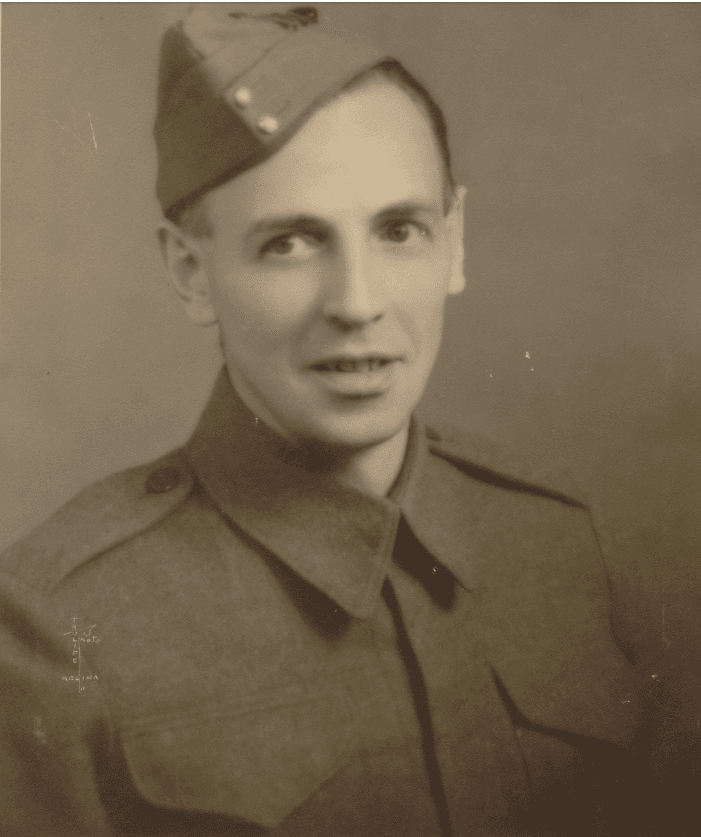
His obituary states plainly that Jack joined the Regina Rifle Regiment in 1940 and went overseas in 1941. The family holds his Regina Rifle Regiment cap badge and a Regina Rifles handkerchief. His medal frame is mounted with the regimental badge. On this the documentary record and the objects agree, and the regiment belongs on this page.
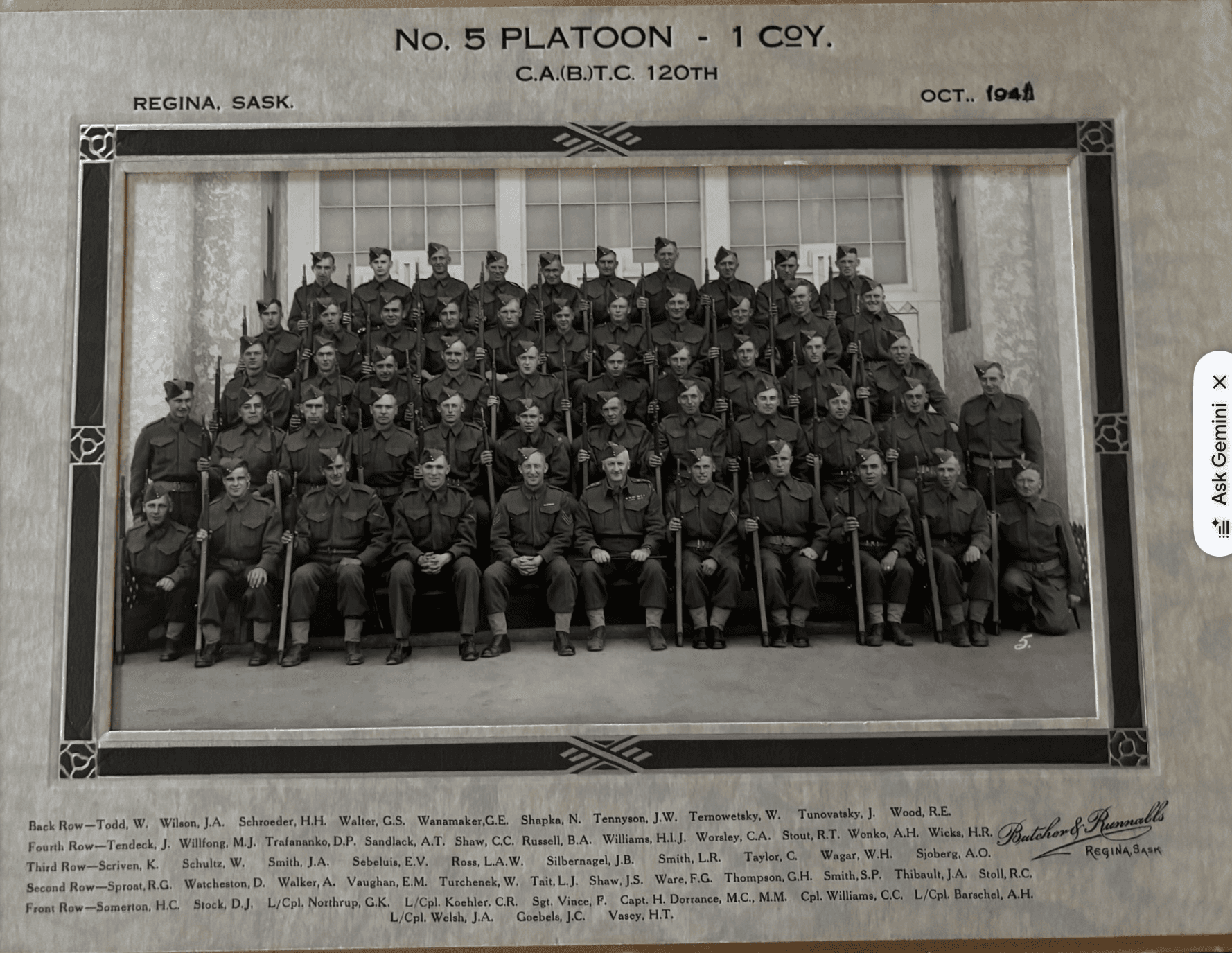
His official active service, though, begins on 27 March 1941, and in October 1941 he was photographed with No. 5 Platoon, No. 1 Company, 120th Canadian Army (Basic) Training Centre, Regina, a large mounted group portrait with the names printed underneath. He appears as "Goebels, J.C.", seated in the front row. The company commander in the centre of that row is Captain H. Dorrance, M.C., M.M., a man already decorated twice in WWI.
The likeliest reconstruction is this. The Regina Rifles mobilised their 1st Battalion for overseas service in June 1940 and it went to Britain in 1941, but the regiment also maintained a 2nd Battalion in the Reserve Army throughout the war and raised a 3rd Battalion for west coast defence. A man who joined the regiment locally in 1940 and did not go onto full active service until March 1941 fits the reserve route, not the 1st Battalion.
No. 3 Provost Company
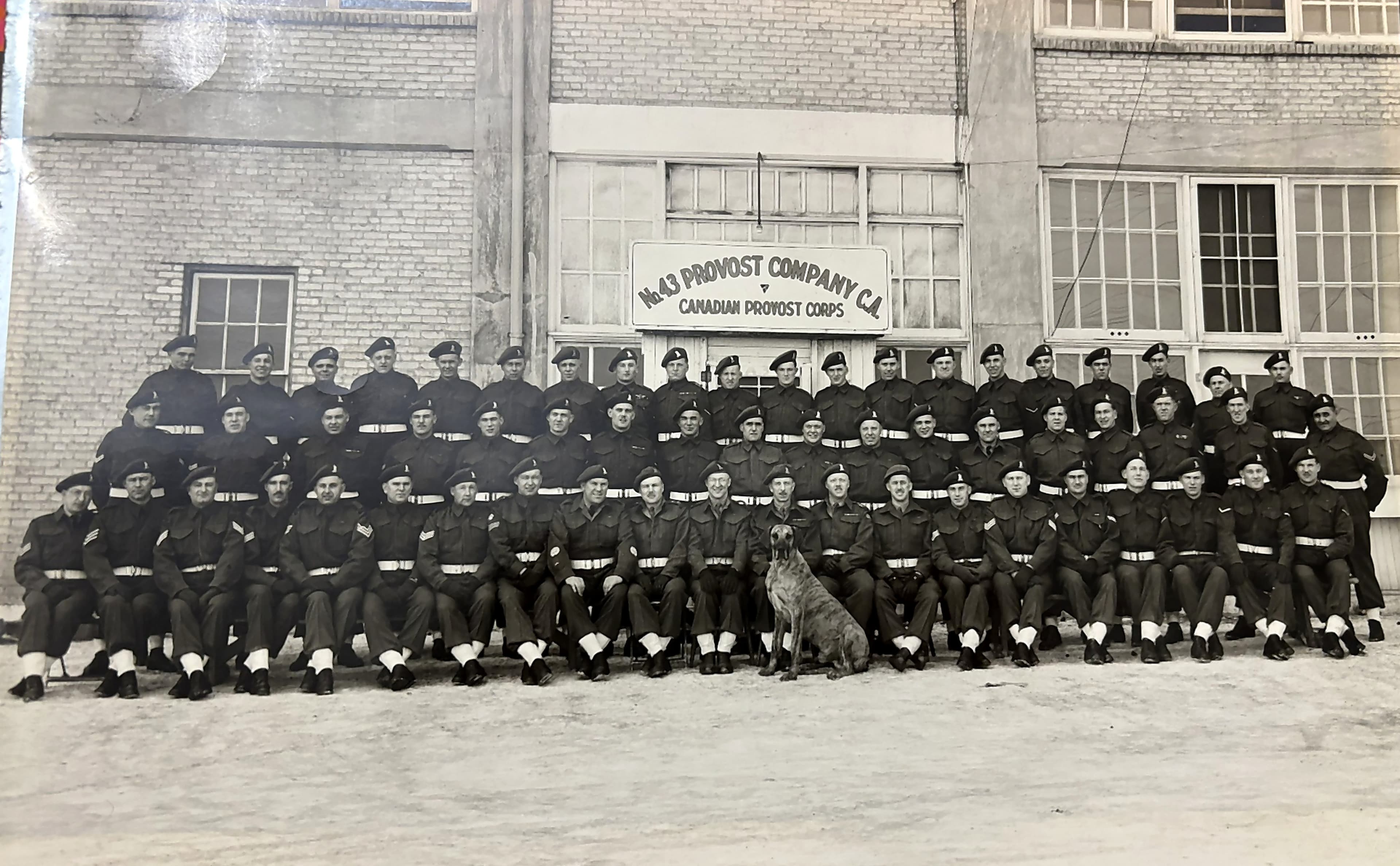
Among the family photographs is a large formal group portrait: well over a hundred men in six ranks, formed up in front of a building with tall multi-paned industrial windows. A board set in the front rank reads No. 3 Provost Company (A), Canadian Provost Corps.
That one line puts Jack in a second corps, and it puts him at home rather than overseas. The Canadian Provost Corps was the army's military police, responsible for traffic control, security and discipline. Its companies were renumbered in 1942 along geographic lines, and No. 3 was the Regina company; the "(A)" marks the Active Force unit as distinct from its Reserve counterpart. The photograph was therefore almost certainly taken in Regina, some time around 1942.
Jack spent part of his war as a policeman in uniform. His son, Fred, would spend the majority of his working life as a policeman out of it.
His discharge certificate is the document that unlocked everything else. It records Pte. John Carl Goebel, L.84035, active service from 27 March 1941 to 3 July 1946, discharged "to return to civil life on demobilization", with theatres of service given as Canada, the United Kingdom and Continental Europe.
The certificate lists the 1939 to 1945 Star, the France and Germany Star, the Defence Medal, and the Canadian Volunteer Service Medal and Clasp. The framed group at home adds the War Medal 1939 to 1945 and the later Canadian Forces Decoration.
Those medals set the floor under his war. The 1939 to 1945 Star required operational service. The France and Germany Star required service in that theatre between D-Day and the German surrender. The Overseas Service Clasp required sixty days outside Canada. The Defence Medal was awarded principally for six months of non-operational service in Britain, which is the piece that says he spent a long stretch in the United Kingdom before crossing to the continent.
He came out as a private after five years and three months. He was five foot four and a half, dark complexioned, with brown eyes and dark brown hair, and he was carrying two laparotomy scars in the right lower quadrant and an appendectomy scar. He had been opened up at least twice before he was thirty nine. He was issued War Service Badge, Service Class, No. 792641.
Whatever happened to him medically during the war is not yet known, and it is one of the more important things the service file should answer (ATIIP requested).
Back in uniform
Most men put the uniform away in 1946. Jack lasted about seven months.
On 30 January 1947 he enlisted in the Regular Canadian Army, and he served without a break until his honourable release on 31 December 1957. Somewhere in that decade he was promoted corporal, and his number acquired an S: SL 84035, the same five digits he had carried through the war with a letter added for the postwar series.
He served with the Royal Canadian Ordnance Corps, the army's supply and equipment service, the people who held, issued, repaired and moved everything an army uses. A surviving group photograph also places him with No. 3 Provost Company (A), Canadian Provost Corps, the military police. A third certificate, dated 1956, carries a different number again, SG 137305, and how that fits has not yet been worked out.
On 5 July 1954 he was awarded the Canadian Forces Decoration, the long service and good conduct award that requires twelve years. Counting the war and the Regular Army together, he had them.
The family's home in those years was Cobourg, Ontario, where 26 Central Ordnance Depot was based. The Department of National Defence bought land at Cobourg in 1951 and built through 1952 and 1953, and the depot's headquarters moved there from Ottawa in 1954. His obituary says the family came to Cobourg in 1950, which is four years earlier than the documented move, and that gap has not yet been explained.
A curling rink at the Waverley
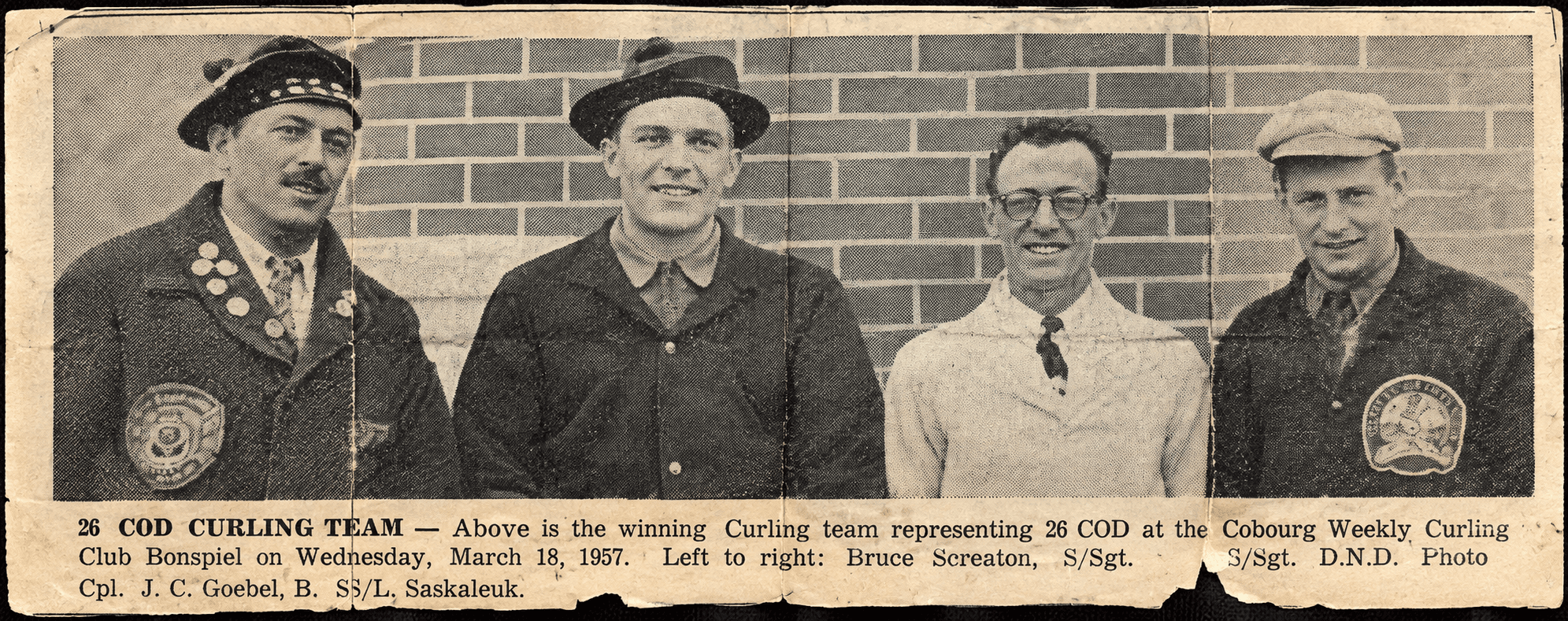
On 13 March 1957 a newspaper photograph shows the winning 26 COD rink at the Cobourg Waverley Curling Club: Bruce Screaton, Staff Sergeant Don Grant, Staff Sergeant Peter Moskaliuk, and Cpl. J. C. Goebel.
It is the only picture in the collection of Jack doing something for the pleasure of it. He was forty nine, nine months from release, on a rink with two staff sergeants from his own depot. He was also a member of Royal Canadian Legion Branch 133 in Cobourg.
23 November 1959
By 1957 the army descriptions had him at five foot five, dark complexioned, hazel eyes, brown hair, with a tattoo on his right forearm and the two abdominal operation scars still on the record.
Two years later he was facing another operation, this one at Sunnybrook Hospital in Toronto, scheduled for 24 November 1959. He did not expect to come through it.
On the twenty third he sat down and wrote out his own will in longhand. He called it his "Last will & Testimony". He explained why he was writing it. He left the house, the car, the furniture and the money to Violet, to use as she saw fit, and told her to sell the house if she did not wish to remain in Cobourg. He stated that he was sane and in complete control of his mind and body, and left the choice of a lawyer to her if probate became necessary.
He signed it John Carl Goebel, Nov. 23rd 1959.
Then he added a line at the bottom:
"May the Good Lord look after her & my little Gwendoline. Signed Dad."
Gwendoline was born in 1950 and was nine years old, the youngest child and the only one still at home. A man who had already been cut open at least three times, who was fifty two and going under again the next morning, used the last line he had to ask that his wife and his little girl be looked after, and signed it not with his name but as their father.
Of everything that survives of Jack Goebel, that is the document that says the most about him.
The last years
He came through the 1959 operation. His obituary says he returned to Regina in 1958, though the will places the family firmly in Cobourg in November 1959 which is an odd discrepancy.
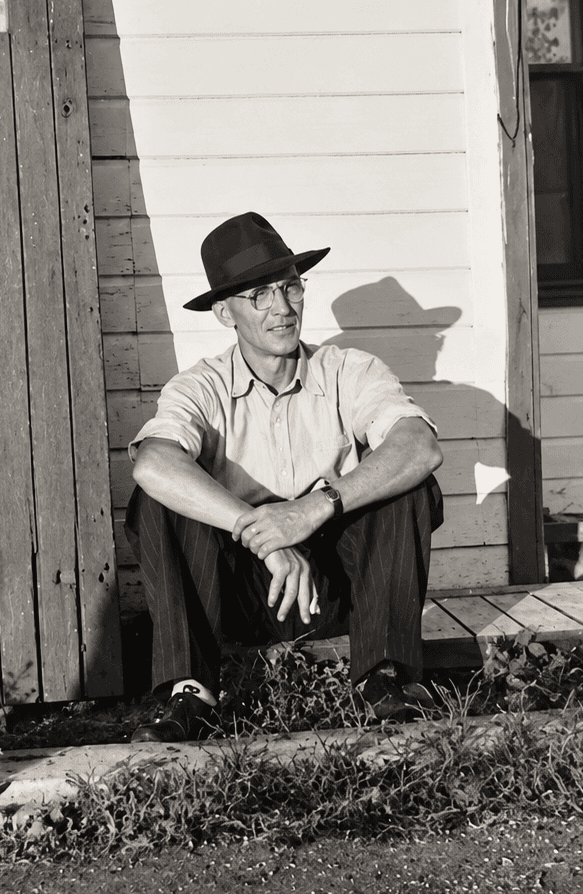
Jack, 1959
He does not appear in the surviving pictures of a family wedding in 1961, although Violet and the children do. That proves nothing on its own, but set beside the 1959 surgery it is worth preserving.
Jack died at Cobourg General Hospital on 3 September 1964, aged fifty seven, after what his obituary called a long illness. The family knows the illness as stomach cancer. Arrangements were through the Templer Funeral Home, and he was buried in Cobourg Union Cemetery on 5 September 1964.
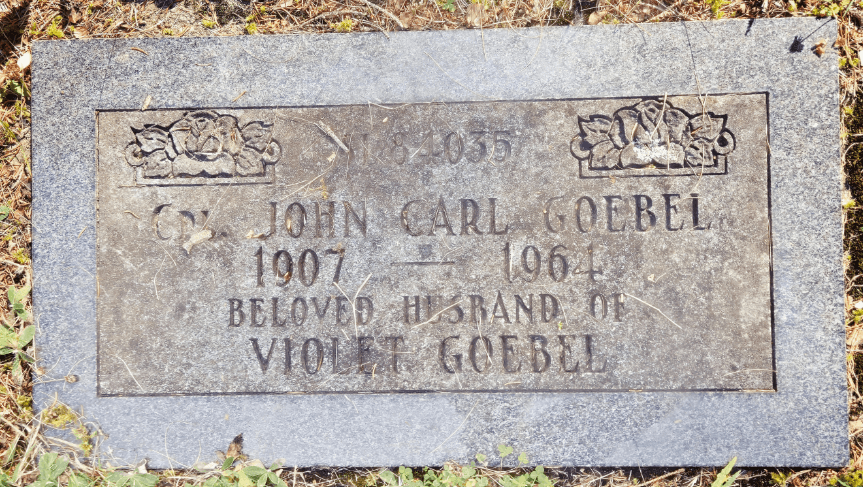
The marker is a flat government pattern veteran's stone, with a maple leaf at each shoulder and his service number across the top:
SL 84035 · CPL. JOHN CARL GOEBEL · 1907 – 1964 · BELOVED HUSBAND OF VIOLET GOEBEL
Sixteen and a half years of his fifty seven were spent in uniform, and the stone records him by rank and number before it records him as a husband.
Violet outlived him. By about 1980 she was living at Strathroy, Ontario, and she is buried in London, not beside him.