Vital Stats
Born
Somerset, England, c. 1844, likely Yatton
Died
Bristol, England, August 26, 1912, age 67
Married
William Charles Rowley Sr., June 29, 1864, Yatton, Somerset
Children
Thirteen, seven living as of 1911
Jane Shepard was born in Somerset, England, around 1844, likely in or near the village of Yatton, and died in Bristol on August 26, 1912, at age 67. The daughter of a farm labourer turned gardener, she entered domestic service as a teenager, married a young Congresbury hawker named William Charles Rowley in 1864, and over the next several decades bore him thirteen children while the family drifted from rural Somerset into industrial Bristol. She buried six of those thirteen children, watched her husband become known as "Charles" rather than William, and lived long enough to see her surviving children move into Bristol's factories and offices — including a son, William Charles Rowley, who would sail for Canada the year after her death. She is remembered on a tall Celtic cross in Bristol simply as "a loving wife, a devoted mother."
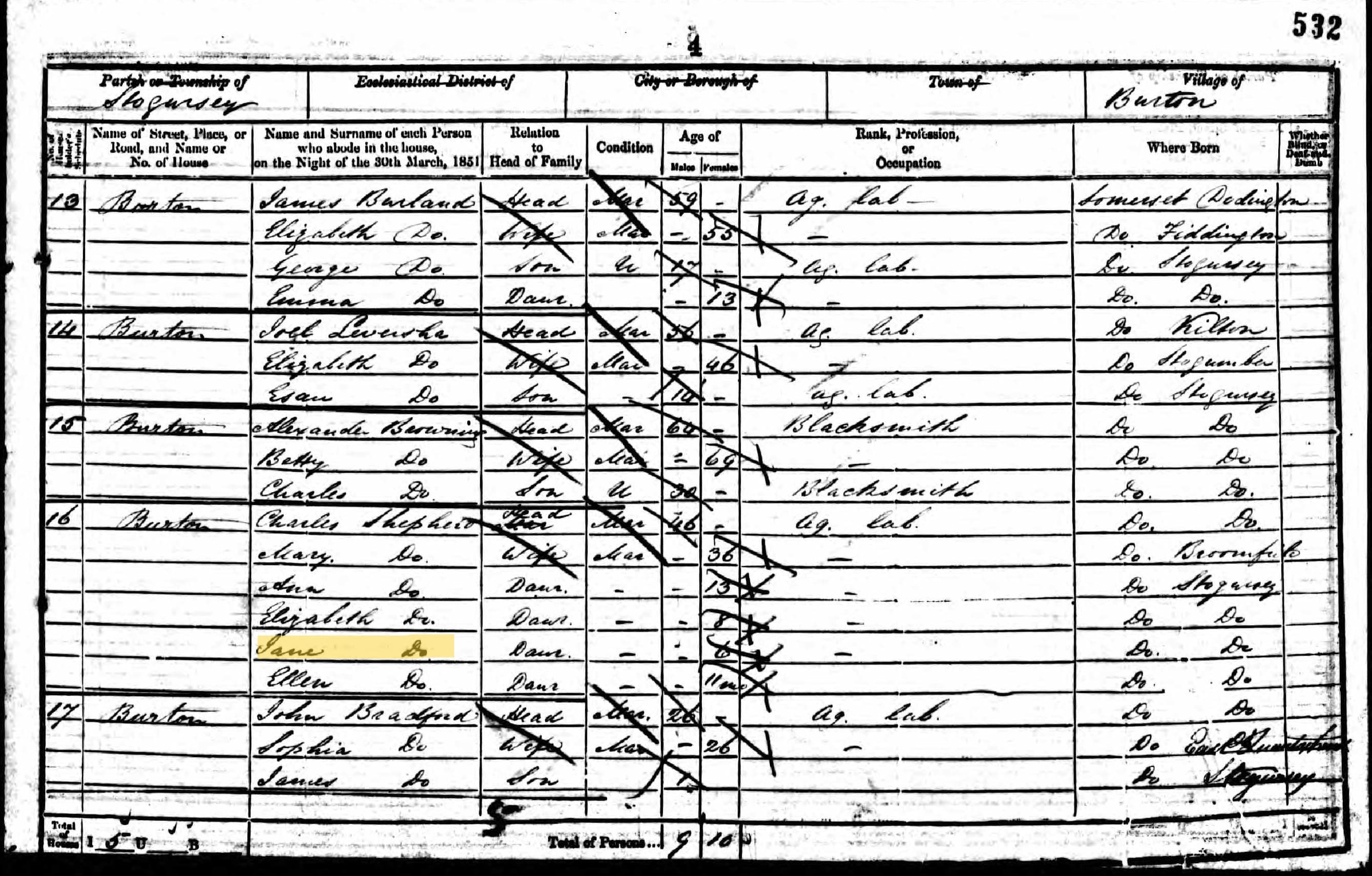
Jane Shepard was born in Somerset in the mid-1840s. The 1844 civil registration index points specifically to Yatton as her birthplace. She grew up in the household of Charles Shepard and Mary Shepard, appearing as a young daughter in the 1851 census. There are several spellings of her last name — Shepard, Shepherd, Shepperd — as is usually seen across different documents.
Charles, her father, was recorded in 1851 as an agricultural labourer, meaning general farm work of whatever kind the season demanded, but by the time Jane married in 1864, he was described more specifically as a gardener, a somewhat more specialized horticultural role. It's not clear whether that reflects a real change in his work or just a more precise description of it, but either way Jane grew up in a household still closely tied to the land.
Yatton itself was a substantial but unmistakably rural Somerset village of a little over 2,000 people; nearby Congresbury, where Jane's future husband lived, was smaller still, at roughly 1,200. The two villages sat only a few miles apart, within the same small network of Somerset communities, and by Jane's childhood, the Bristol and Exeter Railway had already reached Yatton, giving the village a growing connection to the industrial city that would eventually reshape her own life.
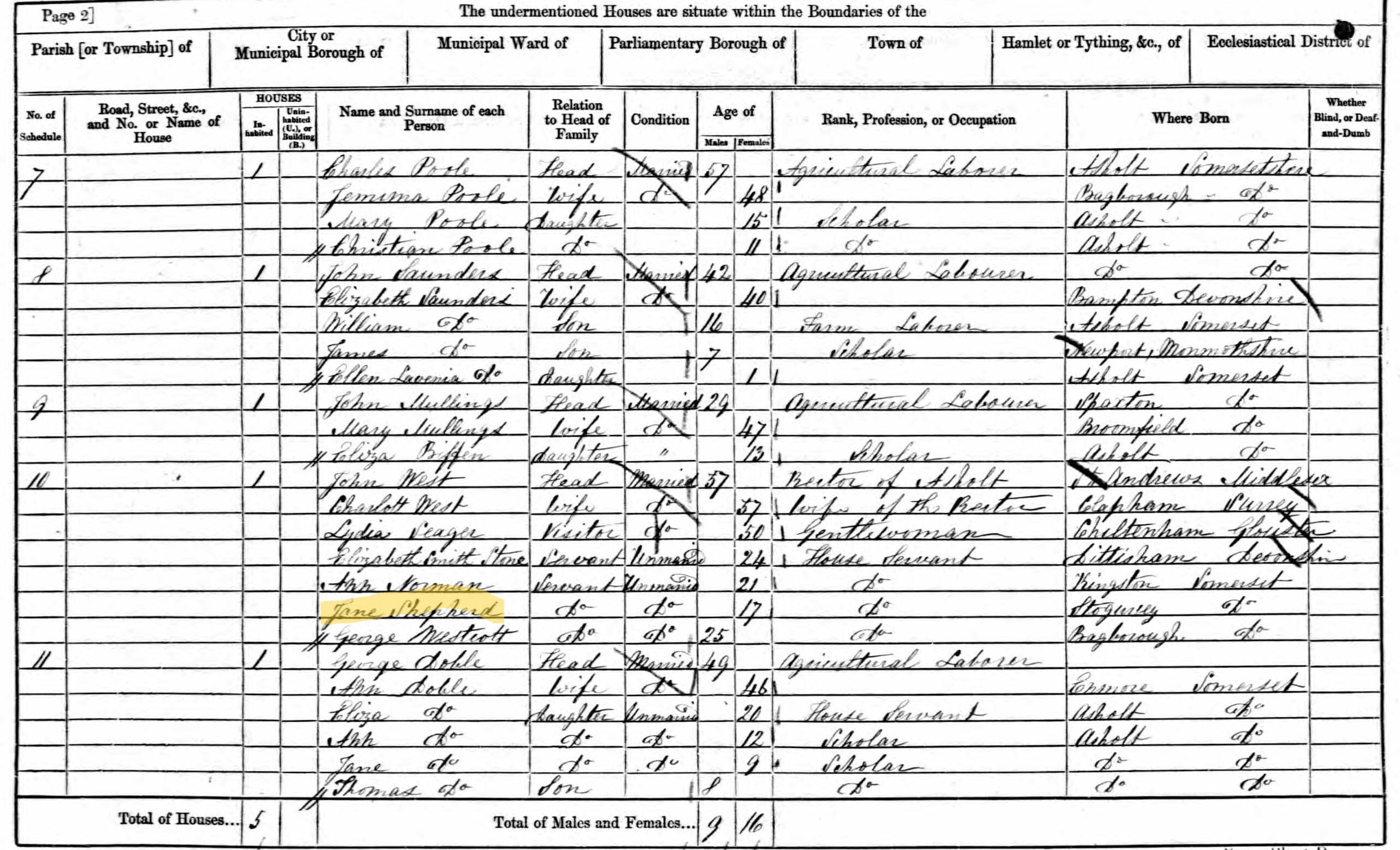
The 1861 census catches Jane at about 17, already unmarried and living away from her parents, working as a house servant in the household of John West, Rector of Ashill. In a small household like a rector's, a single teenage servant effectively became a maid-of-all-work: laying fires, carrying water, scrubbing floors, making beds, helping with meals, washing clothes by hand, and running errands, often starting before the household she served had woken. It may have counted as respectable employment, but it would not have been easy, and at seventeen, Jane was already supporting herself.
Three years later, on three successive Sundays in June 1864, the Yatton parish banns were read for William Rowley, bachelor, of Congresbury, and Jane Shepard, spinster, of Yatton. They married on June 29, 1864 at the parish church in Yatton. William was 22, giving his occupation as a hawker — an itinerant seller who travelled from place to place rather than keeping a shop, his father Thomas noted as a farmer. Jane was 21, her occupation given as servant, her father Charles noted as a gardener. Jane married directly out of domestic service.
A hawker's income was, by nature, irregular — dependent on sales made village to village rather than a guaranteed wage, and shaped by weather, competition, and local demand. That made Jane's role in the household all the more central: as children began to arrive, she would have been the fixed point of family life — managing food, laundry, illness, and household finances while William was often away working the roads.
Sometime after their son William Charles was born, William himself began to be recorded increasingly as Charles rather than William, quite possibly to distinguish father from son now sharing a household. (See William Charles Rowley Sr.'s own page for the fuller picture of that transition, and of his working life as it shifted from hawker to traveller to tanner's labourer.)
By the 1871 census, Jane and William — still near Congresbury — had begun their family, with two small daughters, Annie and Florence, in the household. Over the following decades the family's life became increasingly tied to Bristol and Bedminster, part of the much larger nineteenth-century migration of rural families into Britain's expanding industrial cities. Jane herself had been born into rural Somerset; she would spend the second half of her life in one of Bristol's busiest working-class districts.
The single most striking fact about Jane's life comes from the 1911 census, where she reported her full childbearing history: thirteen children born alive, seven still living, six dead. She had spent a large portion of two decades pregnant, recovering from childbirth, or nursing infants, and had buried nearly half the children she bore, some of whom likely died between census years and left little trace beyond a birth or death registration. Among the children who can be traced across the censuses and parish registers are Annie, Florence, Ellen Jane, Alice, William Charles, Florence Agnes, Minnie, and Frank Ernest; the rest of the thirteen have yet to be reconstructed.
A parish record from May 10, 1882 shows two of the children — William Charles and Ellen Jane — baptized together, not as infant twins but simply on the same day; their father's occupation is given as "traveller," consistent with his hawking trade continuing into the 1880s. The following year, on April 27, 1883, daughter Florence Agnes was baptized in Bedminster, the family living at 29 Whitehouse Street and Charles's occupation now recorded as tanner — a sign of the family's shift from itinerant selling into Bristol's industrial trades.
By 1881, Bedminster held roughly 44,759 people, and greater Bristol more than 200,000 — an enormous change in scale from the roughly 2,000 people of Jane's native Yatton. South Bristol's economy ran on tanning, coal, smelting, glass, tobacco, and other heavy industry, with all the coal smoke and industrial smell that came with it; running a household there, without electricity, refrigeration, or running hot water, and with as many as thirteen children to feed and clothe over the years, would have been physically demanding work in itself, even though census-takers only ever recorded Jane simply as "wife."
By the 1901 census, Charles, about 56, was working as a tanyard labourer, and Jane, about 55, still had three children at home: William C. (about 20, a pawnbroker's assistant), Minnie (about 13), and Frank E. (about 10). Ten years later, in 1911, Charles — now a tanner's labourer in his late sixties — and Jane, married 47 years, were living at 132 East Street, Bedminster; son Frank Ernest, about 20, worked as an agent for the Prudential Assurance Company, and daughter Minnie, about 23, worked in one of Bristol's Wills tobacco factories, one of the district's largest employers. Within Jane's own family, in other words, sits a small version of Victorian Britain's whole economic transformation: a gardener's daughter and a hawker's wife whose children went on to work in factories and insurance offices.
Jane died in Bristol on August 26, 1912, at age 67; the civil death index records her as Jane Rowley, district Bristol. She had been married to William — increasingly known by then as Charles — for nearly 48 years. Her son William Charles Rowley sailed for Canada the following year, in 1913; nothing in the record ties the two events together directly, but the timing is hard to overlook.
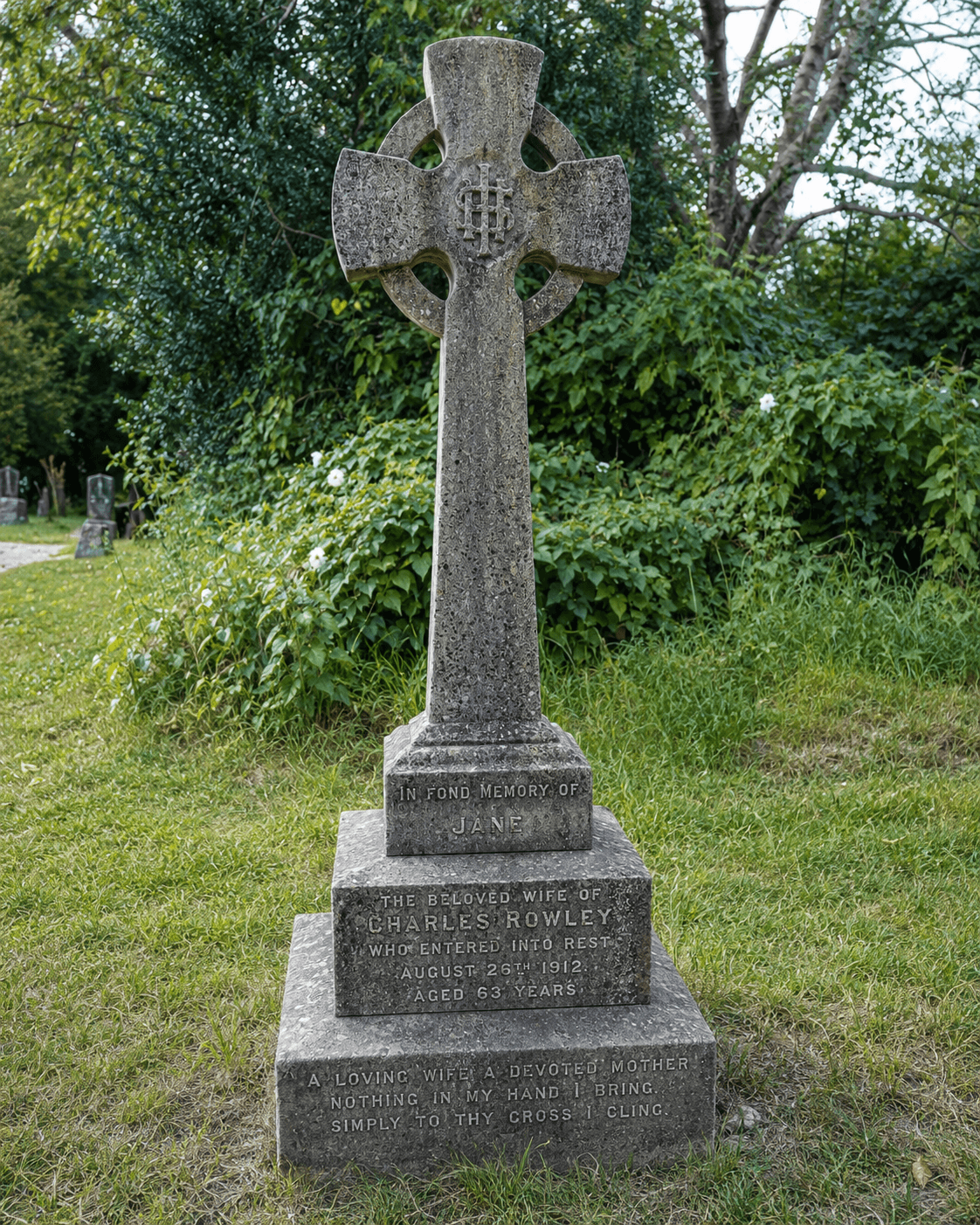
Jane is remembered on a tall Celtic cross, set on a substantial stepped stone base — a scale of monument that likely reflects what her surviving children could pool together to honour her, rather than any wealth of her own. The main inscription reads:
IN FOND MEMORY OF JANE, THE BELOVED WIFE OF CHARLES ROWLEY, WHO ENTERED INTO REST AUGUST 26TH 1912, AGED 63 YEARS
The stated age of 63 sits noticeably lower than the roughly 67–68 years suggested by her likely 1844 birth and 1912 death — one more small inconsistency in a record already carrying several spellings of her surname (Shepard, Shepherd, Sheppard all appear across different documents). The base of the monument carries the words the family chose to define her by:
A LOVING WIFE, A DEVOTED MOTHER. NOTHING IN MY HAND I BRING, SIMPLY TO THY CROSS I CLING.
The closing lines come from the hymn "Rock of Ages," and echo the same explicitly Christian, Anglican language found on her husband's own gravestone. Read against the 1911 census — thirteen children born, seven living, six lost — "a devoted mother" was not simply sentimental Victorian phrasing. It was, plainly, a summary of what her adult life had actually been.