Vital Stats
Born
Kenn, Somerset, England, c. 1842
Died
Bristol, England, August 18, 1929, age given as 84
Married
Jane Shepard, June 29, 1864, Yatton, Somerset
William Charles Rowley Sr. was born around 1842 in the small farming parish of Kenn, in north Somerset, and died in Bristol on August 18, 1929, at an age his gravestone gives as 84. He was the son of an agricultural labourer, lost his mother as a boy, and could not confidently sign his own name — yet he raised a household of thirteen children with his wife, Jane Shepard, and spent his working life on the move: first as a hawker peddling goods door to door through the villages south of Bristol, later as a general labourer and a tanner's labourer in the city itself. Partway through his life he began going by his middle name, appearing in records first as William and later, consistently, as Charles. He buried six of his thirteen children early and, in his last years, his wife of nearly fifty years. He is remembered on a tall Celtic cross in Bristol inscribed simply: "Now the labourer's task is o'er." He was the father of William Charles Rowley, who sailed for Canada in 1912.
The strongest baptismal match for William is dated March 27, 1842, in the parish of Kenn, Somerset — a tiny rural community near Yatton and Congresbury, close enough to Bristol to feel its pull but still entirely agricultural. The register names his parents as Thomas and Harriet Rowley, with Thomas's trade given as labourer.
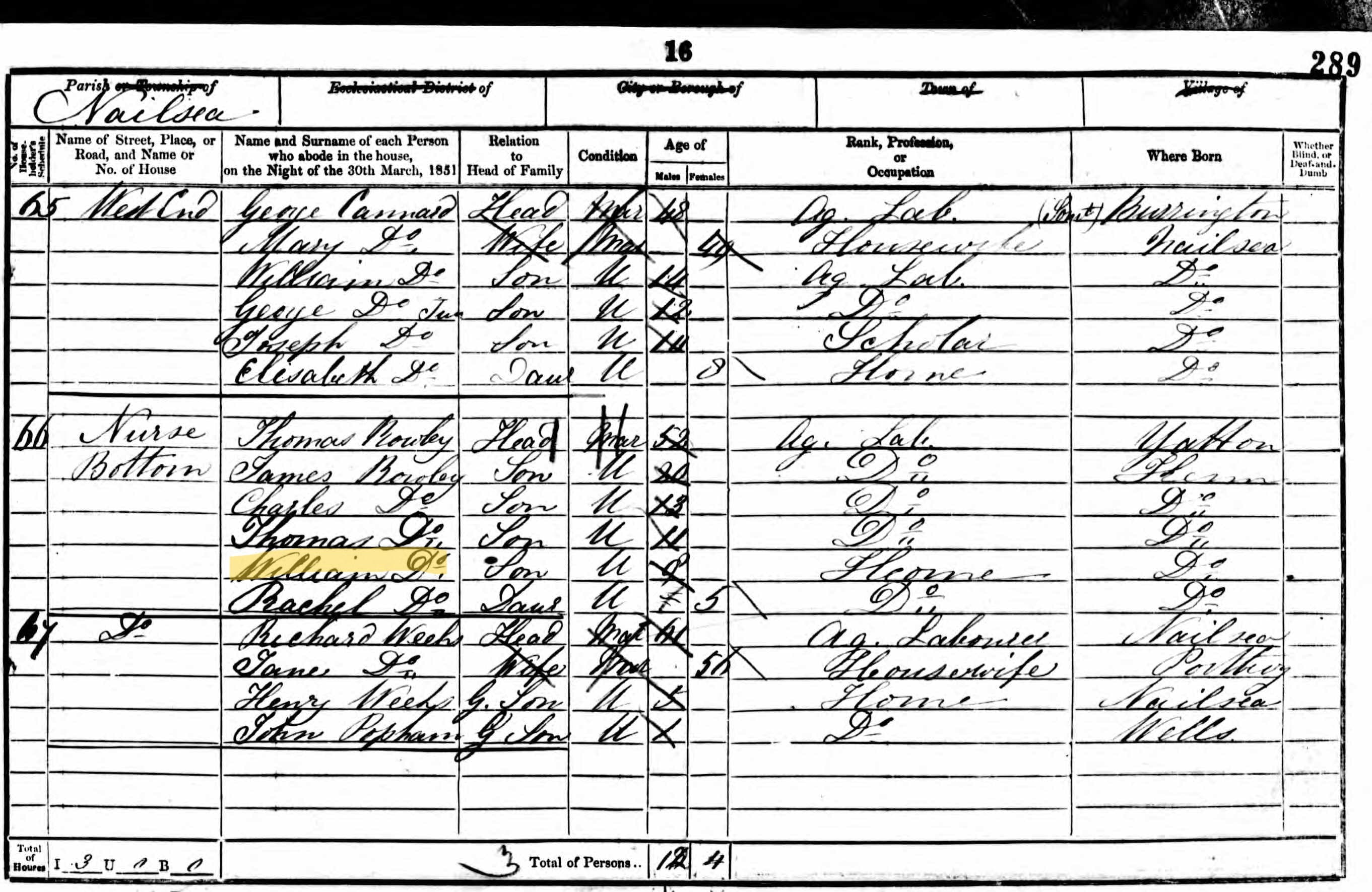
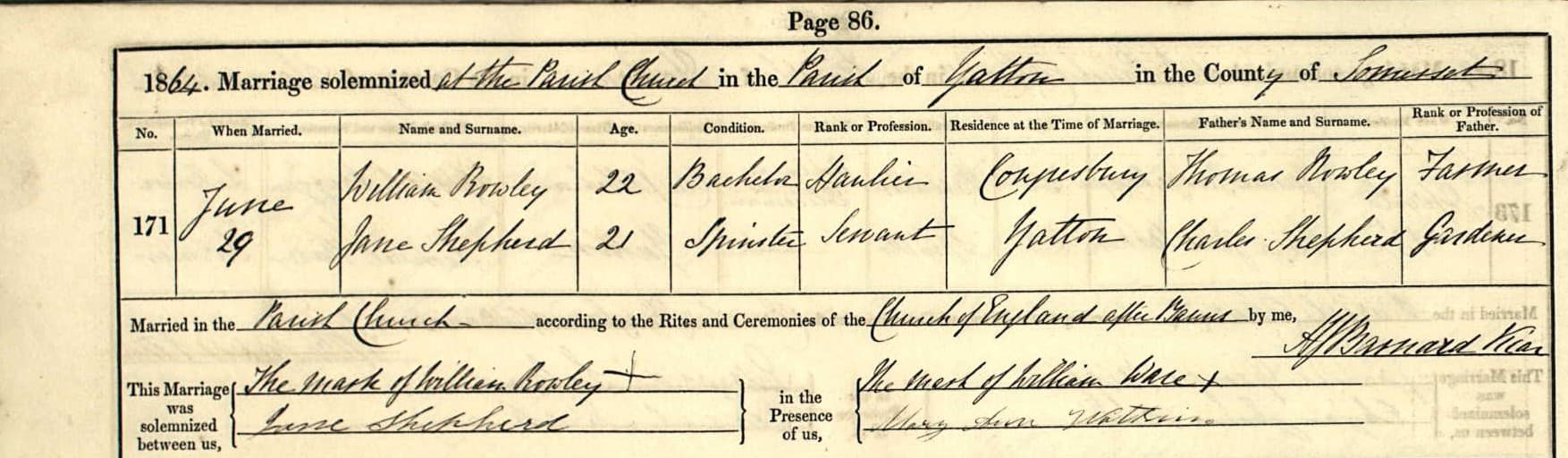
By the 1851 census, a William Rowley of about nine is recorded in a household headed by Thomas Rowley — now a widower. If this is the right family, as the evidence suggests, William had already lost his mother by the time he was nine years old, and grew up in a household with one parent, no money to spare, and no schooling to speak of: the national system of compulsory elementary education was still decades away. When William married in 1864, both he and his bride signed the register with a mark rather than a signature — a plain, ordinary sign of how little formal education either had received.
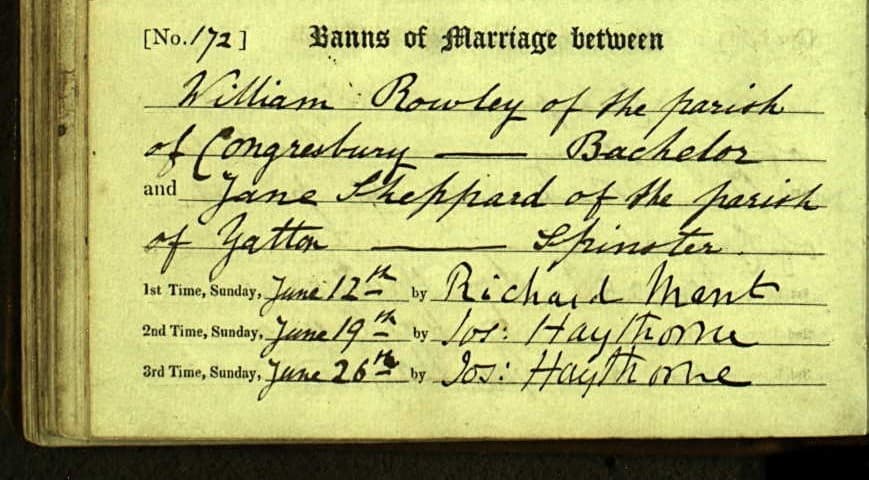
Banns were read at Yatton parish church on three successive Sundays in June 1864 — the 12th, the 19th, and the 26th — for William Rowley, bachelor, of Congresbury, and Jane Shepard, spinster, of Yatton. They married at Yatton on June 29, 1864. William was 22, a bachelor of Congresbury; his father, Thomas, was recorded as a farmer. Jane was 21, working as a servant; her father, Charles Shepard, was a gardener. Both bride and groom made their mark rather than signing their names.
Marriage banns were public announcements of an intended marriage, read aloud in the couple's parish church on three successive Sundays before the wedding (in William and Jane's case, 12, 19, and 26 June 1864, ahead of their 29 June marriage). The point was to give anyone in the community a chance to raise a legal objection such as an existing marriage or a close blood relationship before the ceremony took place. Reading banns was the standard, low-cost route to marriage in the Church of England and continued well into the mid-1900s.
It was the start of a marriage that would last until Jane's death nearly forty-eight years later — and that would produce thirteen children.
By the 1871 census, William and Jane were living at Smallway, near Congresbury, with two small daughters, Annie and Florence. William's occupation was recorded as hawker — a travelling seller who carried goods from village to village rather than keeping a shop, working out of a cart or on foot, relying on regular routes and familiar customers rather than a fixed premises. It was precarious work: income rose and fell with the weather, the roads, and who else was selling the same goods that week. Later records describe William as a "traveller," suggesting the same kind of itinerant trade continued for years afterward — he appears this way at his son William Charles's baptism in 1882, and again as father of the bride at daughter Florence's marriage in 1889.
The family's slow drift toward Bristol over these years mirrors a much larger nineteenth-century story: as the city's factories, tanneries, and railways expanded, rural Somerset families like William's increasingly found their way into its industrial economy. William's father had worked the land; William himself worked the roads between farms and market towns; his own children would go to work inside Bristol's factories and offices.
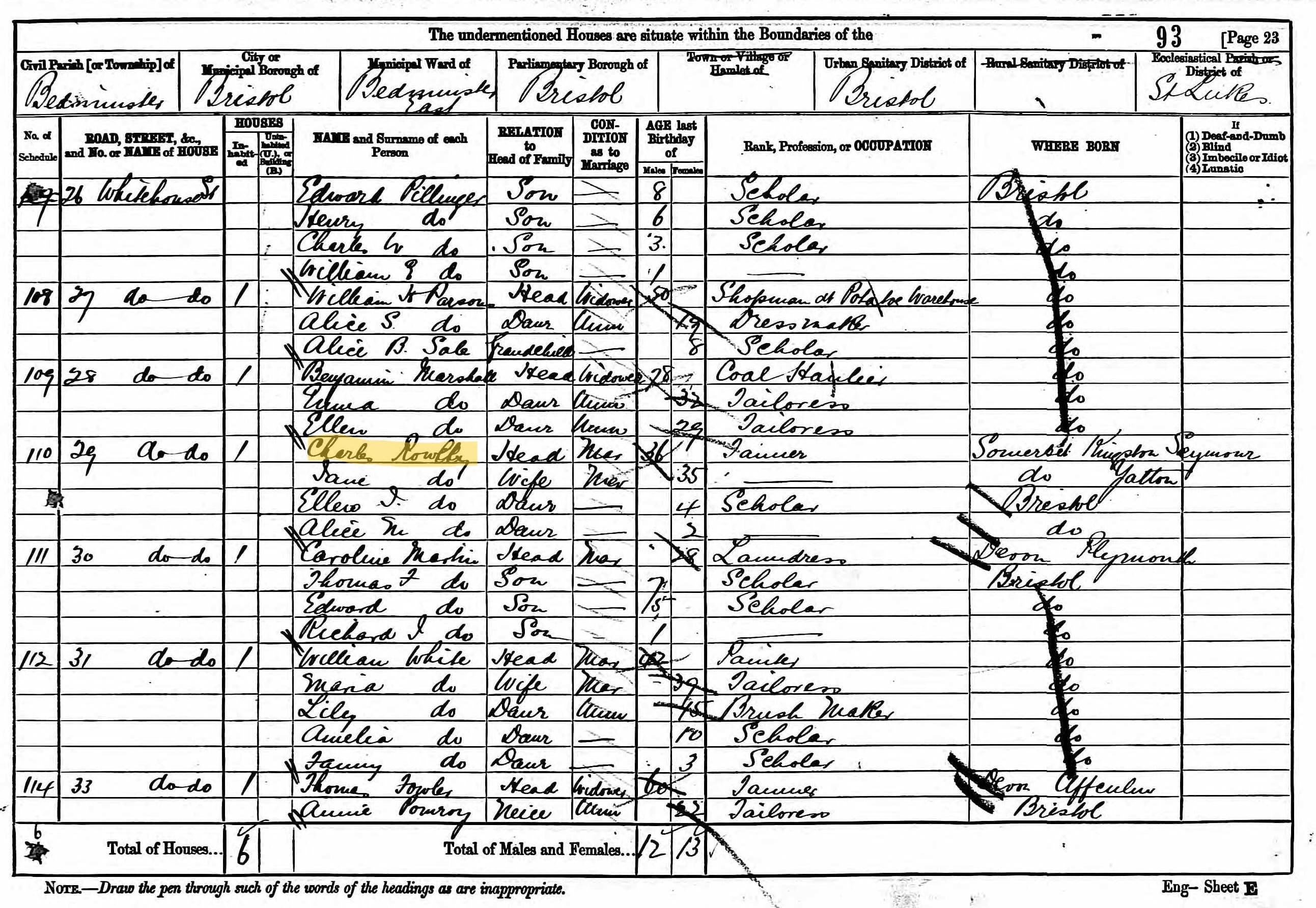
Somewhere between 1889 and 1901, William began going by his middle name. The household that appears in the 1871 and 1881 records as "William Rowley" reappears in 1901 as "Charles Rowley" — same wife Jane, same children (William C., Minnie, Frank R.). By 1911, Charles and Jane reported having been married 47 years, which lines up exactly with their 1864 wedding — the detail that ties the two names conclusively to one man. Why he made the switch isn't recorded; he may simply have preferred his middle name later in life. From 1901 onward, family and official records alike call him Charles.
By 1901 he was working as a general labourer; by 1911, in his late sixties, as a tanner's labourer — physically hard, unpleasant work cleaning and treating hides in one of Bristol's tanneries. He was still working manually into old age, in an era with no pension to fall back on.
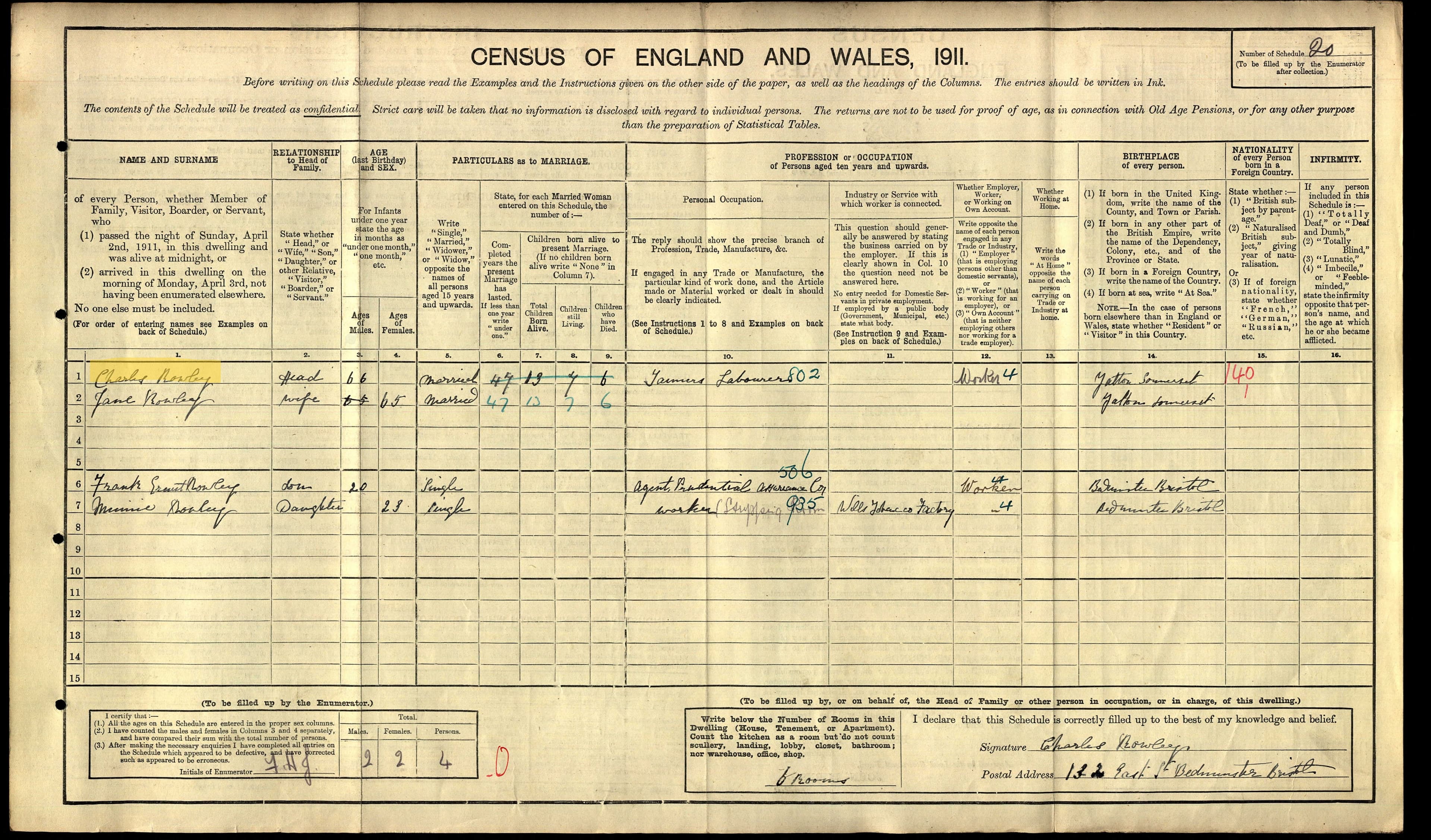
The single most striking fact in William and Jane's record comes from the 1911 census, where Jane reported the couple's full childbearing history: thirteen children born alive, seven still living, six dead. Nearly half their children did not survive to see 1911. Among the children who can be traced in the records are Annie, Florence, William Charles (who would go on to marry Rosella Vincent and emigrate to Canada), Minnie, and Frank.
This was an ordinary tragedy for a working-class family of the period, living without reliable healthcare, sanitation, or any social safety net — but it is no less a defining fact of William and Jane's life together for being ordinary. By 1911, the surviving children were moving into steadier work than their father had ever known: Minnie in Bristol's tobacco trade, likely at the Wills works, and Frank with the Prudential Assurance Company.
Jane died in 1912, after nearly forty-eight years of marriage; her gravestone remembers her as "the beloved wife of Charles Rowley." Their son William Charles Rowley sailed for Canada the following year, in 1913. Nothing in the record proves a direct connection between the two events, but the timing is hard to ignore: within about a year of losing his mother, William Charles left the country his family had lived in for generations.
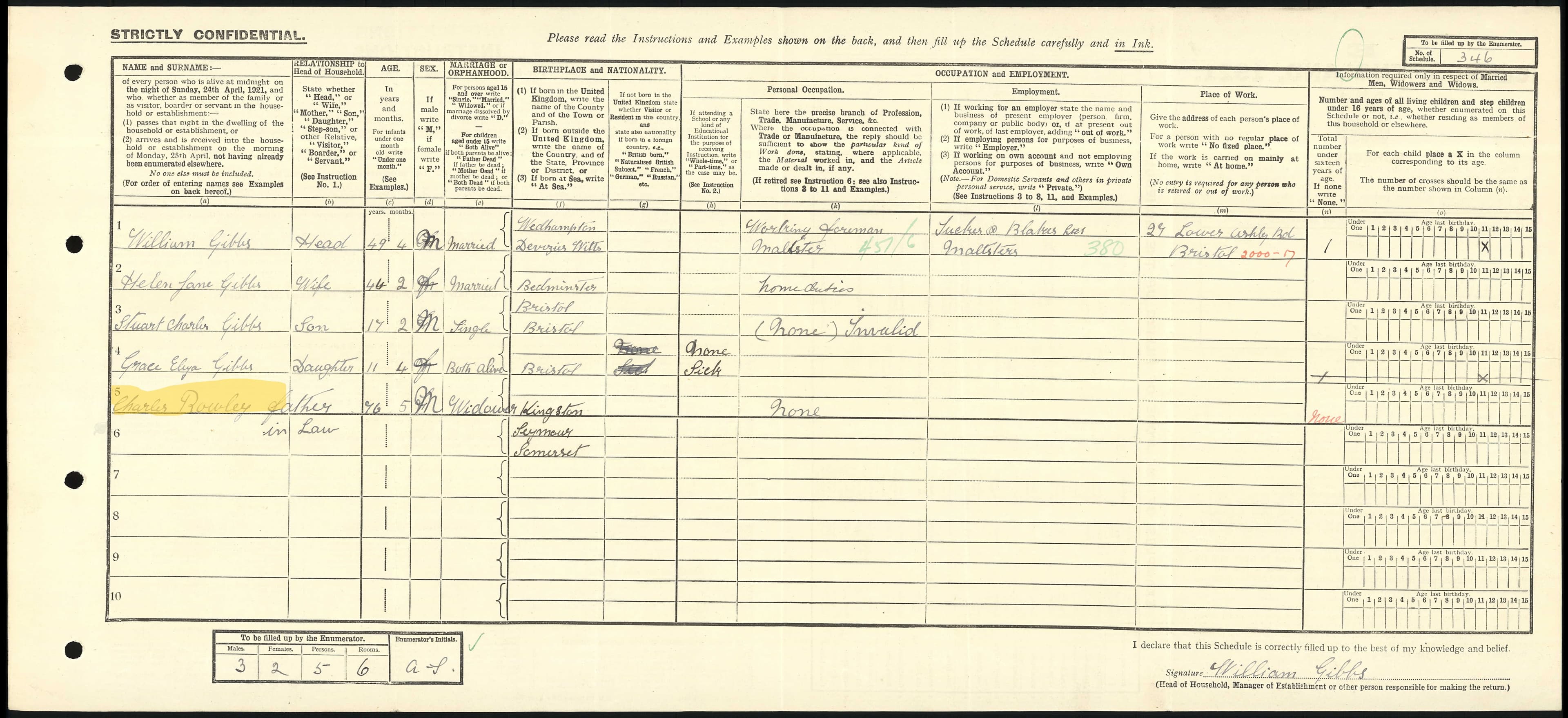
By the 1921 census, Charles — now a widower in his mid-seventies — was no longer keeping his own household. He was living with his married daughter, Helen Jane Gibbs, and her husband, William Gibbs, recorded in their home as "father-in-law." His birthplace is given there as Kingston Seymour, Somerset — a slightly different parish than the Kenn and Congresbury references found elsewhere, though all of them sit within the same small stretch of north Somerset countryside, and such small inconsistencies were common in how birthplaces got recorded from one census to the next.
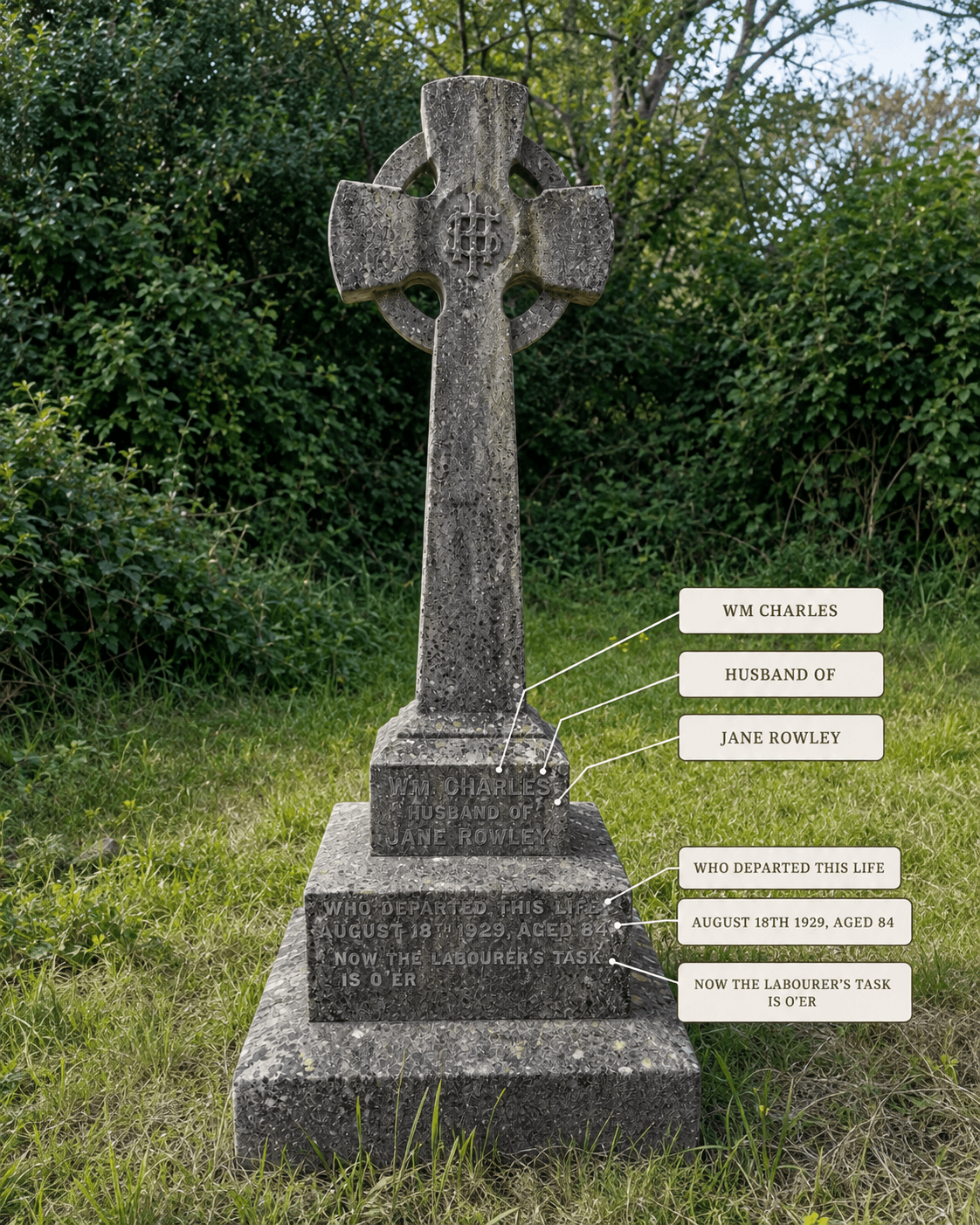
Charles Rowley died in Bristol on August 18, 1929. His gravestone gives his age as 84, which would put his birth around 1844–45 — a few years later than the 1842 baptism, 1851 census, and 1864 marriage record all independently support. The earlier documents, made closer to his actual birth and consistent with one another, are the more reliable guide; the gravestone age is worth preserving as part of the record.
His grave is marked by a tall Celtic cross on a heavy stepped base — a substantial monument for a man whose own records describe him, again and again, simply as a labourer. Its scale likely reflects what his children could pool together to honour him, rather than any wealth of his own. At the centre of the cross is the IHS Christogram, an ancient monogram for the name of Jesus, fitting with the family's Anglican faith.
Beneath it runs the inscription: "Now the labourer's task is o'er."
For William Charles Rowley Sr., who spent his working life as a hawker, a traveller, a general labourer, and finally a tanner's labourer, the word "labourer" in that epitaph was not a figure of speech. It was simply what he had done, for the whole of a long working life — and his family chose to make that fact, rather than hide it, the center of how they wanted him remembered.