Eliza Chandler, February 9, 1870, Fenstanton, Huntingdonshire
Emigrated
Summer 1882, aboard the Allan Line steamship Sarmatian, Britain to Quebec, destined for London, Ontario
Died
October 16, 1930, age 87, Oakland Cemetery, Longwoods Road, Mosa Township, Ontario
0:00 / 0:00
Listen to Samuel's storyRecorded account, approx. 36 min
His Story
Samuel Thompson spent about thirty-nine years in England and forty-eight in Canada. The English half was lived inside a circle a few miles across. So was the Canadian half. In between there was one ocean crossing, made at the age of thirty-nine, in the same year his farming business collapsed.
The village he came from
Farcet sits just south of Peterborough, on the western edge of the English fens. It was small. The population was 363 in 1801 and 756 in 1851, when Samuel was a boy. It did not even become a civil parish in its own right until 1866, when he was in his twenties.
The soil was fen and loam over clay and gravel. Alongside the farms ran a second economy, brickworks strung out along the main railway line north from London. Farcet clay went into the bricks that built late Victorian England. Samuel did not take that road. He took his father's.
There is one thing that happened in his childhood worth knowing, because he would have watched it and it certainly impacted his livelihood.
A few miles from Farcet lay Whittlesea Mere, the largest lake in lowland England, roughly six miles across and only two to seven feet deep. It was drained in 1851 and 1852. Samuel was about eight years old. In the space of a year or two, the biggest natural feature in his part of England ceased to exist and became fields.
That was the confidence of the generation that raised him. You could make farmland out of water. What took longer to become obvious is that drained peat shrinks. The land sinks, the drains have to be pumped harder, and the drainage rates keep coming whatever the harvest does.
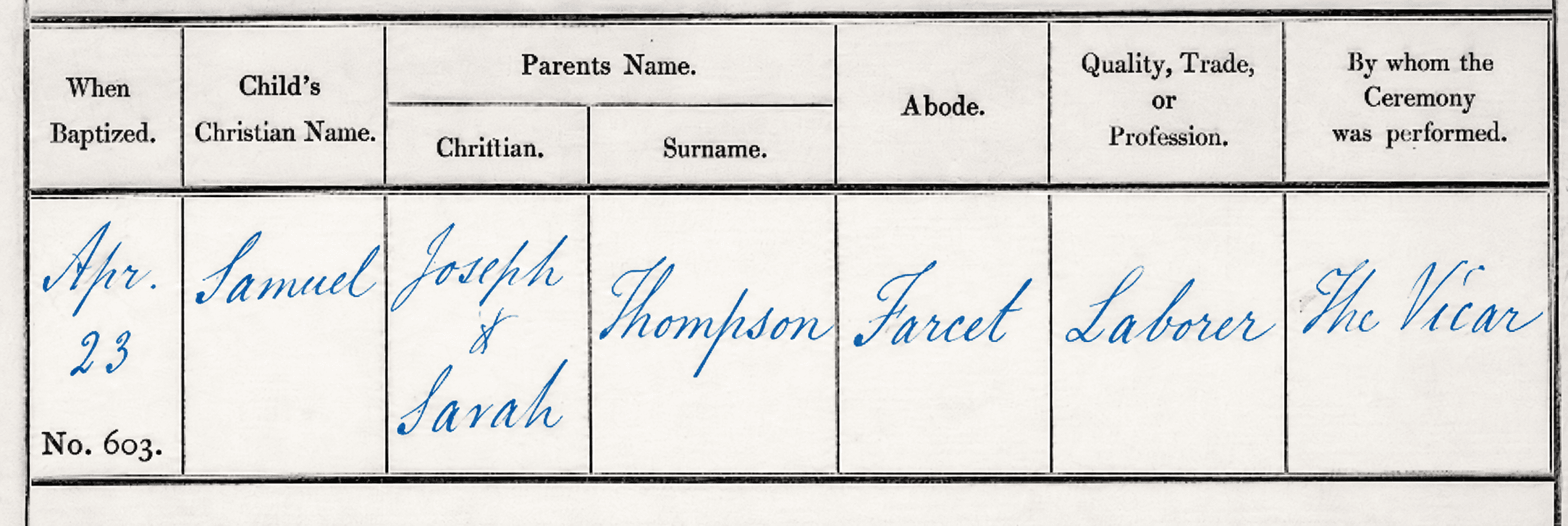
Samuel's baptism record
Marriage, 1870
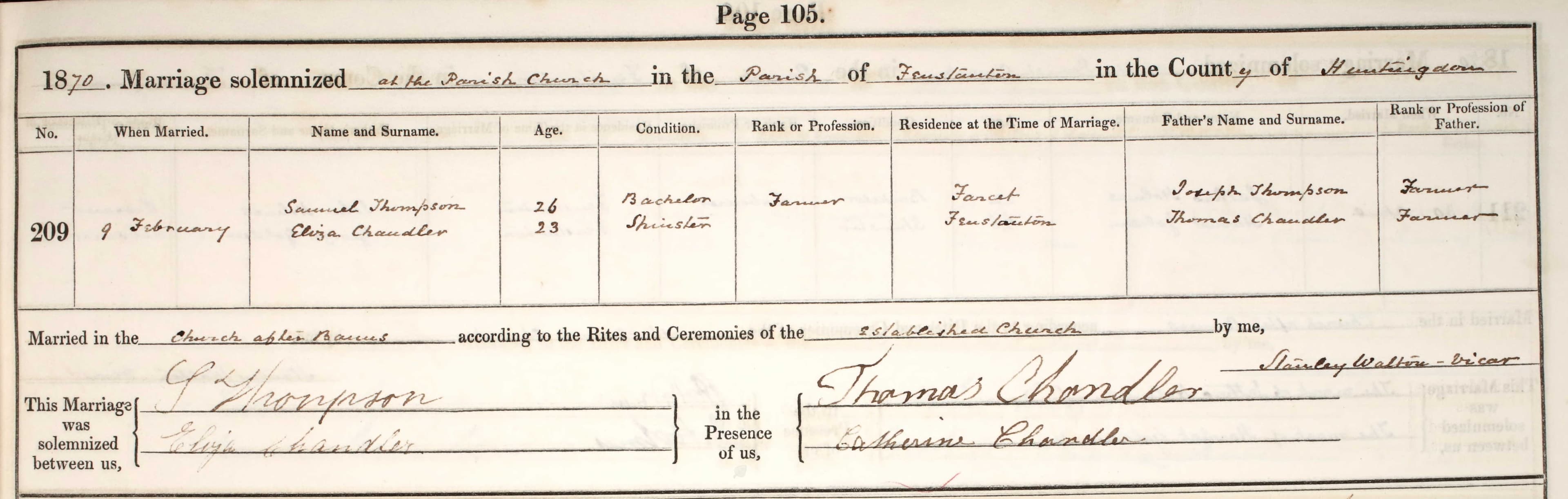
On 9 February 1870, Samuel Thompson married Eliza Chandler at the parish church of Fenstanton, Huntingdonshire.
He was 26, a bachelor, and already describing himself as a farmer, living at Farcet. She was 23, of Fenstanton, about twenty miles west near St Ives, on the Great Ouse. Both fathers were farmers: Joseph Thompson and Thomas Chandler. Thomas Chandler signed as a witness at his daughter's wedding, alongside Catherine Chandler.
Two farming families joining. It is the most ordinary document in this file and, in hindsight, the last uncomplicated moment in it.
Samuel and Eliza's marriage document
Fifty acres by 1871
The 1871 census finds the couple at Farcet Fen. Samuel was about 28. The entry reads: farmer of 50 acres employing one man. Their first child, Walter, was ten months old.
Fifty acres is worth pausing on, because the word "farmer" can suggest something grander than this was. Fifty acres with a single hired hand is a small working holding. It is a family that farms its own ground and has very little margin. Samuel's entire livelihood sat on fifty acres of reclaimed peat.
Ten years later, in 1881, they were still there, with three children in the house: Walter, about 10, Stanley J., about 2, and Mary C., about 1.
The census entry looks stable. It was not.
1882
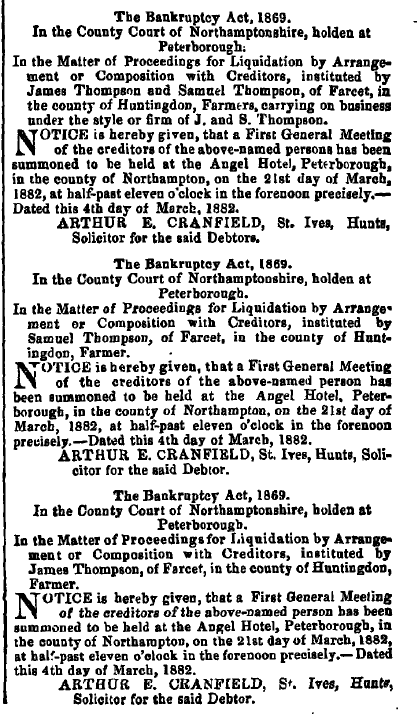
On 7 March 1882, three notices appeared side by side on a single page of the London Gazette.
The first concerned James Thompson and Samuel Thompson, of Farcet, Hunts, carrying on business under the style or firm of J. and S. Thompson, Farmers. The second concerned Samuel alone. The third concerned his brother James alone.
All three announced proceedings for Liquidation by Arrangement or Composition with Creditors in the County Court of Northamptonshire at Peterborough. All three summoned creditors to a first general meeting at the Angel Hotel, Peterborough, on 21 March 1882 at half past eleven in the morning. All three named the same solicitor, Arthur E. Cranfield of St Ives.
Bankruptcy announcement
Why it happened
Samuel's farm did not fail because Samuel was a bad farmer. It failed at the worst moment in English farming for a century.
The agricultural depression that ran from 1873 to 1896 was caused by the opening of the American prairie and the collapse of the cost of moving grain across the Atlantic. American railway mileage tripled between 1860 and 1880. Freight rates from Chicago to Liverpool fell by roughly two thirds. Cheap wheat poured into Britain. Prices fell from about 56 shillings a quarter around 1870 to 27 shillings by the 1890s. Britain's dependence on imported grain went from about a quarter to nearly half.
On top of the price collapse came bad harvests in 1875, 1877 and 1878, and then the cold, sodden summer of 1879, the worst agricultural year of the century.
The distress was severe enough that the government appointed a Royal Commission on the Depressed Condition of the Agricultural Interests. It sat from 1879 to 1882. It was still sitting when Samuel and James walked into the Angel Hotel.
A small arable holding on reclaimed fen, carrying rent, drainage rates and a hired man, hit by four bad harvests in five years and then by permanently cheaper foreign grain, had nowhere to go. The 1881 census counted 92,250 fewer agricultural labourers in England and Wales than 1871. Samuel was one very small part of a very large fact.
The crossing
No document says "we are leaving because the farm failed." The connection is an interpretation. But the interval is short between selling everything and the departure. Creditors met on 21 March 1882. That summer, Samuel, Eliza and three children were aboard the Allan Line steamship S.S. Sarmatian, bound for Quebec, with a stated destination of London, Ontario.
The arithmetic of that voyage is the heart of this story: Samuel was 39, Eliza was 35, Walter was about 12, Stanley was about 3 and Mary was about 2.
This was not a young man chasing an adventure. It was a middle-aged couple with a toddler, leaving behind a trade, a village, a church and two sets of relatives, because the alternative was worse.
Glencoe, Ontario
The family gave London, Ontario as their destination and settled about thirty miles southwest of it, at Glencoe in Mosa Township.
What made Glencoe itself was the railway. The Great Western main line reached it in 1853. Then it became a junction: the Great Western Railway main line, 1853, later Grand Trunk, later Canadian National; the Canada Air Line branch, 1873, a more direct route toward Detroit and Buffalo; the Canadian Pacific Railway, 1889, part of the CPR London-to-Windsor main line; and a Grand Trunk loop line northwest to Alvinston, 1891.
Read that against the family. Samuel arrived in 1882 with a three-year-old son named Stanley. In 1889, when Stanley was about ten, the CPR drove a brand-new main line straight through the town he was growing up in.
Stanley James Thompson did not accidentally end up in the railway business. He grew up in a junction town during a railway boom.
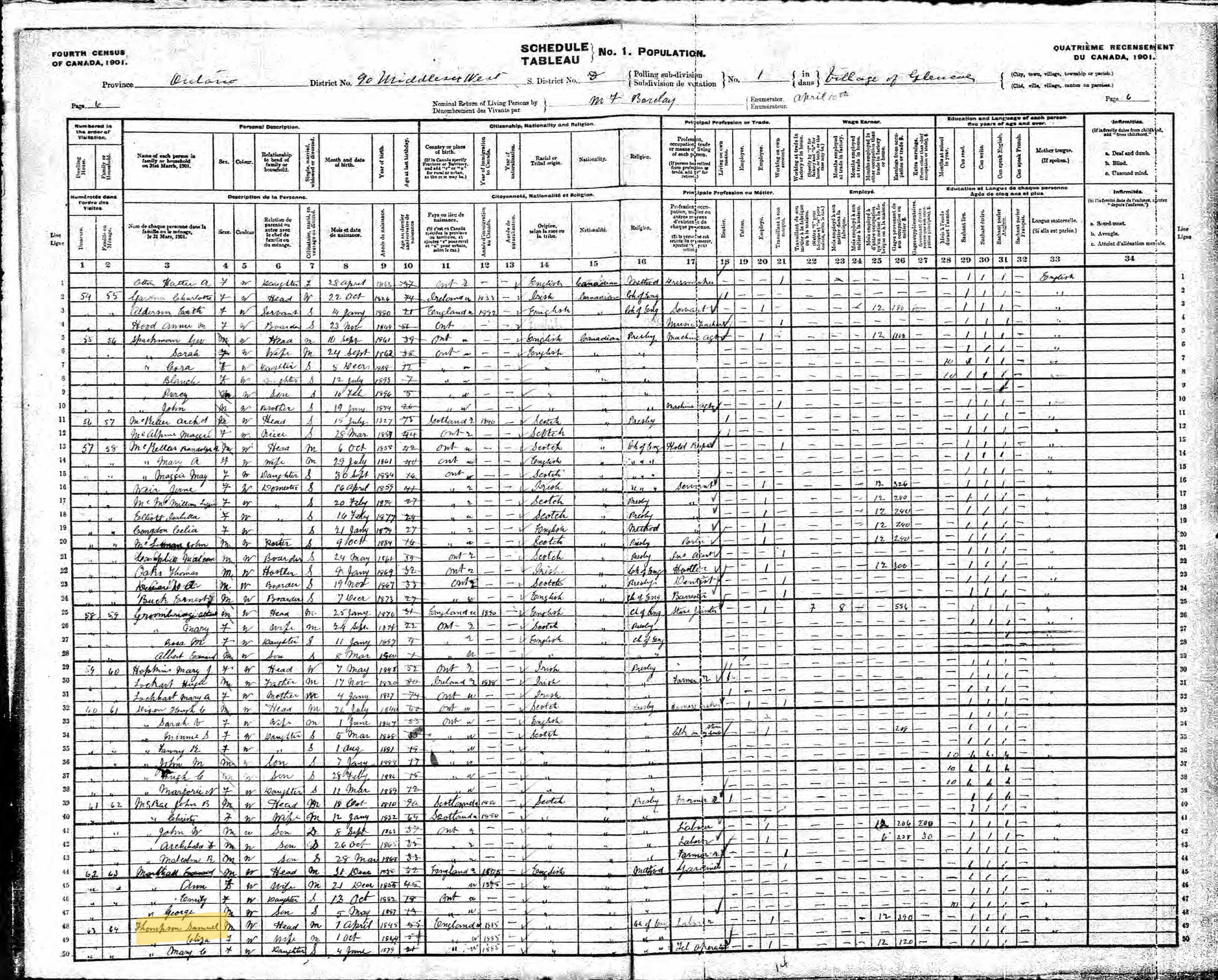
1901: what the census says
By 1901 Samuel and Eliza were living in the village of Glencoe, Middlesex West, with their daughter Mary.
1901 Census
Two things stand out.
Mary was a telegraph operator. In a town with four railways running through it, telegraph work was railway work. So by 1901 the railway had taken not just Stanley but the household. The son went to the CPR and the daughter sat at a telegraph key.
Samuel was a labourer. That is the hard line in this story and it should not be smoothed over. Nineteen years after arriving, a man who had farmed fifty acres of his own ground in England was working for wages at 55. Whatever Canada gave this family, it was not a restored farm. The second act was survival and a foothold for the children, not a return to what had been lost.
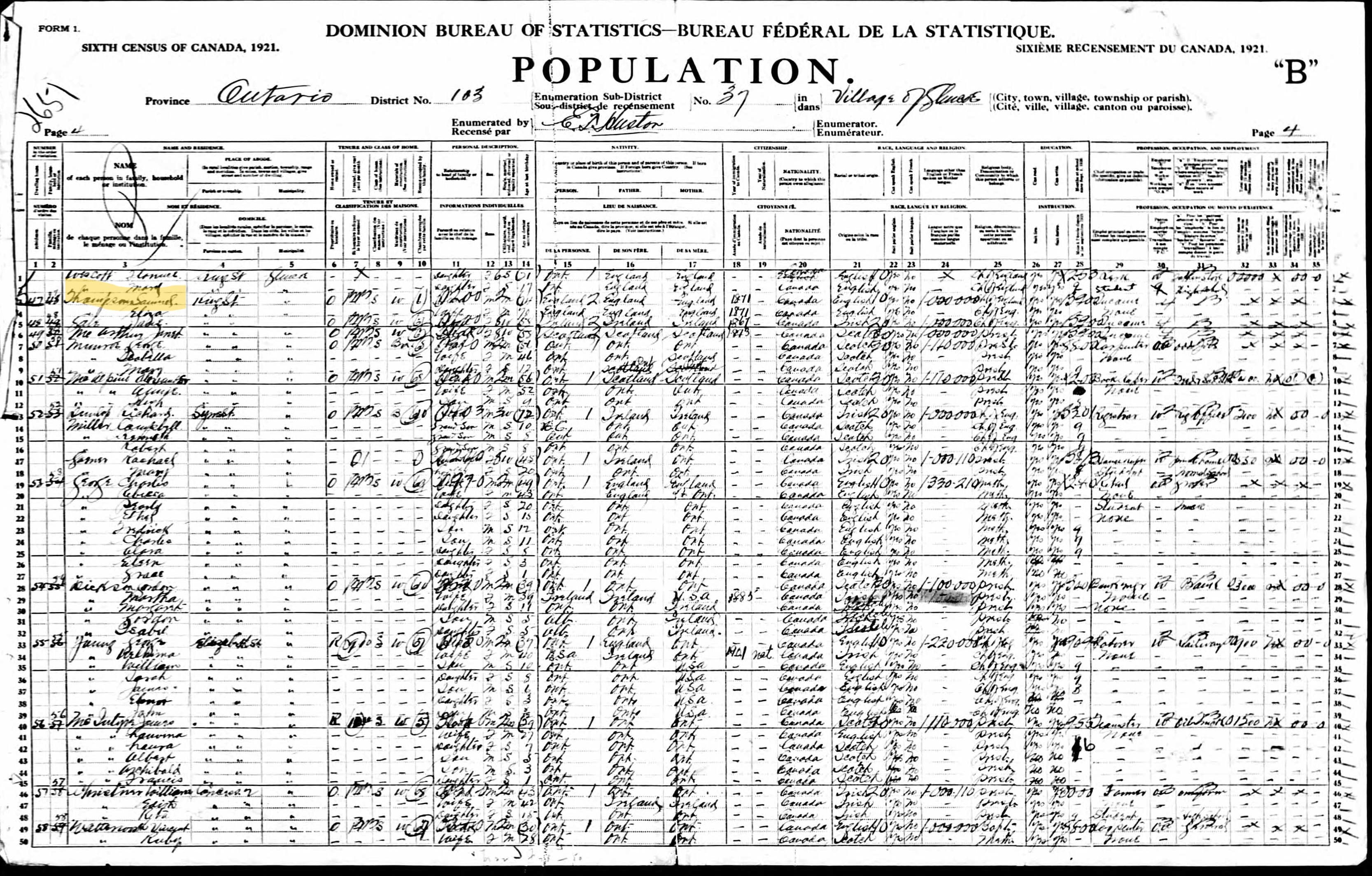
1921 Census
The 1921 census finds them still in the Village of Glencoe, on King Street, indexed under a garbled version of the surname. Samuel and Eliza, married, English born, with English born parents, living by themselves. Two people in their seventies on a village street, their children grown and gone. It is the only specific Canadian address we have for them.
Final resting place
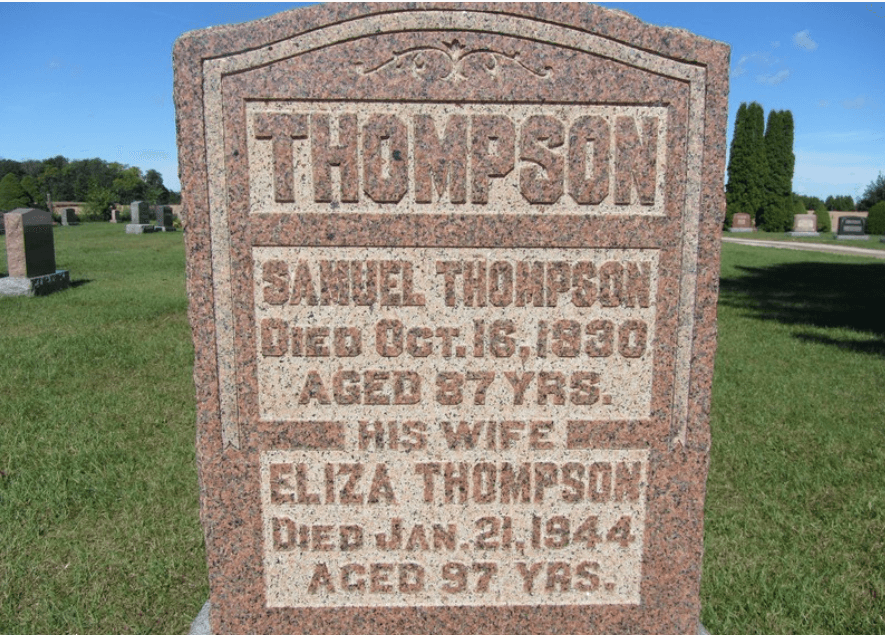
Samuel Thompson died on 16 October 1930, aged 87. He is buried at Oakland Cemetery on Longwoods Road, in the historic Mosa Township. The stone reads:
SAMUEL THOMPSON DIED OCT. 16, 1930 AGED 87 YRS.
Oakland Cemetery had opened only in May 1894, established by a board of ten local men on five acres bought from a nearby farmer. So Samuel and Eliza did not inherit a family plot. They bought into a burial ground that was founded twelve years after they landed in Canada, and they chose the new community cemetery rather than the older Presbyterian ground in the village. For an English, Church of England family living among Scottish Presbyterians, that is a small but real signal about where they fitted.
The same stone carries Eliza:
HIS WIFE ELIZA THOMPSON DIED JAN. 2, 1944 AGED 97 YRS.