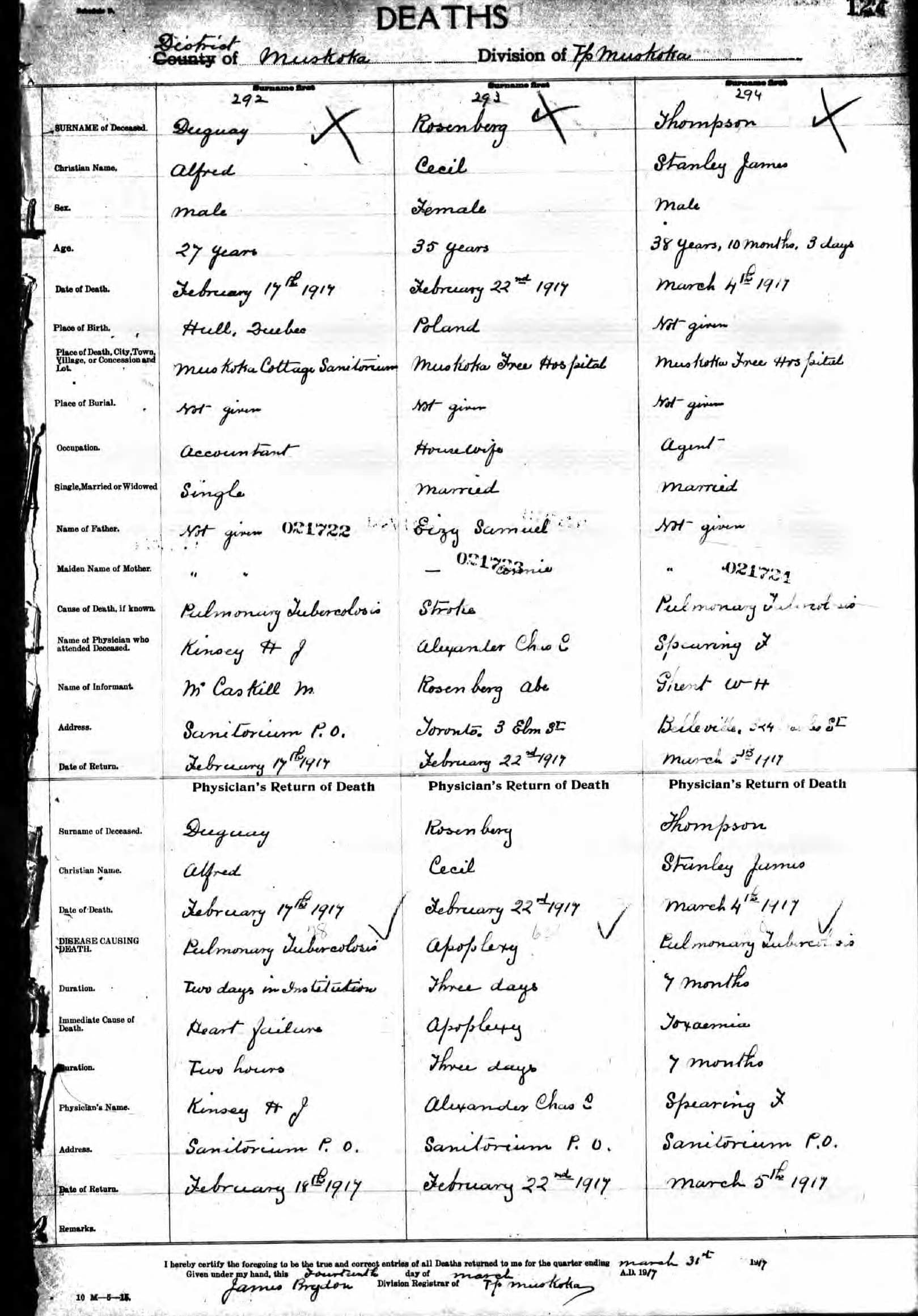
Stanley James Thompson was born about 1 May 1878 at Farcet in Huntingdonshire, the son of a fenland farmer working fifty acres. Before he was four years old the farm failed and the family sailed for Quebec. He grew up in Canada, went to work for the Canadian Pacific Railway, and by 1906 was the CPR agent at Bothwell in Kent County, where he married Laura McGaffey. In 1911 the census taker found the family living not on a lot and concession like their neighbours but on the railway's own right of way, and recorded that Stanley earned eight hundred dollars a year and carried a thousand dollars of life insurance. Sometime after that the company moved him roughly four hundred kilometres east to Brighton, on a line the CPR had only just built. His youngest son, George Arthur, was born there in July 1916. By then Stanley had been ill for about a month. He died at the Muskoka Free Hospital for Consumptives on 4 March 1917, aged 38 years, 10 months and 3 days, of pulmonary tuberculosis, and left Laura with five children under eleven.
Where he came from
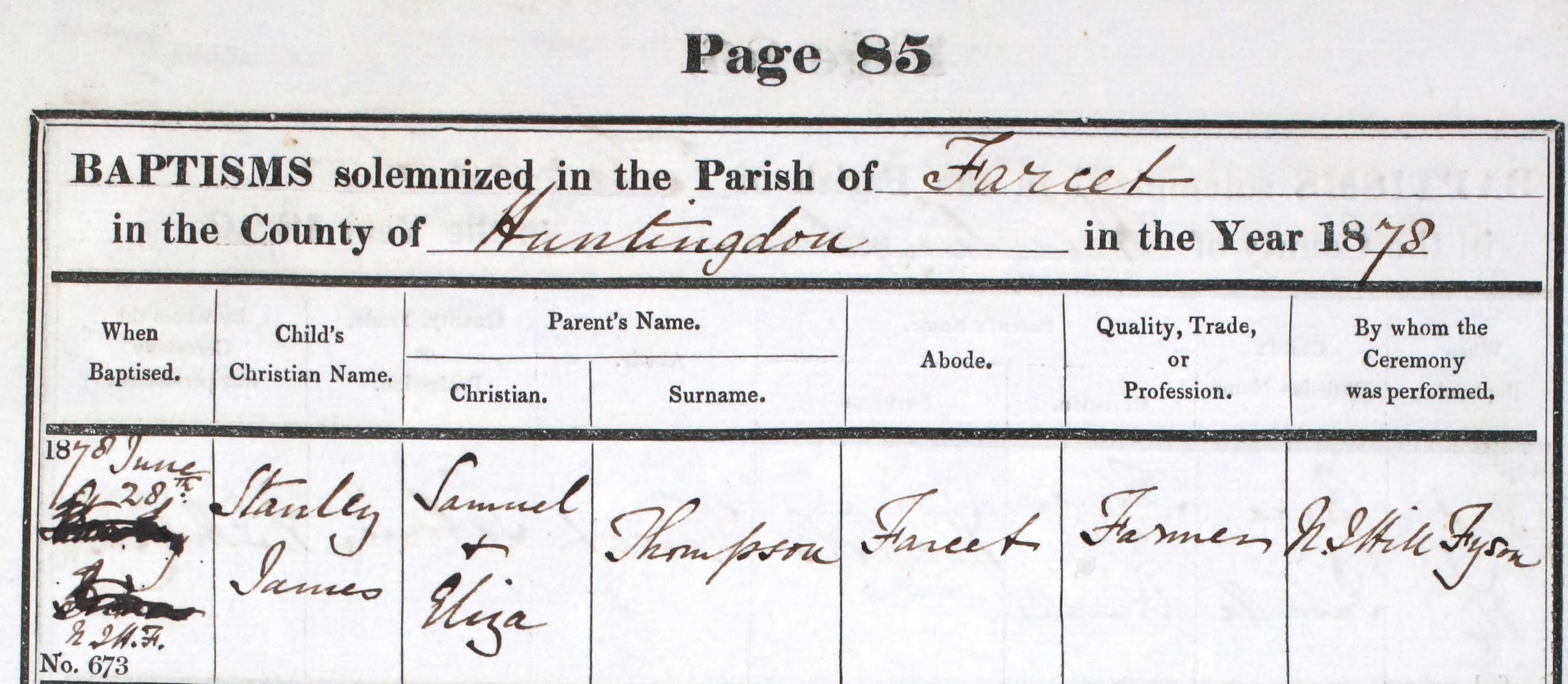
Stanley was baptized at Farcet, a chapelry on the drained fen just south of Peterborough, on 28 June 1878. His father was Samuel Johnstone Thompson, a farmer of fifty acres employing one man. His mother was Eliza. In 1881 the household was Samuel, Eliza, Walter aged ten, Stanley aged two, and a servant. A sister, Kate, followed.
In March 1882 Samuel and his brother James, who farmed together as J. and S. Thompson, called their creditors together at the Angel Hotel in Peterborough and surrendered their affairs. British arable farming was in the worst of the great agricultural depression, and a fifty acre tenant holding had no cushion against it.
Fifteen weeks later the whole family sailed from Liverpool on the Allan Line steamer Sarmatian, bound for Quebec and then Toronto. Stanley was four.
The missing years, 1882 to 1901
This is still the largest gap in the record and no Canadian document has been found for Stanley between the age of four and the age of twenty two.
What can be said is that the family's Canadian geography is not random. By 1901 his mother Eliza was living at Glencoe in Middlesex County. Glencoe is mile 29.7 on the Canadian Pacific line from London to Windsor, and Bothwell, where Stanley would marry and settle, is mile 41.3 on the same line. Twelve miles apart, one railway, and it is the railway he made his career on. The line was built by the Ontario and Quebec Railway, leased to CP in 1884, and opened in 1890, when Stanley was about twelve.
Whether he learned telegraphy at a station on that line is unknown, but that is how the trade was normally entered: a boy hung around the station, learned the key, and was given a small office of his own in his late teens.
Milton, 1901: the boarding house
There is a 1901 census entry showing Stanley in district 68 Halton, town of Milton, north ward, enumerated 24 April 1901. Household 21 is a boarding house, and the first three entries on the page are all boarders. The household's head is not on this page, which means the household began at the foot of the previous one.
- Ryan, Frank, boarder, single, C.P.R.
- Thomp[son], Stanley, boarder, single, born 1 May 1879, Operator C.P.R.R., twelve months employed
- Mead, William, boarder, single, carpenter
Milton sits on the CPR's Galt subdivision. This is a house full of railway men.
Bothwell: the agent on the right of way
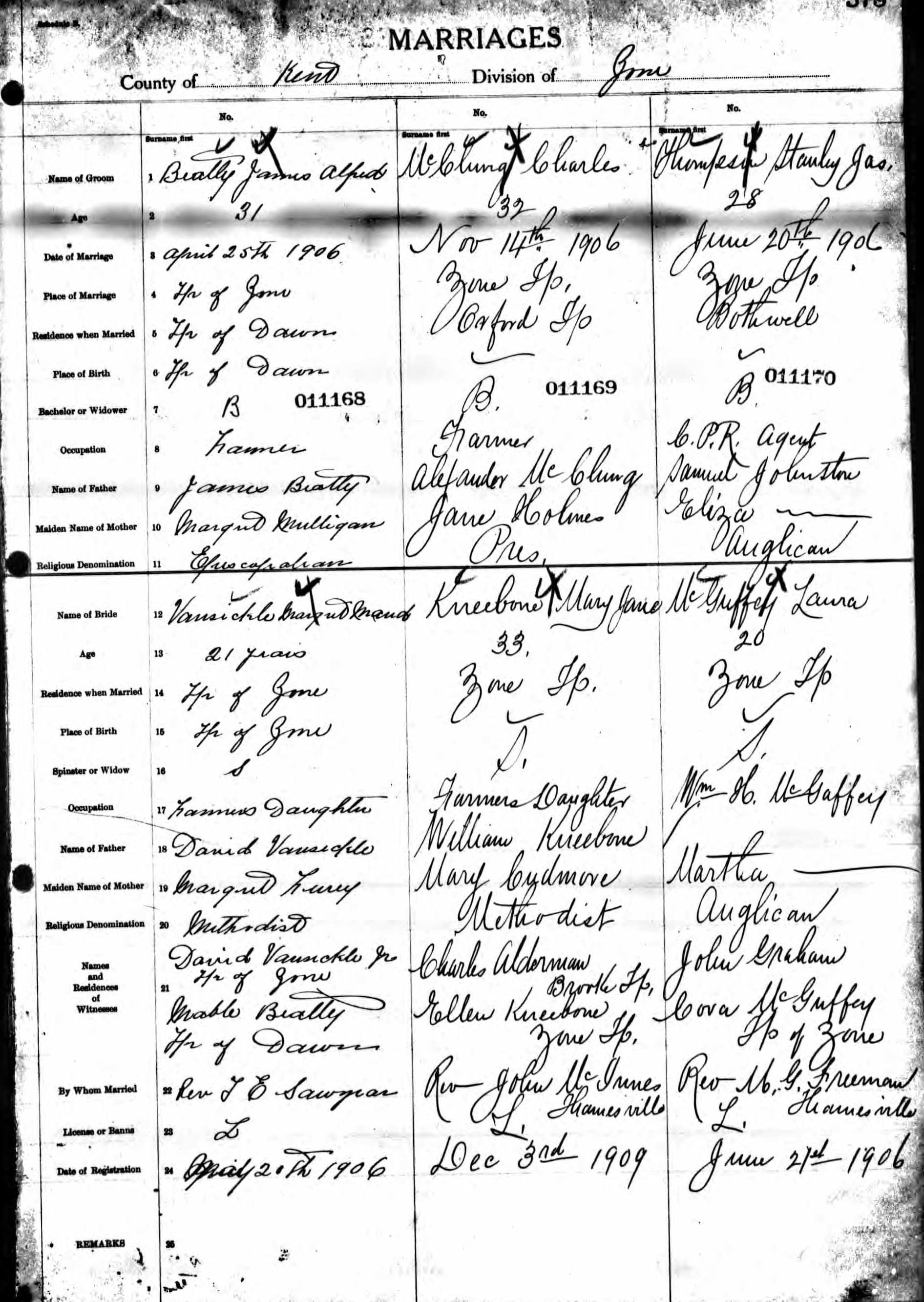
On 20 June 1906, at Zone Township in the county of Kent, Stanley married Laura McGaffey. Ontario marriage registration records him as Thompson, Stanley Jas., aged 28, bachelor, of Bothwell, C.P.R. Agent, Anglican, son of Samuel Johnstone and Eliza. Laura was 20, a spinster of Zone Township, Anglican, daughter of Wm. H. McGaffey and Martha. Stanley gave his age as 28.
By the 1911 census the family were in Zone Township, Kent East. Stanley J. Thomson, head, born May 1879, aged 32, from England, English origin, Anglican, chief occupation Agent C.P.R. Laura, wife, born October 1887. Iva, daughter, born June 1907. Victor, son, born 1909.
The detail that repays a second look is the address column. Every neighbour on the page is entered at a lot and concession. Stanley is entered on the C.P.R. right of way. He was not living in the village and walking to work. The company housed him at the station, on its own land, and the enumerator had no lot number to write down. Other households on the same page list men employed by the C.P.R. as labourers.
That one column tells you what kind of life this was. The company owned the job and the roof over the family's head.
What the household was worth
The 1911 census asked more financial questions than any census before or since, and Stanley's row is filled in. For the year 1910, it records him as employed at the office, 52 weeks worked at his chief occupation, earnings of $800, life insurance of $1,000 in force as of June 1, 1911, no accident or sickness insurance entered, and $33 paid that year for the life insurance.
Set against the neighbours on the same page, this is a settled skilled income. A locomotive engineer a few doors along earned $650 and carried $2,000 of life insurance. Two C.P.R. labourers earned $400 and $600 for sixty and sixty five hour weeks. Stanley earned more than any of them and worked every week of the year.
The insurance is the line that deserves attention. Thirty three dollars a year is over four per cent of his income, paid out of a household with two small children, and he had been paying it long enough for the policy to be in force well before the census. A rate of that size on a thousand dollars suggests a limited payment or endowment policy rather than the cheapest ordinary life cover, which is to say he was buying it deliberately rather than being sold it casually.
Six years later he was dead at thirty eight and Laura had five children under eleven.
Whether that policy paid is not documented and should not be asserted here, but it is worth saying what is likely. Life policies of the era became incontestable after one or two years, and a policy already running in 1911 was long past that by 1917. Death from tuberculosis after six years of premiums is an ordinary claim, not a disputed one. A thousand dollars in 1917 was about fifteen months of his last recorded salary. It would not raise five children. It would bury him, clear the debts, and buy Laura a year.
Brighton, and a railway that had just arrived
The Canadian Pacific reached Brighton in 1914, at the outbreak of the war, as the town's second carrier alongside the Grand Trunk main line that had served it since 1857. Brighton is mile 111.5 on what is now CP's Belleville subdivision. A new station on a new stretch of main line needs an agent, and Stanley was a CPR agent of about ten years' standing.
George Arthur Thompson was born at Brighton on 3 July 1916. Stanley registered the birth four weeks later and signed the register himself. On the strength of the death registration, he had already been ill for about a month when his son was born.
Muskoka
The Muskoka Free Hospital for Consumptives at Gravenhurst, opened in 1902, was the first free tuberculosis hospital in the world. It was founded and driven by Sir William Gage through the National Sanitarium Association, and it existed precisely because the institution next door, the Muskoka Cottage Sanatorium, was for people who could pay. Ontario had no public health insurance. For a working man with tuberculosis, charity was the system.
The register page that records Stanley's death shows both institutions side by side. The entry above his is Cecil Rosenberg, an accountant from Toronto, 35, dead of apoplexy at the Free Hospital thirteen days earlier. Above that is Alfred Duguay, 27, dead at the Cottage Sanatorium two days after being admitted.
Treatment in 1917 meant rest, food, fresh air and separation. No drug touched the disease.
Whether the tuberculosis had anything to do with the work cannot be established and this should not claim that it does. Historical studies of occupational mortality do find higher tuberculosis rates among men working in crowded indoor public-facing jobs, which describes a station agent well. But Stanley could have caught it anywhere, and it could have sat latent for years before it moved.
Death at thirty eight
Ontario death registration entered in the division of Muskoka, county of Muskoka, as entry 294, records: Thompson, Stanley James, male, 38 years, 10 months, 3 days, died 4 March 1917, place of death the Muskoka Free Hospital, occupation Agent, married. The physician's return gives pulmonary tuberculosis, seven months, contributory toxaemia, seven months, signed J. Spearing, Sanatorium P.O., 5 March 1917.
Seven months of recorded illness puts the onset around August 1916, when George Arthur was a month old.
The family's account is that his body was brought back to Bothwell and that Laura was buried with him when she passed many years later.