Vital Stats
Born
Brighton, Northumberland County, Ontario, July 3, 1916
Died
London, Ontario, August 22, 1994, age 78
Married
Hilda Emma Rowley, May 24, 1941, at St. Paul's Cathedral, London, Ontario
Siblings
Youngest of 5
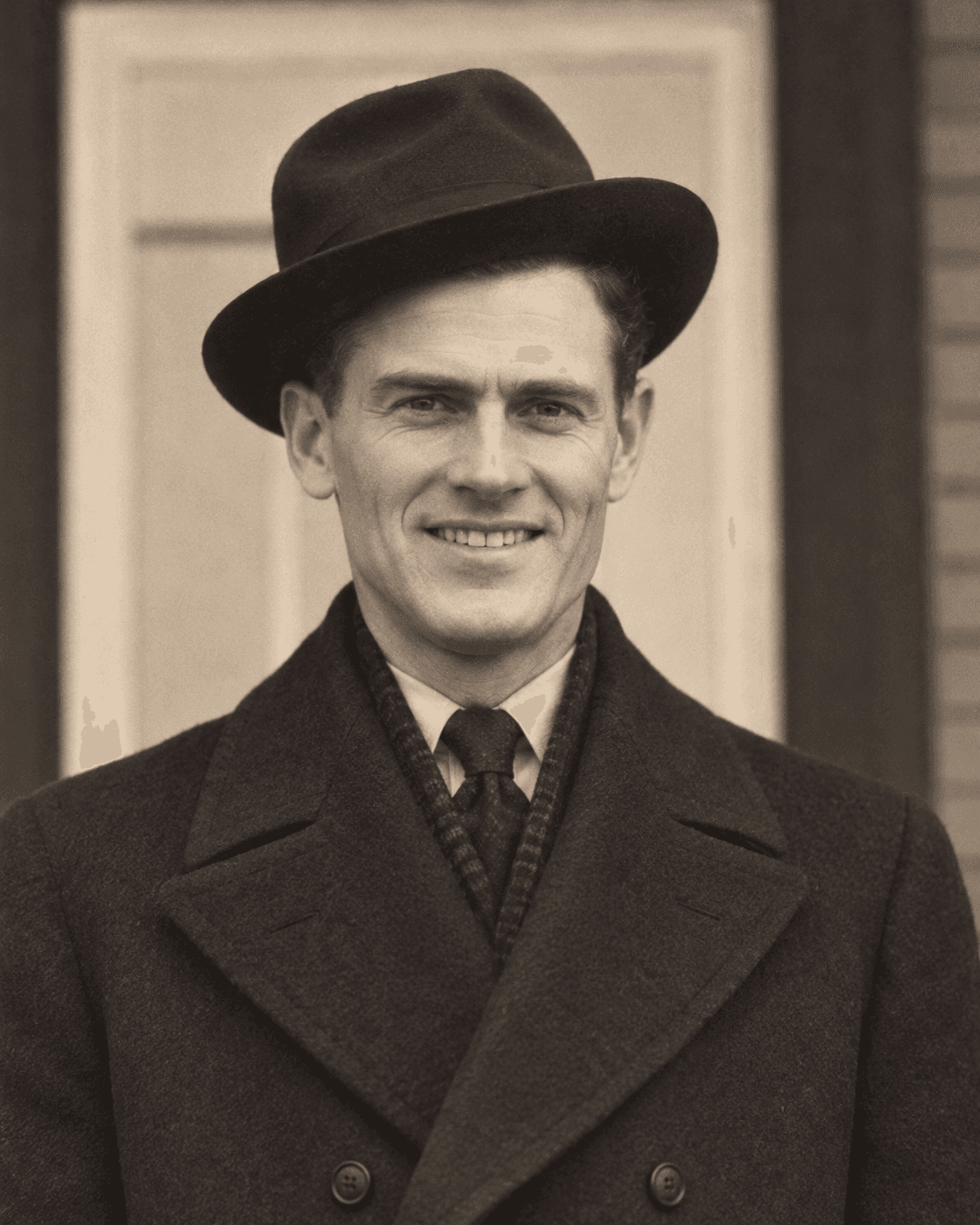
George Arthur "Art" Thompson was born in Brighton, Ontario on 3 July 1916 and died in London, Ontario on 22 August 1994, in his 79th year, due to a stroke. He was eight months old when his father, an English-born railway station agent, died of tuberculosis in a charity sanatorium, and he grew up in Bothwell, Ontario, in a rented boarding house his widowed mother ran through the Depression. He came to London around 1941, married Hilda Emma Rowley within months of arriving, it appears, and in June 1943, at 26, married, with a one-year-old daughter, he volunteered for the Canadian Army. He served as a clerk and cipher operator with the Royal Canadian Corps of Signals and was with the Juno Beach division in northwest Germany when the guns stopped. He kept the message that stopped them. He came home on the Île de France in January 1946, spent the next thirty years selling for the Hudson's Bay Company, and lived at 15 Gammage Street for the majority of the rest of his life. He is buried at Mount Pleasant Cemetery in London, in the same ground as Hilda's family.
Art was born at his parents' home in Brighton, a fruit-growing town on the shore of Lake Ontario, on 3 July 1916. His father registered the birth four weeks later and signed the register himself.
His father was Stanley James Thompson, baptized 28 June 1878 at Farcet in Huntingdonshire, England, the son of Samuel Johnstone Thompson, a farmer of fifty acres at Farcet. His birth date of 1 May 1878 is calculated from the age of 38 years, 10 months and 3 days given on his 1917 death registration. Stanley emigrated to Canada in 1882 as a boy and went to work for the railway. By 1906 he was a CPR agent, and in June that year he married Laura McGaffey. Station agents were posted where the railway needed them, which is the only reason a Kent County family was living 400 kilometres east in Brighton in 1916.
On 4 March 1917, when Art was eight months old, Stanley James Thompson died at the Muskoka Free Hospital of pulmonary tuberculosis. He was 38. He left Laura, aged 30, with five children under eleven.
The Muskoka Free Hospital for Consumptives at Gravenhurst was one of Canada's charity sanatoriums, the one you went to when you could not pay for the private one next door. A working railway agent died there, 250 kilometres from his family.
Laura took the five children home to Bothwell, the small Lambton County town southwest of London where she had grown up. In 1921 she was listed on Chestnut Street as head of the household, with Iva, Victor, Harold, Arlis and George, aged four. Church of England. Renting, about ten dollars a month.
In 1931, in the second year of the Depression, she remained head of a nine-room house rented at $12.50 a month with five boarders living in it: a garage car repairer, a bank clerk, a dentist, a bakery deliveryman and a domestic. Iva, 23, was a bank stenographer earning $760 a year. Victor, 20, was a general labourer who had been out of work 26 weeks of the previous twelve months. Harold, 19, drove a truck on road construction and had been out of work 27 weeks. Arlis, 17, and George Arthur, 14, are both listed as students: two grown sons half unemployed, five strangers at the table, and she kept the youngest two in school anyway.
Laura was a member of Bothwell Chapter No. 87, Order of the Eastern Star, the Masonic order for women, which held a memorial service for her the night before her funeral. In that era, the lodge and the chapter were the practical safety net, and her membership is very likely part of the answer to how a widow with five children kept a household running.
She lived to 98 and died on 9 May 1985. Art was 68 at the time.
Art was confirmed on 16 June 1929 at St. Stephen's Church in Thamesville. He was twelve. The following year he passed his High School Entrance examination, certified at Chatham in 1930.
Art does not appear in Vernon's London city directory in 1937, 1938, 1939, 1940 or 1941. However, one of his brothers (Arlis) does, from 1937 onward. Art first appeared in 1942 in the city of London directory.
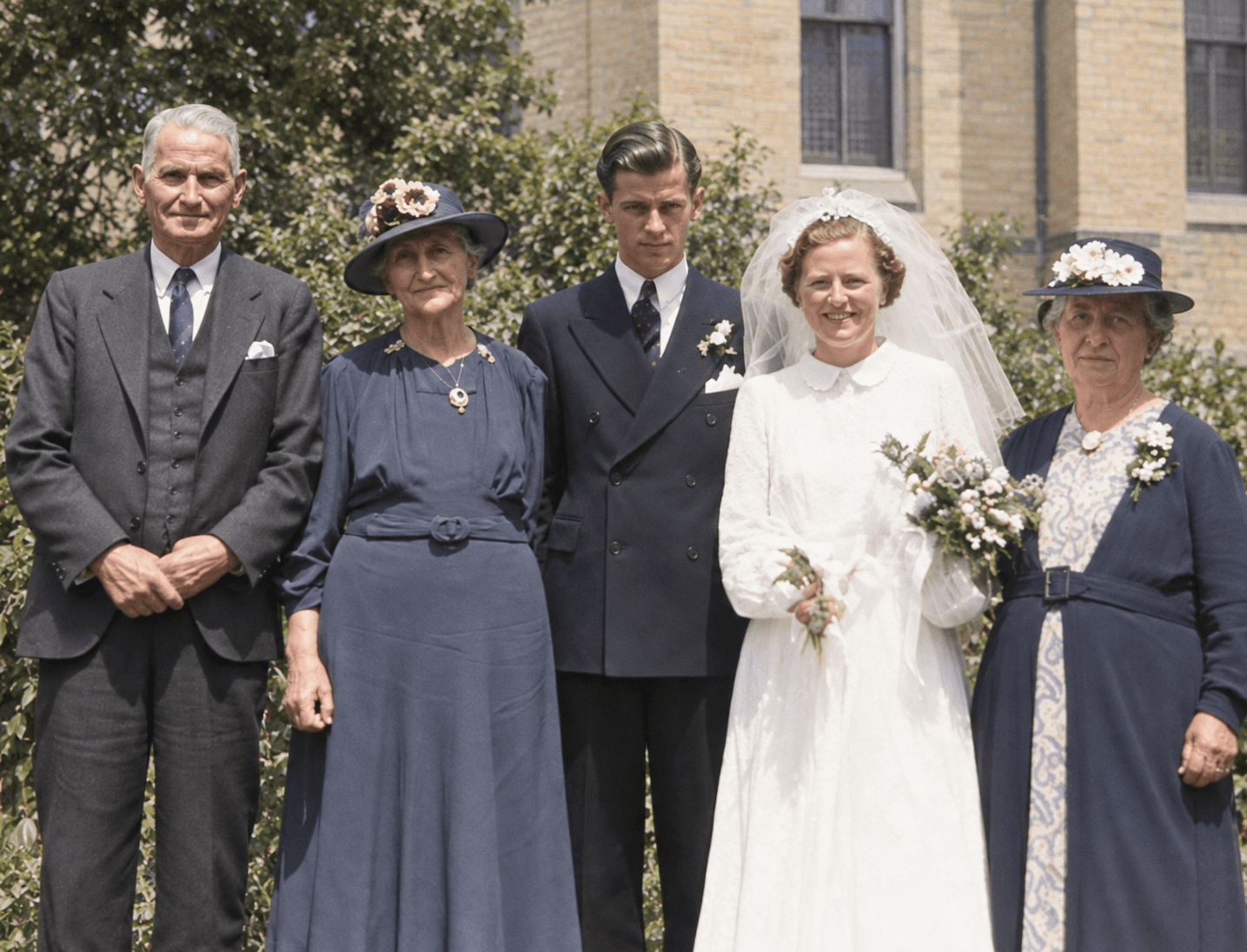
On 24 May 1941 he married in London and gave London as his residence, and the marriage was by banns, which required at least fifteen days living in the parish and three successive Sundays of the intention being read out in church. It's likely he moved to London prior to his wedding but after the data had been collected for the 1941 directory.
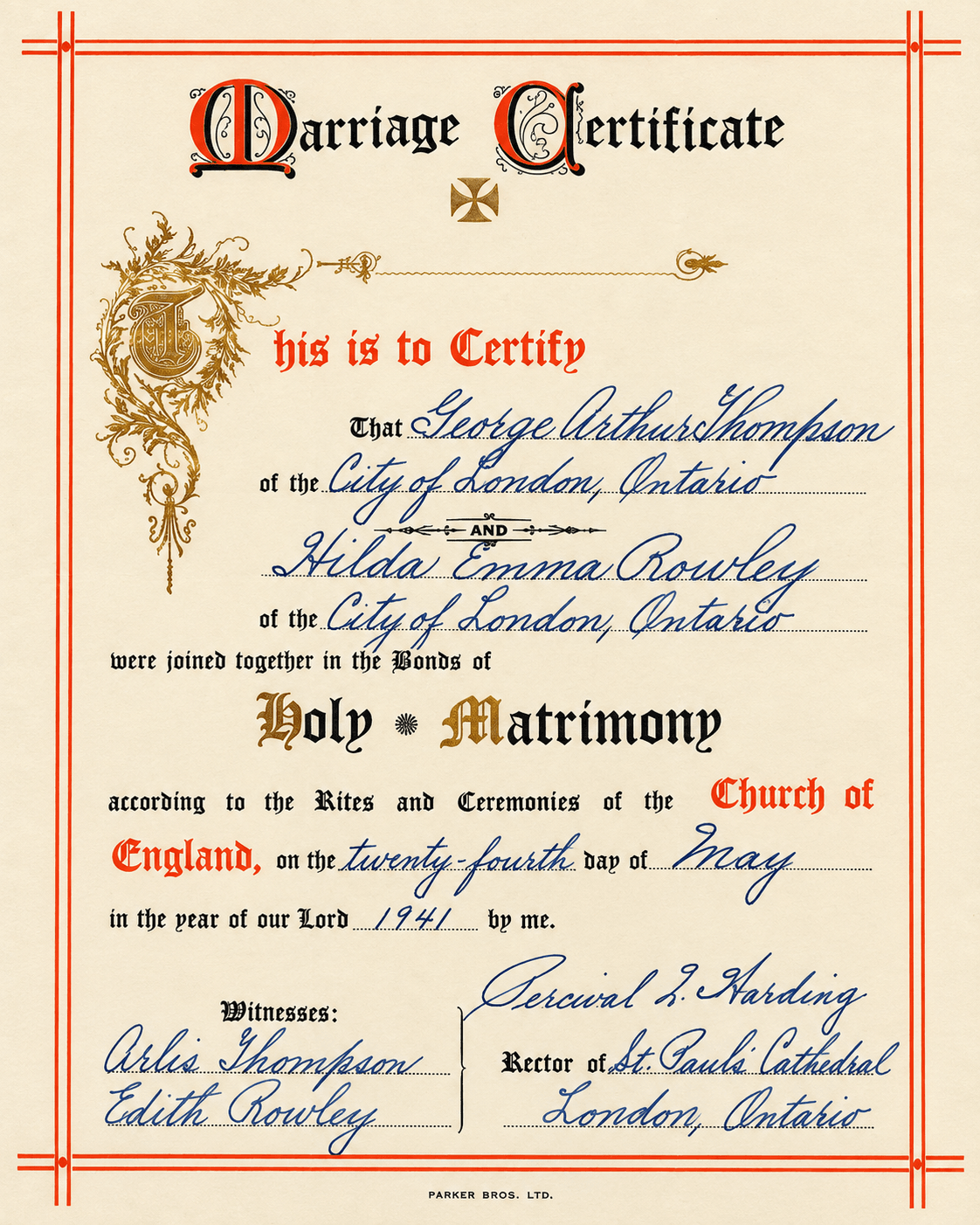
So the sequence seems tight. He came to London, almost certainly because a brother was already there, and inside a year, possibly a great deal less, he had met and married Hilda Emma Rowley. Family lore indicates that Art and Dolly likely met at a church camp.
The certificate records him as 24, a bachelor, occupation shipper, Anglican, born Brighton. Hilda was 30, a spinster, occupation clerk, Anglican, born Bristol, England. She was six years older than him and had a settled job at the bank. The witnesses were Arlis Thompson, his brother, and Edith Rowley, her sister. The service was conducted by the Reverend Percy F. Harding of 180 Queens Avenue — St Paul's Cathedral.
On 28 June 1943, Art walked into No. 1 District Depot in London and enlisted. He was 26 years old, married, and Joan was one.
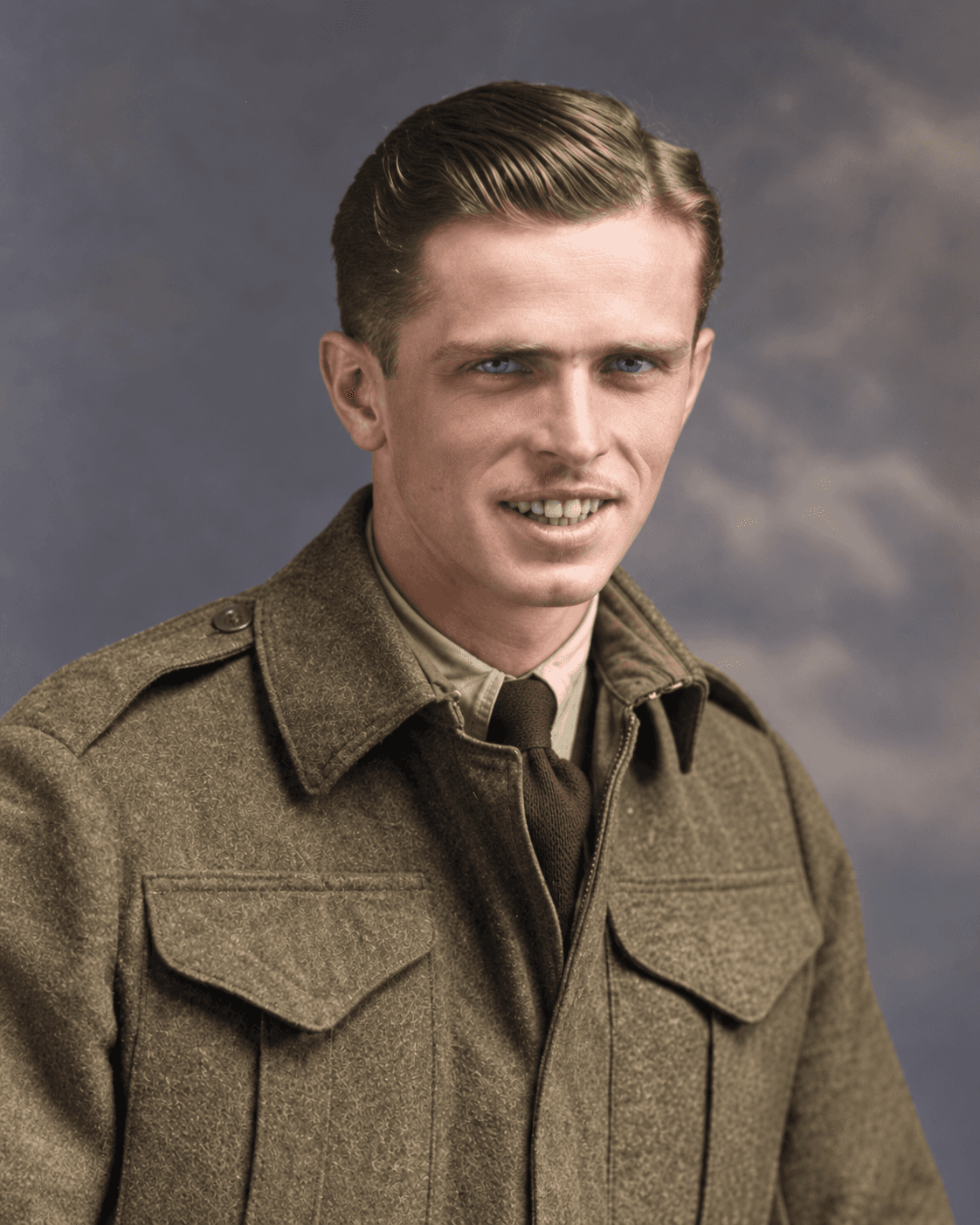
He did not have to enlist. The Canadian Volunteer Service Medal he was awarded is precisely what its name says: a medal for men who volunteered. Married men with babies were the last group anyone expected to see at the recruiting desk in the summer of 1943.
He served with the Royal Canadian Corps of Signals, and his two surviving trade certificates say what he actually did: Clerk, approximately twenty-four months, trade group C, and Operator (Cipher), approximately sixteen months.
His total service was about thirty-two months, so those overlap. He was a signals office man for essentially the whole war: a clerk who was also trained to encrypt and decrypt, handling the traffic that carried orders between a divisional headquarters and the units under it.
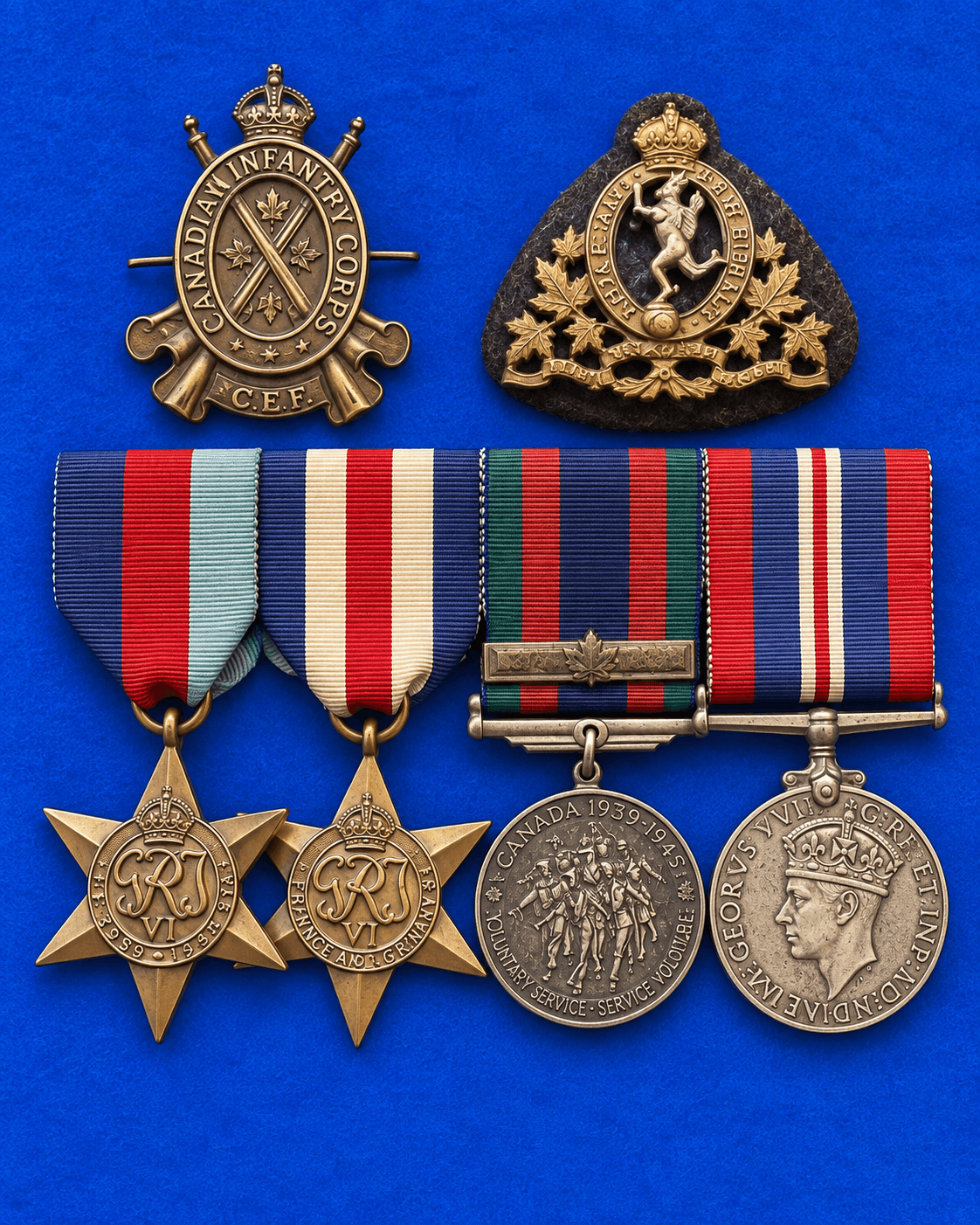
His discharge certificate records service in Canada, the United Kingdom and Continental Europe, and three medals: the 1939 to 1945 Star, the France and Germany Star, and the Canadian Volunteer Service Medal with Clasp. Read together those set a floor under his war. The 1939 to 1945 Star required six months of operational service. The France and Germany Star required service in France, Belgium, Holland or Germany between D-Day and 8 May 1945. The Clasp required sixty days outside Canada. He was in northwest Europe, forward, from late 1944 at the latest.
At discharge he was five foot seven, fair, with blue eyes, brown hair and a mole on the left side of his neck. He came out a Lance Corporal, a modest rank for nearly three years, which reads less like a man passed over than a man who was useful exactly where he was and stayed there.
Among Art's papers is a single sheet of British Army message form, C2136. It is the most remarkable object in the family's collection, and it is worth explaining exactly what it is.
At 18:30 on the evening of 4 May 1945, on Lüneburg Heath in northern Germany, Field Marshal Montgomery accepted the surrender of all German forces in Holland, northwest Germany, the Frisian Islands, Schleswig-Holstein and Denmark. The surrender instrument specified that all hostilities were to cease at 0800 hours British Double Summer Time on Saturday 5 May 1945.
Art's sheet is timed 042220B: twenty-two twenty on the evening of 4 May, in that same time zone convention. It went from 3rd Canadian Infantry Division to its brigades and attached units. It reads:
GO 13 (.) RESTRICTED (.) Cancel all offensive OPs forthwith and CEASE FIRE at 0800B hrs 5 MAY 45 (.) Further details later (.)
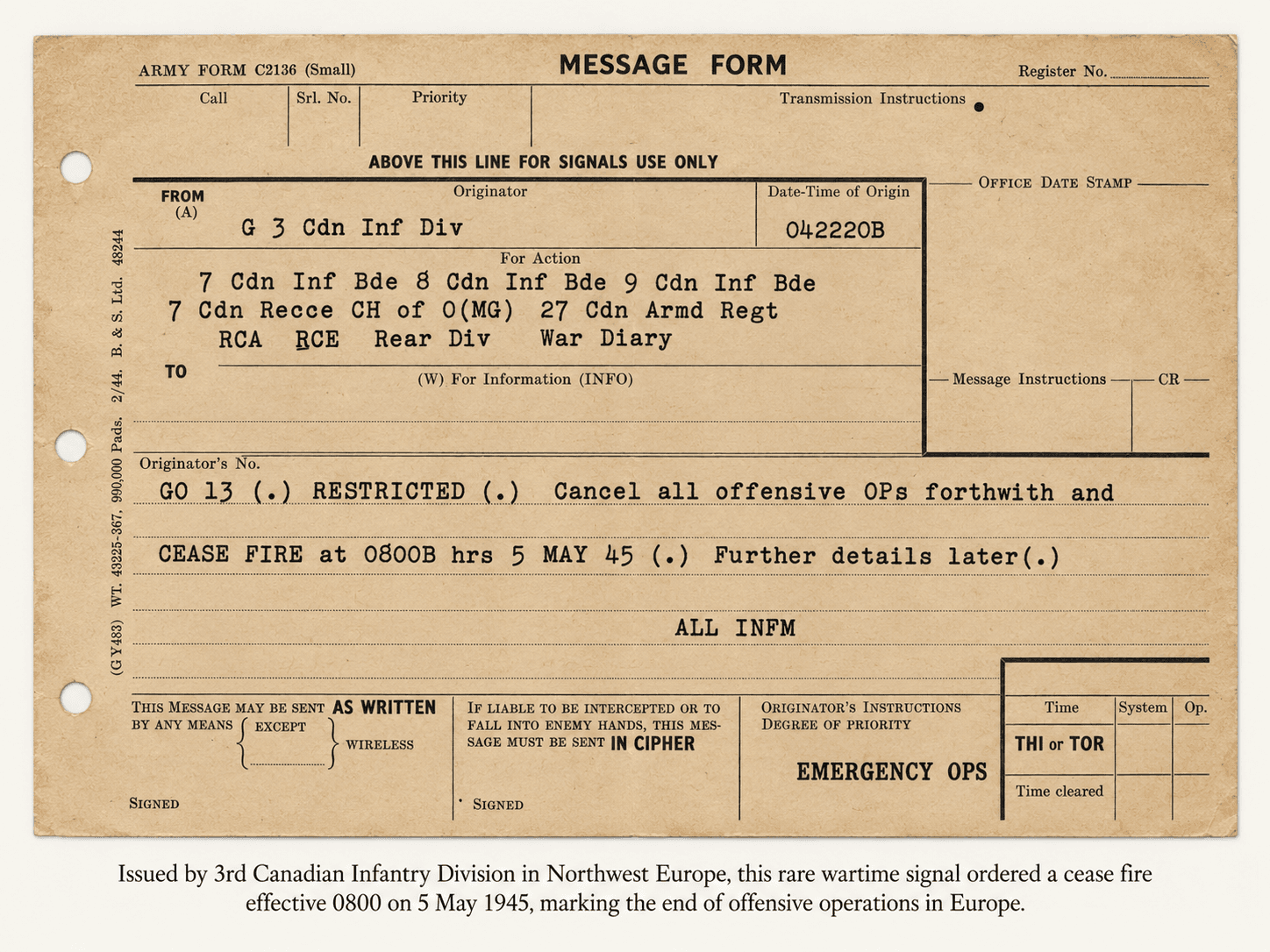
Under four hours separate Montgomery's signature from that order coming down through the division's signals office and out to the men in the field. This is not a souvenir printed afterward. It is the working paper of the night the war ended in his sector, on a form that carries the standing instruction that any message liable to interception must be sent in cipher.
3rd Canadian Infantry Division was the Juno Beach assault division. It had come from the Normandy landings through Caen, the Channel ports, the Scheldt and the Rhineland, and in the last week of the war it was pushing across the Ems and the Leda toward Leer, Aurich and Emden. The official Canadian history records that 8th Brigade was on the outskirts of Aurich, its brigadier negotiating the town's surrender, when operations were suspended on 4 May. That is where the division stood when this signal went out.
The master copy is in the divisional war diary at Library and Archives Canada. Message forms were working paper, meant to be filed or destroyed, and the men in a position to keep one were the small number who handled the traffic.
He did not come home quickly. Canadian repatriation ran on a points system that weighted length of service and having a wife and children, and Art should have scored well on both. He still waited more than eight months after the shooting stopped.
On 19 January 1946 he sent a Canadian National telegram to Mrs. A. Thompson at 488 Maitland Street, London:
SAILING 20 JAN ISLE DE FRANCE LOVE AND KISSES = ART
The Île de France had been one of the great French Line luxury ships of the 1920s. The war took her: first a troopship, then, after a refit in South Africa in 1943, largely a prisoner-of-war transport with barbed wire strung through her public rooms. She was handed back to her owners in the autumn of 1945 and spent the next eighteen months carrying American and Canadian soldiers home across the winter Atlantic before going into a two-year rebuild. She did not carry a paying passenger again until 1949.
That is the ship Art came home on: stripped, grey, still half military.
He was discharged at Wolseley Barracks in London on 9 March 1946.
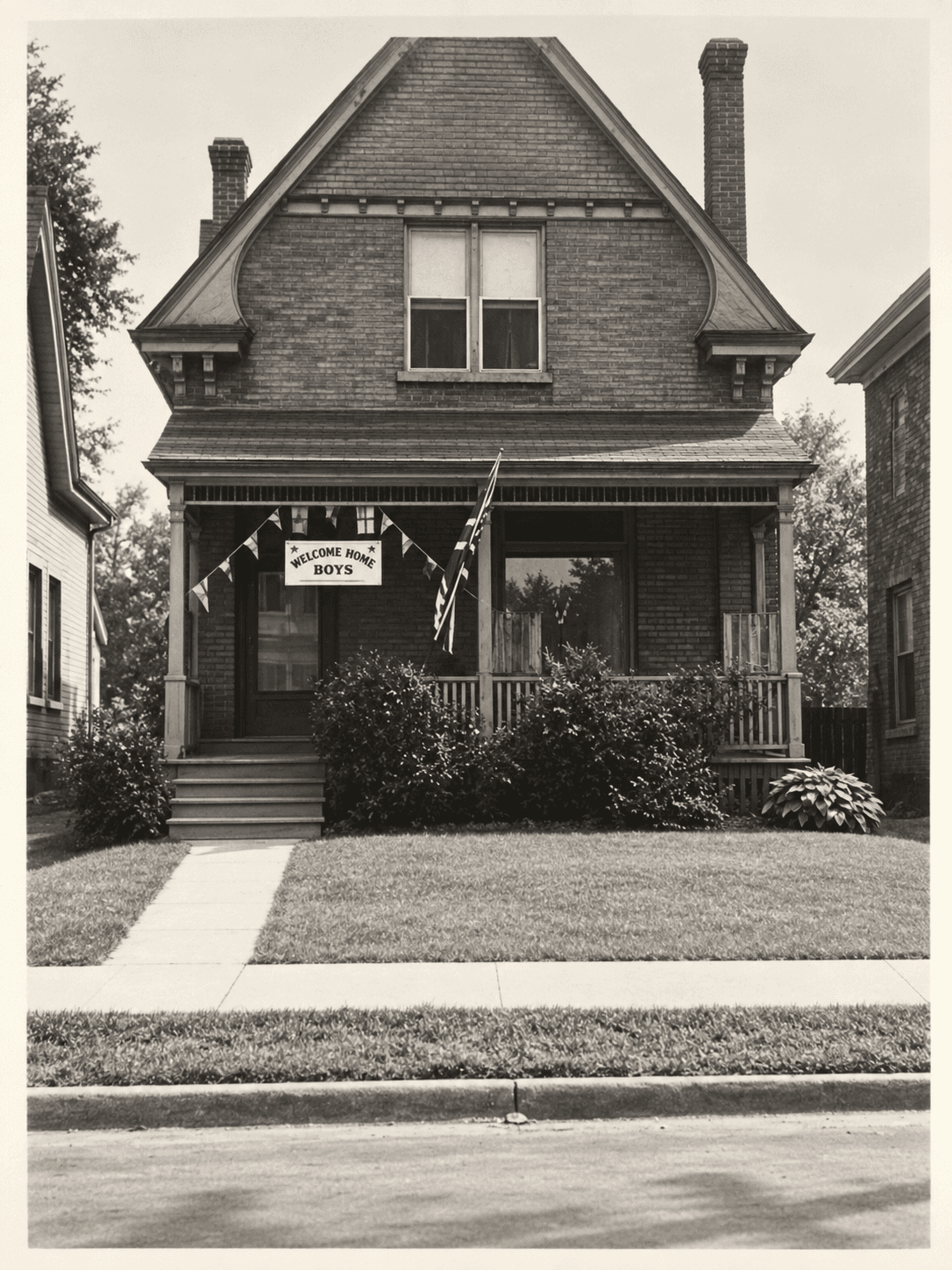
The family were at 488 Maitland Street in 1945 and January 1946. By the time Joan started kindergarten at five, they were at 15 Gammage Street, so the move happened in 1946 or 1947, around the time their son David was born in 1947. Art stayed at 15 Gammage for the rest of his life, close to fifty years.
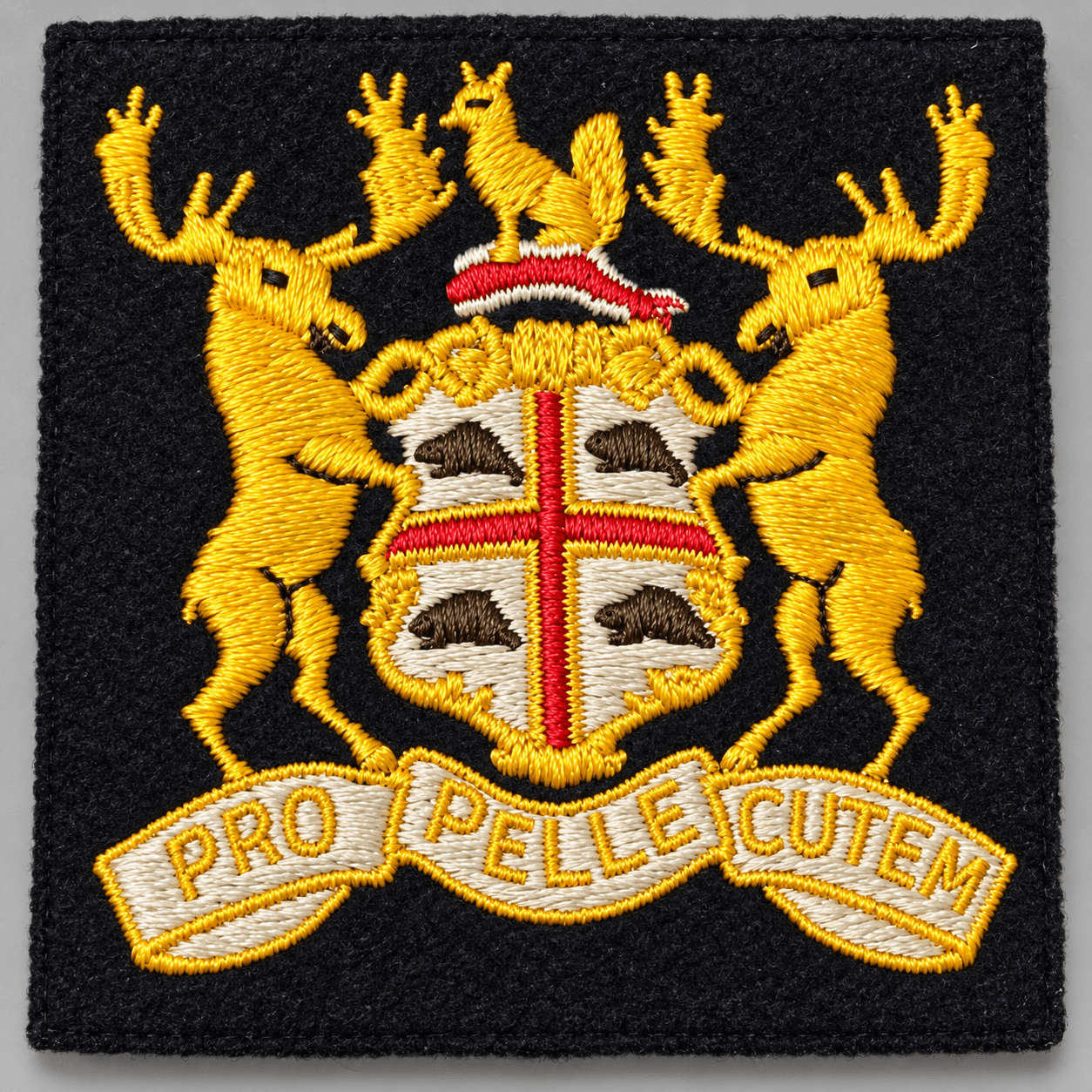
He went to work for the Hudson's Bay Company and spent about thirty years there as a salesman. Every civic record from the postwar years forward gives his occupation the same way. He appears on the London voters list at 15 Gammage as "George Arthur Thompson, salesman," with Hilda, and with David listed as a printer while he still lived at home. By the 1972 list David has gone and it is just the two of them. Their polling station was Knollwood Park School at 70 Gammage Street, a two-minute walk from the front door.
He was a shooter and a bowler. A Firearms Acquisition Certificate issued by the City of London Police in January 1979 survives, along with a gun club registration and a bowling trophy.
And he and Hilda travelled, which for a couple of their background is the detail that most rewards a second look. There are photographs of the two of them in Morocco in 1974, getting off the plane in Madrid, in Seville, at Banff. A boy from a Bothwell boarding house and a girl from a three-room house in Bristol, in their late fifties, in Marrakesh.
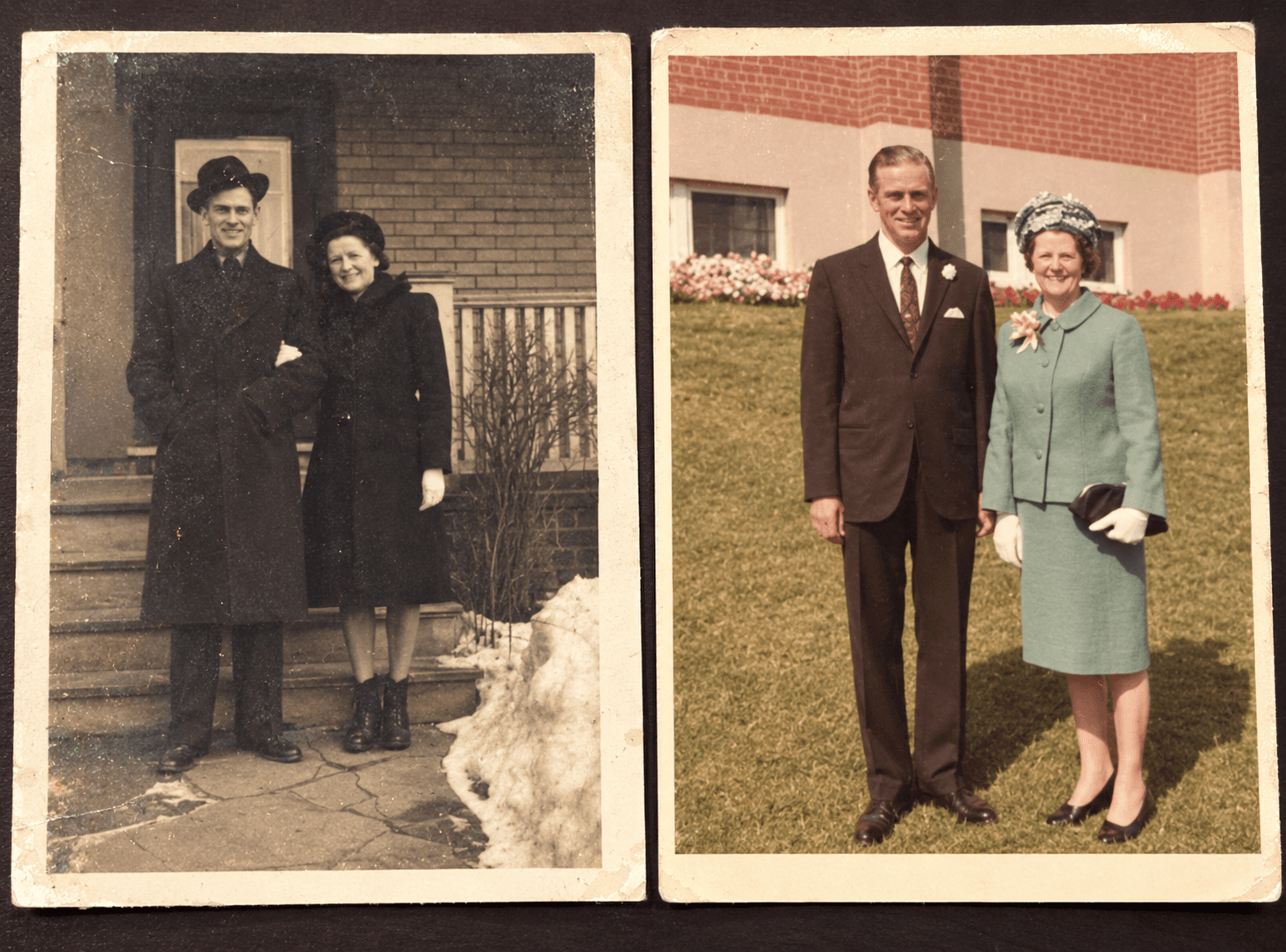
Hilda died on 9 January 1993, after fifty-one years of marriage.
Art died on Monday, 22 August 1994, at St. Joseph's Health Centre in London, in his 79th year, nineteen months after his wife. His obituary calls him the beloved husband of the late Hilda "Dolly" Thompson.
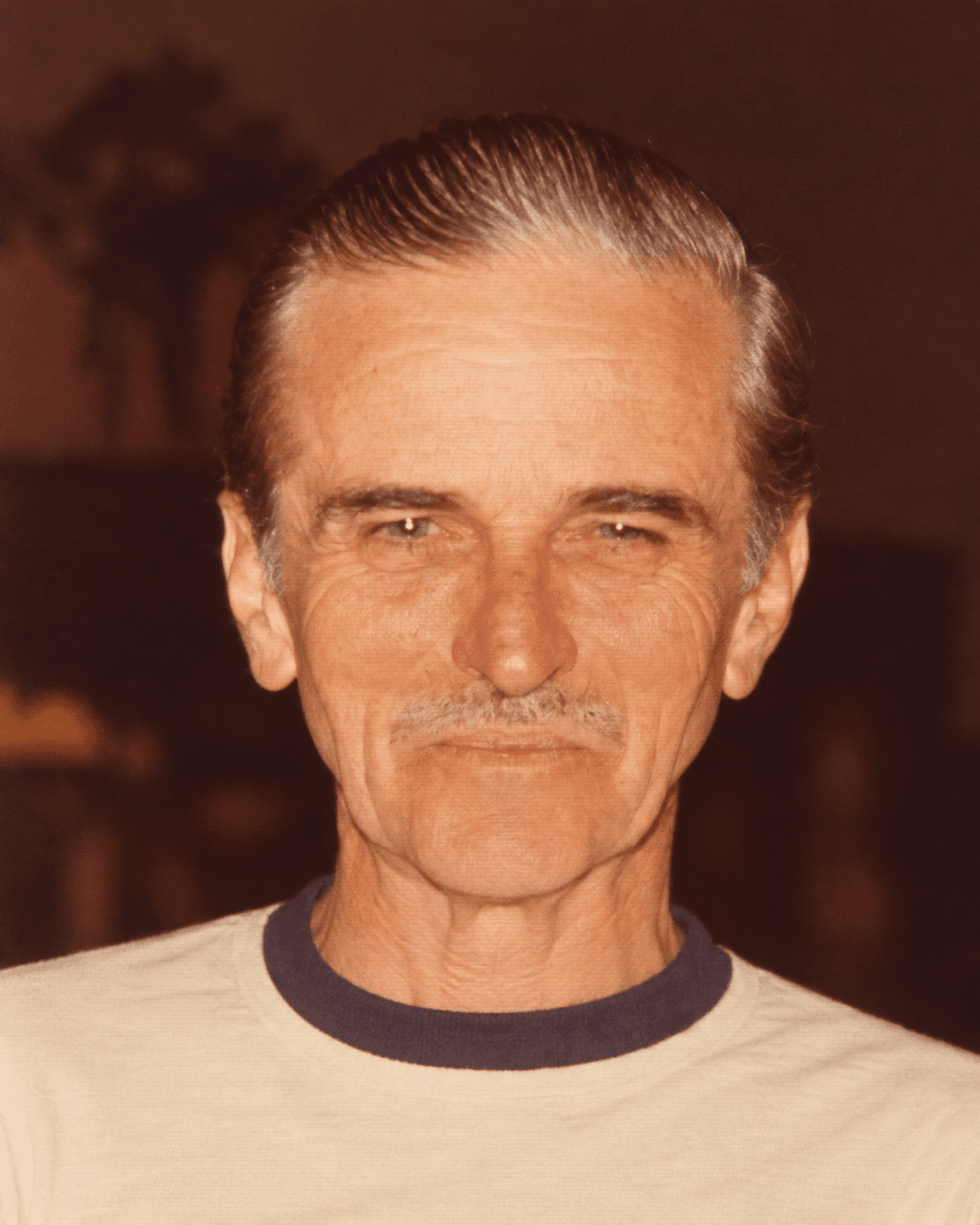
He was received at the A. Millard George Funeral Home on Ridout Street South, and the service was held in the chapel on 24 August, conducted by the Very Reverend Bruce H.W. Howe of St. Paul's Cathedral. Memorial donations were directed to the Heart and Stroke Foundation.
He is buried at Mount Pleasant Cemetery in London, the same cemetery close to where Hilda's mother Rosella bought the Rowley family lot in December 1950.