Vital Stats
Born
October 22, 1886, Zone Township, Kent County, Ontario
Died
May 9, 1985, Four Counties General Hospital, Newbury, Ontario, age 98
Married
Stanley James Thompson, June 20, 1906, Zone Township, Ontario
Children
5
Laura McGaffey was a farmer's daughter who married a Canadian Pacific agent at Bothwell in 1906 and followed the railway wherever it sent him. Ten years and eight months later she was a widow at thirty, in a town four hundred kilometres from home, with five children, the eldest nine and the youngest eight months old. She took them back to Bothwell and stayed there. Through the worst of the Depression she ran a nine room boarding house on Oak Street with four boarders, a live-in servant and five children. She kept the two youngest boys in school while the two older ones took whatever work there was, and watched her daughter marry one of the boarders. Somewhere in those years she helped found the town's Order of the Eastern Star chapter and eventually rose to district office. She lived another sixty eight years after Stanley died, longer as a widow than most people live at all, and when she died in 1985 at ninety eight she left thirteen grandchildren, forty great grandchildren and twelve great great grandchildren.
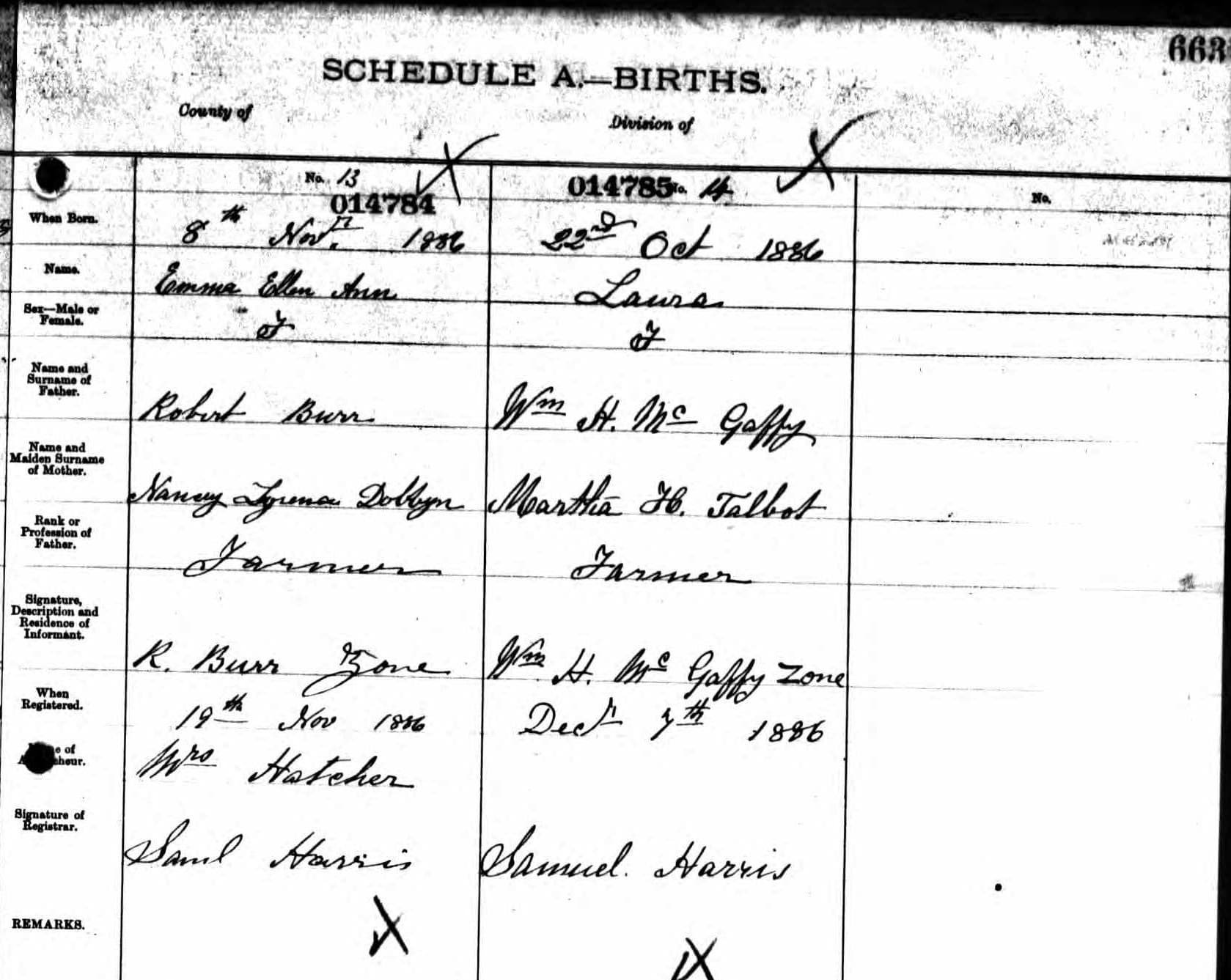
Laura was born on 22 October 1886 in Zone Township, Kent County, and registered simply as Laura, with no middle name. Her father, William H. McGaffey, walked in to the division registrar at Zone six weeks later, on 7 December, and gave the particulars himself.
A year later, on 31 October 1887, Laura was baptized in an Anglican church in Quebec, in the same registry district as her parents' wedding, with her mother and two Talbot aunts, Alice and Nancy E. Talbot, standing as godparents. She had been carried east as a baby to be christened in front of her mother's family, then brought home to Zone Township, where she was raised.
The McGaffeys were farmers. William was born in Ontario on 2 December 1856 to an Irish father, John McGaffey of County Tyrone, and a Quebec born mother, Nancy Galbraith, and was Church of England all his life. Her mother, Martha H. Talbot, was born in Quebec on 25 August 1861 to Quebec born parents, which is why every census that asked would record Laura's mother's birthplace as Quebec while everyone else on the page said Ontario.
Laura had an older brother, Harold Talbot McGaffey, born 21 October 1885, who died in 1889 before he reached school age. She would name her third son Stanley Harold, almost certainly after him, just as her fourth, Arlis Kenneth, carries the name of the younger brother she lost a few years later.
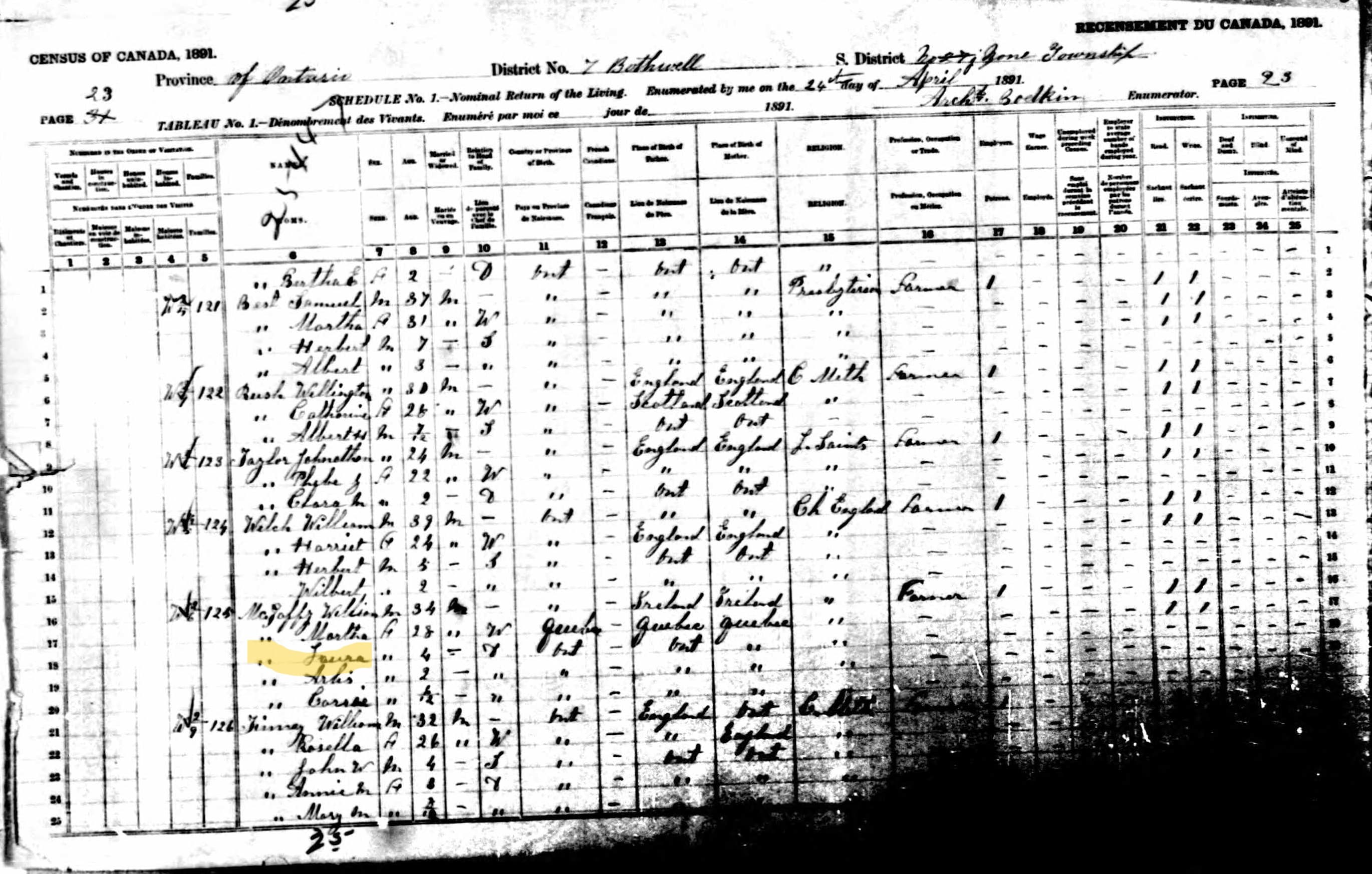
The 1891 census found four children in the house: Laura at four, Arlis at two, and Cassie, six months old. Two households along, a Richard McGaffey, also thirty four, also Ontario born to Irish parents, farmed with his wife Rosa and sons Charles and John. Almost certainly William's brother.
By the 1901 census, only two of the children remain. Laura, fourteen, and Cora, born 8 October 1890, who is the "Cassie" of ten years earlier. Arlis is gone. There is no record of a marriage, and at eleven or twelve there could not have been one. Arlis died in 1894, at about five.
Zone Township in the 1880s was a farming community living in the quiet after a spectacular noise. Oil had been struck at Bothwell in 1863, the population had briefly touched seven thousand, and by the time Laura was born the boom had been over for twenty years and the farms had the place back. It was the railway, not the oil, that had made the township in the first place. The Great Western came through in 1854 and Bothwell grew up along it. That is worth holding on to, because the railway is what she married.
She married Stanley James Thompson at Zone Township on 20 June 1906. She was nineteen, five months short of twenty, and the register rounds her up. He was twenty eight, born in Huntingdonshire, and gave his residence as Bothwell and his occupation as C.P.R. Agent.
Small details from the register that are worth noting. They married by licence, not by banns. Banns were free and took three Sundays. A licence cost money and could be had at once. Thirty five years later her youngest son would marry Hilda Rowley in London by banns. The officiant was Rev. M. G. Freeman of Thamesville. In 1929 her son Art would be confirmed at St. Stephen's, Thamesville. The same Anglican parish is serving this family twenty three years apart. The witnesses were John Graham and Cora McGaffey of the Township of Zone. Her younger sister stood up with her.
Five children came in nine years: Iva in June 1907, Victor in December 1909, Harold about 1911, Arlis about 1913, and George Arthur in July 1916.
The 1911 census caught the family in Zone Township and recorded something the neighbours did not have. Every other household on the page is entered at a lot and concession. The Thompsons are entered on the Canadian Pacific right of way. The company owned the job and the roof over it. Stanley earned $800 that year and carried $1,000 of life insurance, and the household was doing better than the labourers and the locomotive engineer living within a few doors of them.
Then the company moved them. The Canadian Pacific had reached Brighton, in Northumberland County, in 1914, and a new station on a new stretch of main line needs an agent. That is four hundred kilometres east of everything Laura knew. George Arthur was born there on 3 July 1916, at home, with Dr. H. C. Rundle attending, and Stanley registered the birth himself four weeks later.
By then, on the evidence of his death record, Stanley had been ill about a month.
He died on 4 March 1917 at the Muskoka Free Hospital for Consumptives at Gravenhurst, of pulmonary tuberculosis, aged thirty eight. The Free Hospital was the charity institution, the one you went to when you could not pay. It is roughly two hundred and fifty kilometres from Brighton and four hundred from Bothwell.
The full account of Stanley's life, the insurance and the sanatorium is on his page.
Laura was thirty years old.
She took the children home.
The 1921 census finds them back in the Town of Bothwell, St George Ward, on Chestnut Street: Laura, head, widow, and five children aged thirteen, eleven, nine, seven and four. Rented, single, wood, eight rooms, ten dollars a month. Church of England. No occupation is recorded against her name.
That last detail is the whole problem of the next twenty years in one blank column. Ontario had no widow's pension worth the name, no public health insurance, and no unemployment relief. Whatever came in came from the house itself and from whatever the older children could earn.
Ten years later the picture is much sharper, and much more impressive.
The 1931 census records the household on Oak Street: rented, single, wood, nine rooms, twelve dollars and fifty cents a month, with a radio. Laura, head, widowed, occupation homemaker.
She had traded up in the middle of the Depression. More rooms, more rent. That only makes sense if the rooms were paying for themselves, and the census page shows exactly how. Eleven people. Nine rooms.
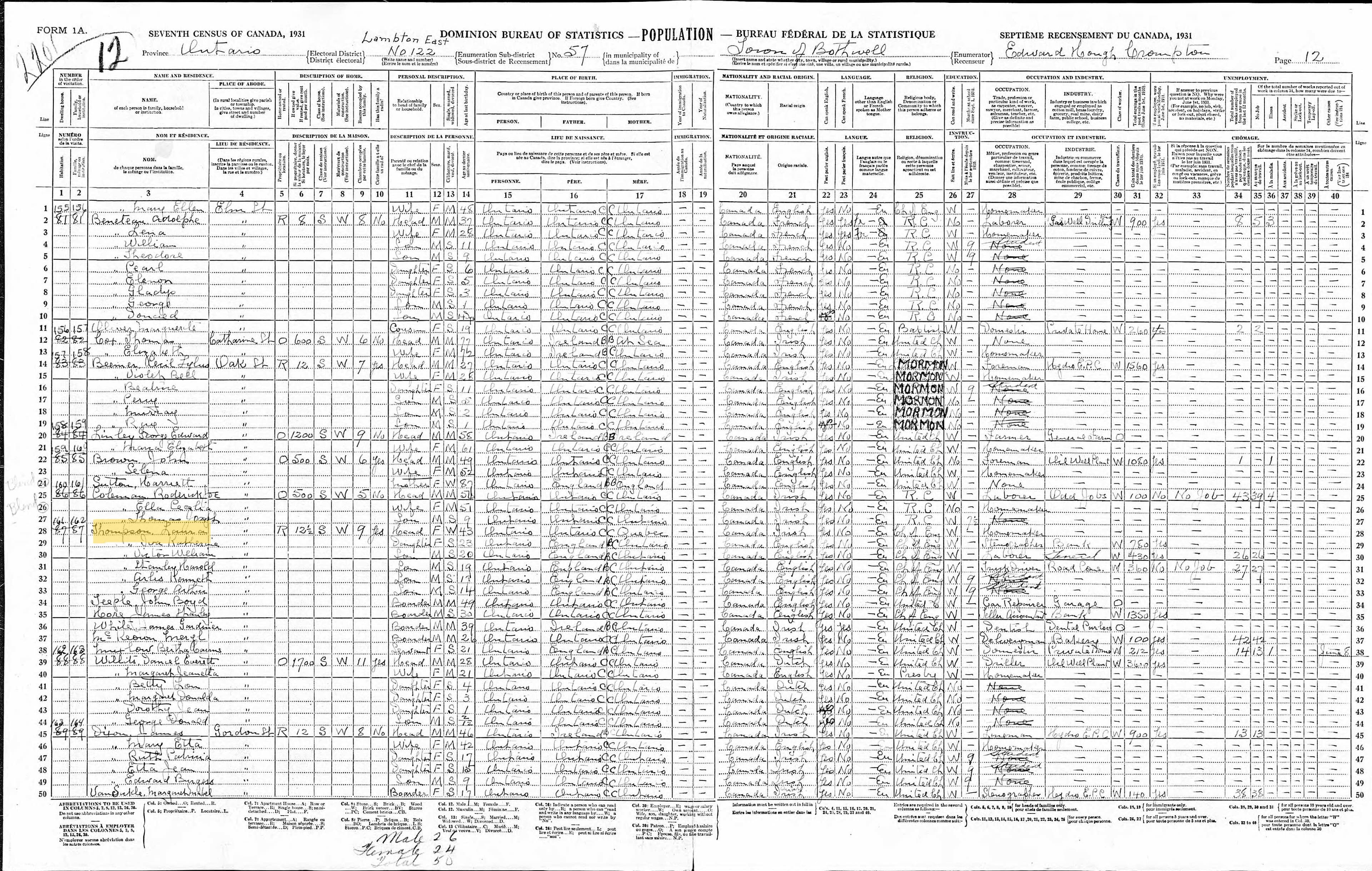
As you read the census, Laura was not taking in whoever turned up. Her boarders were a dentist, a bank accountant, a garage owner and a bakery driver: the salaried and self employed men of a small town, the ones whose money kept coming in when nobody else's did. Two of her own sons were out of work for half the year. Her boarders were not.
She was also employing help. A widow with a live in domestic in 1931 is not a woman scraping by. She is running a business.
And she kept the two youngest boys in school. Arlis at seventeen and George Arthur at fourteen are both entered as students with nine months of schooling that year, while the two older boys took road construction and general labour. That was a choice, and it was made in the second year of the Depression.
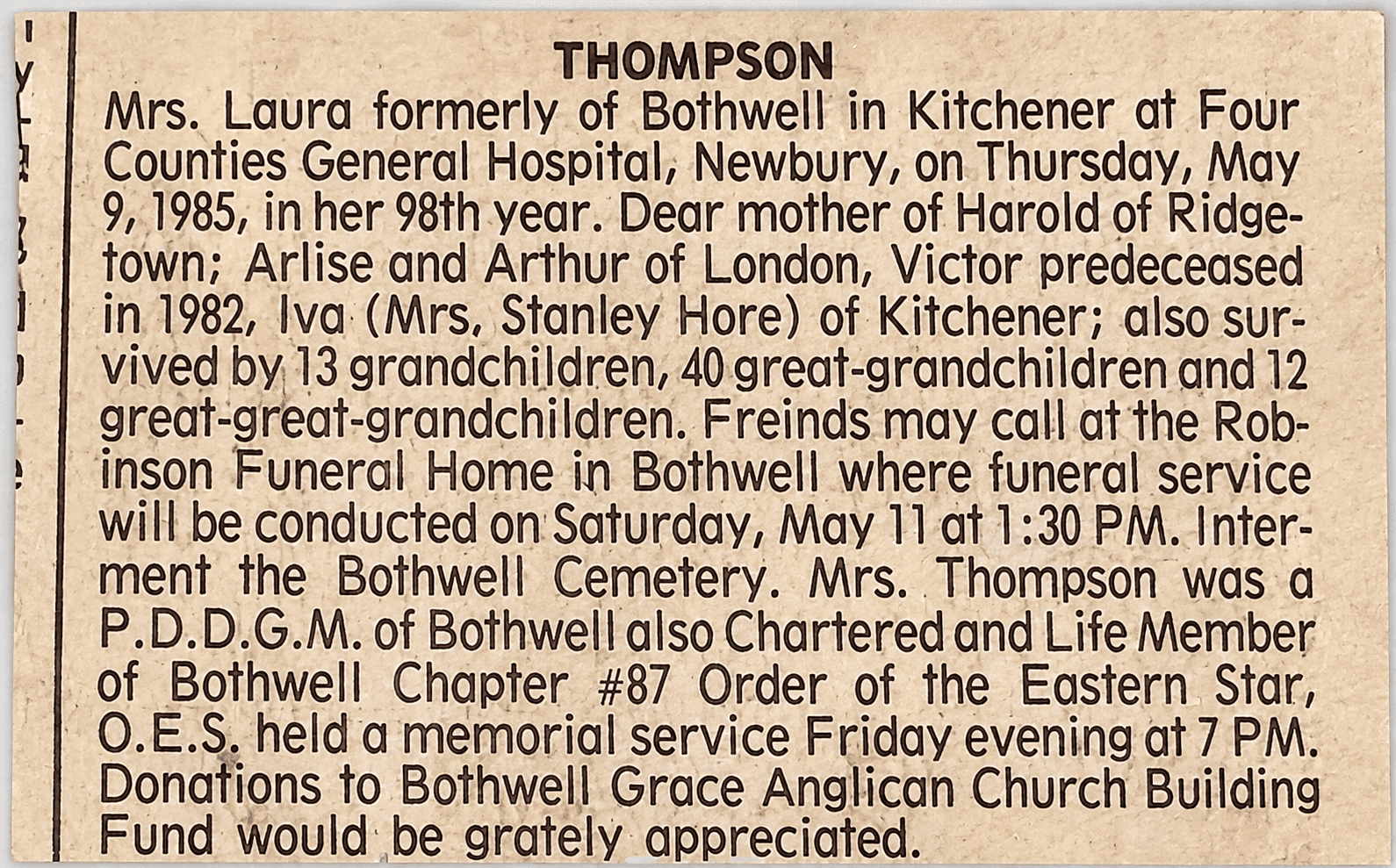
Laura's obituary names her daughter as Iva, Mrs. Stanley Hore, of Kitchener.
On the 1931 census page, three lines below Iva, is a boarder named James Stanley Hoare: single, thirty, a bank teller and accountant, earning $1,350 a year, the highest income in the building. Iva, twenty three, was a bank stenographer earning $780.
A single man of thirty, boarding in the house, working at a bank, alongside the daughter of the house who worked at a bank, in a town of a few hundred people. Men of that generation routinely went by their middle names.
The marriage registration has not yet been pulled, so this should not state it flatly. But on the face of the record, Laura's daughter married one of Laura's boarders, and the boarding house that was built to keep the family afloat is also the room where Iva met her husband.
Her obituary carries three separate marks of standing in the Order of the Eastern Star, and they are worth taking apart, because together they describe a public life nobody in the family has told.
Chartered member. She was there when Bothwell Chapter No. 87 was founded, one of the original members named on the charter.
Life member. She never left it.
P.D.D.G.M., Past District Deputy Grand Matron. Not a local office. District Deputy Grand Matrons represented the provincial Grand Chapter across a whole district, made formal visits to other chapters, and were publicly honoured for it. It meant standing up in front of rooms full of strangers on behalf of the order.
There is a useful piece of arithmetic hiding in the chapter number. The Grand Chapter of Ontario was founded in 1915, and the first issue of its magazine, Ontario Eastern Star, in November 1915, reports the chapters being instituted that first summer: Canada No. 16 at Toronto in June, Maple City No. 17 at Chatham on 29 June, Wenonah No. 18 at Kenora in July, Erie No. 19 at Kingsville in August, Unity No. 20 at West Toronto, and Leamington No. 21 announced for October. Ontario was at twenty one chapters at the end of 1915.
Bothwell is No. 87. Sixty six charters further down the list.
So Bothwell Chapter No. 87 is not a 1915 chapter. It belongs to the late 1920s or the 1930s, and that changes what the Eastern Star means in Laura's story. It was not something she came into as a young wife. It began during her widowhood, most likely in the same years she was running the boarding house with five children in it. She helped start it, she stayed in it for fifty years or more, and she rose through it to district office.
The Eastern Star was not a church and never claimed to be. Laura was Anglican from her marriage register in 1906 to the memorial gift her family asked for in 1985. What the order gave her was the other thing a widow in a small town needs: a network with obligations in it, dinners and installations and official visits, and a body of women who would look after their own.
There is one loose end. Eastern Star membership in that era required a qualifying relationship to a Master Mason: a husband, father, brother or son. Bothwell had a lodge, Star of the East No. 422. Which of her men it was has not been established.
At some point after the children were grown, Laura left Bothwell for Lambeth, then a village in Westminster Township, on the southwest edge of London.
Two printed electors lists put her there. Neither list gives a street. Neither shows any of her children on the same page, and both lists run alphabetically, so nobody printed near her can be assumed to have lived with her. What the two documents do establish is a settled eight year stretch in one place, at an age when she was in her sixties and seventies, still on the voters roll in her own name.
By 1985 she was living in Kitchener, where her daughter Iva was, though no record yet found says she was living with her.
She died on Thursday 9 May 1985 at Four Counties General Hospital in Newbury, aged ninety eight.
Of her five children, only Victor had gone before her, in 1982. Harold was at Ridgetown, Arlise and Arthur were both in London, and Iva was in Kitchener. She had thirteen grandchildren, forty great grandchildren and twelve great great grandchildren.
Friends called at the Robinson Funeral Home in Bothwell. Bothwell Chapter No. 87 held its own memorial service for her on the Friday evening at seven o'clock, the night before the funeral. The funeral was at half past one on Saturday 11 May, and she was buried at Bothwell.
The family asked for donations to the Grace Anglican Church, Bothwell, Building Fund. Fifteen years later that church building was sold and became the premises of the Badder and Robinson funeral home, so the two institutions that buried her ended up under one roof.
She had lived in Bothwell, left it, and come back to it for good. Sixty eight years a widow.