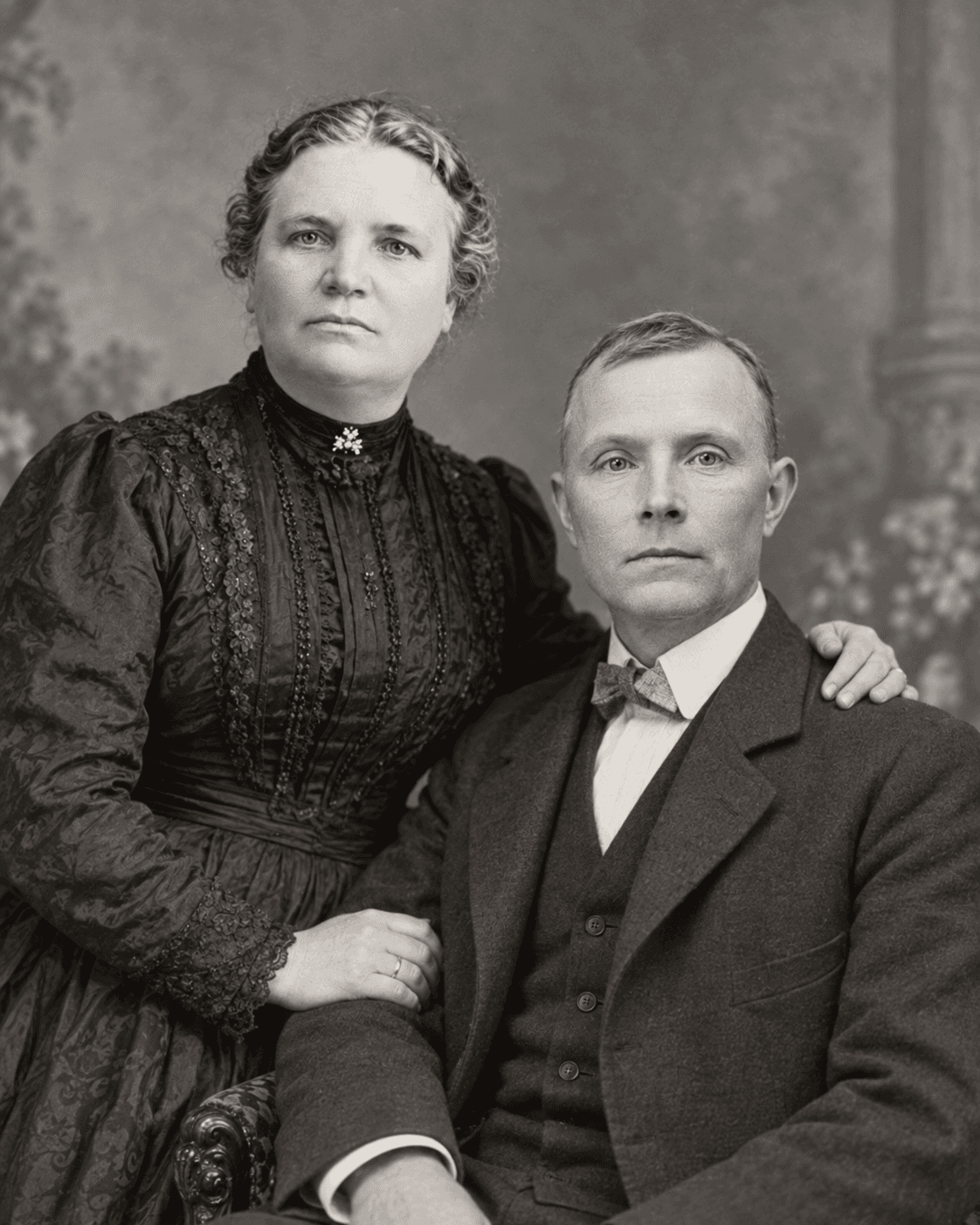
Vital Stats
William — Born
about 1844
William — Died
not established
Margaret — Born
about 1856
Margaret — Died
not established
Married
about 1877
Children
Fourteen born, thirteen living in 1911
Most family pages start with a birth and end with a grave. This one cannot, and it is better to say so at the top. William and Margaret McBurney were the parents of Jennie McBurney, and of at least nine other children, and the records that survive for them are a handful of documents. What follows is what those documents say, what they leave open, and why Irish records make a family like this so hard to pin down. Every date on the old online trees that gave either of them a death has been removed, because none of them had a source.
Margaret is the easier of the two to see. Two Irish census returns, ten years apart, describe her. In 1901 she was 44. In 1911 she was 54. The two ages agree, which puts her birth at about 1856, and in 1911 she gave her birthplace as County Down. She belonged to the Church of Ireland, the Episcopalian tradition, in both years.
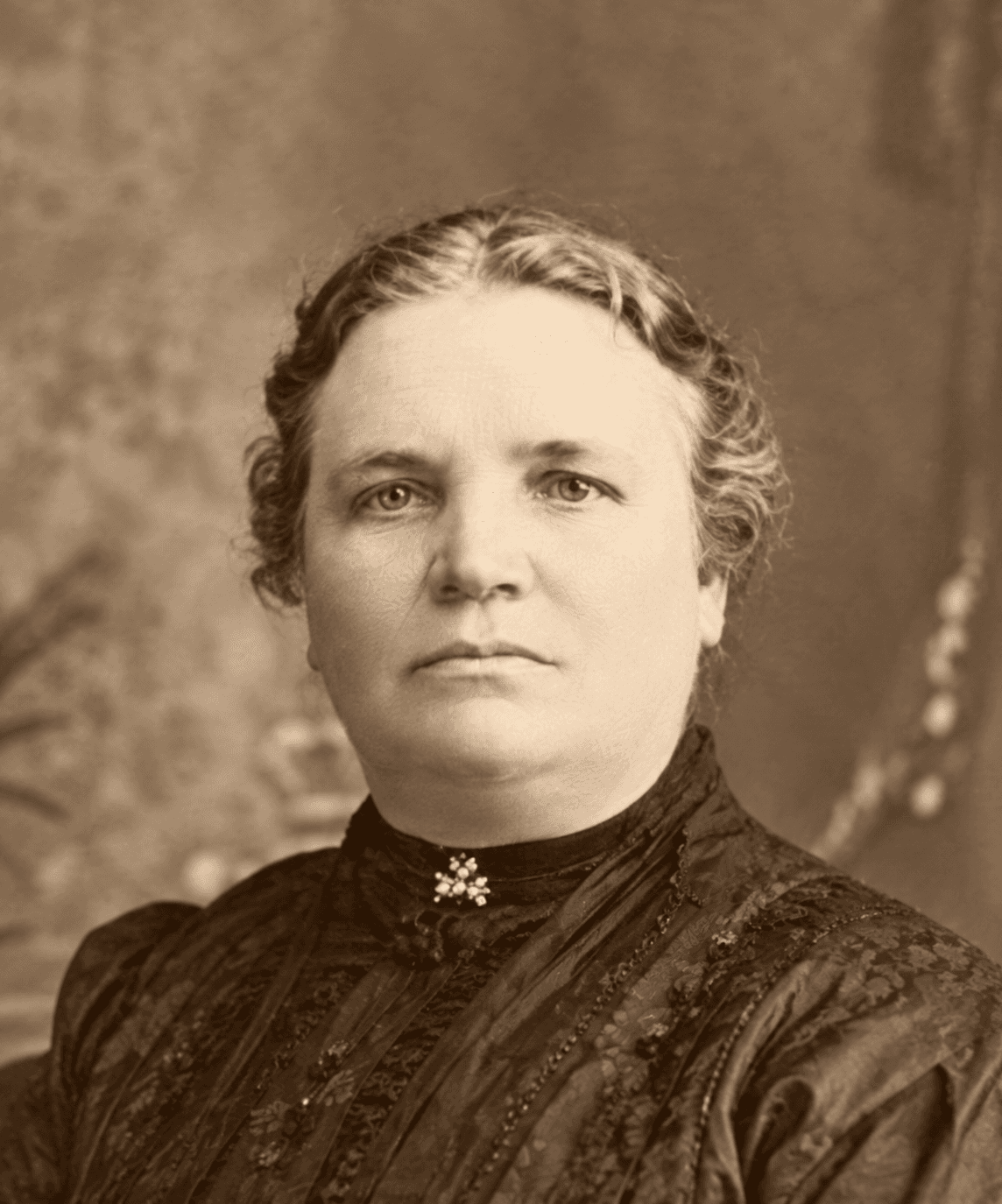
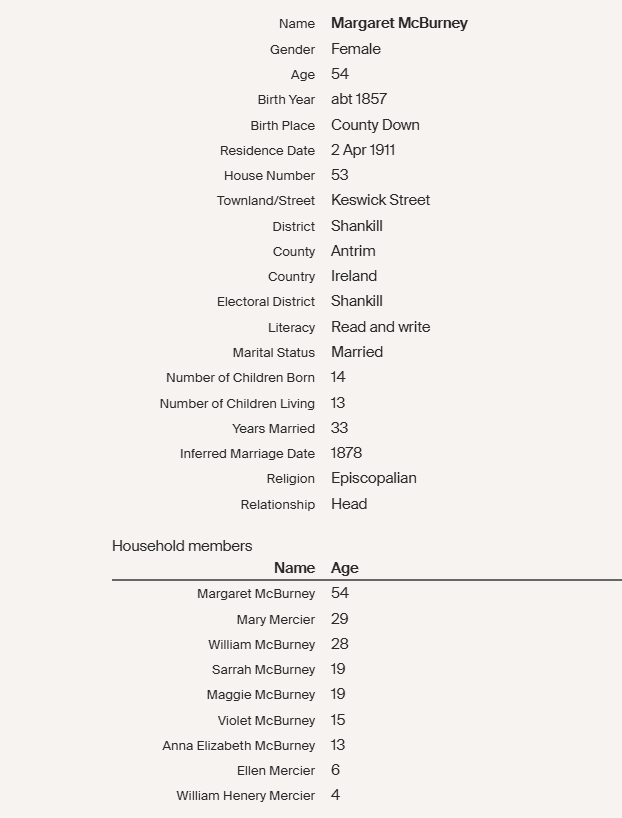
The 1911 return is the richest thing we have on her. It says she was married, that she had been married 33 years, and that she had borne fourteen children, thirteen of them still living. That points to a marriage about 1877 or 1878, when Margaret would have been about twenty. It also means that for roughly a quarter of a century she was pregnant, nursing, or both, and that at least one child died before 1911. Her maiden name was Cowan.
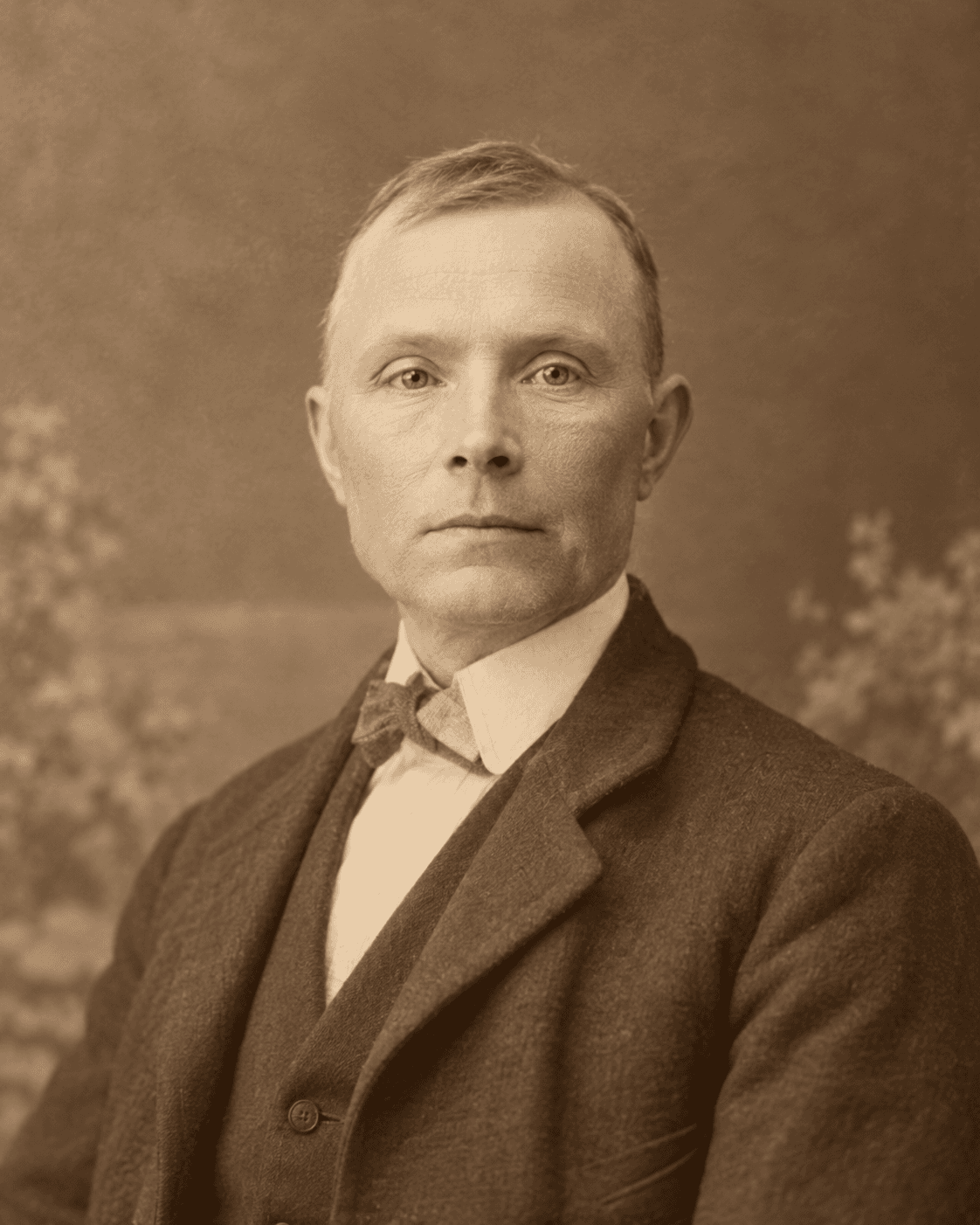
William is much harder to see, and there is no honest way to make him clearer than the records do.
His name comes from their son Ernest's wartime papers, which name William and Margaret McBurney as his parents. He does not appear in either census household. His birth, his parents, his death and his trade are not established.
Family memory, recorded on Jennie's page, says William was a coach maker and a musician who played the pipes in a local band. It is the kind of detail a family remembers well and a record does not always capture, and it is offered here as memory, not as fact.
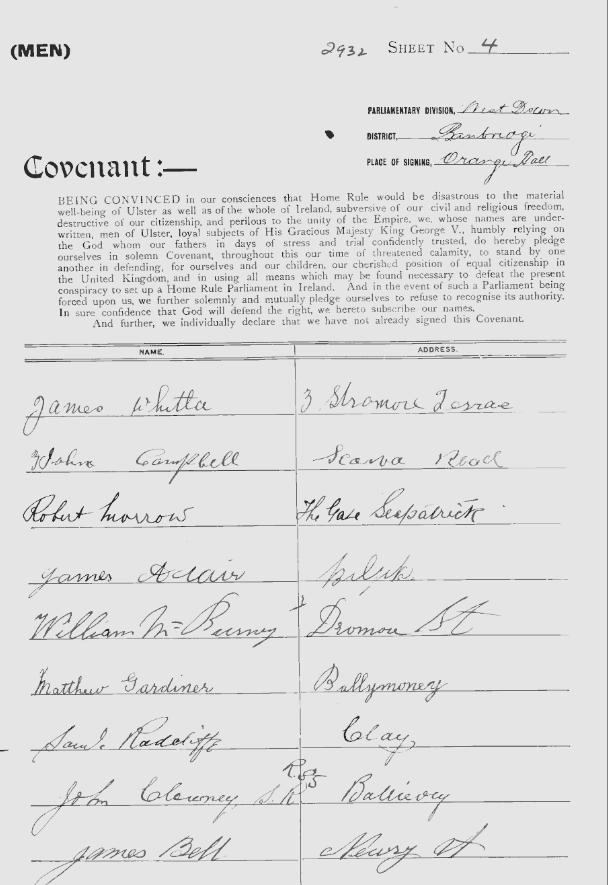
On 28 September 1912, known as Ulster Day, nearly half a million people across Ulster signed the Ulster Covenant and the matching Declaration for women. Men signed the Covenant and women signed the Declaration. Both were a pledge to resist the Third Home Rule Bill, which would have set up a parliament in Dublin, and to use "all means which may be found necessary" to defeat it. People signed in churches, halls and town halls, and the original signatures are held by the Public Record Office of Northern Ireland and can be searched by name. Each entry gives only a name, an address and the place of signing.
In Banbridge the signing took place at the Orange Hall, and among the signatures is a William McBurney of Dromore Street, in the Banbridge district of West Down. We believe this is our William. He was living in the town where Jennie was born in 1877 and Violet reportedly in 1895, and the Orange Hall fits a Church of Ireland family from a Protestant, Orange town. It also places him alive in September 1912, eighteen months after Margaret told the 1911 census she was married.
The family's earliest confirmed place is Banbridge, in County Down. Jennie was born there on 29 July 1877, according to an Irish birth and baptismal record. Banbridge in those years was a linen town, set on the River Bann and crowded with mills, bleach greens and warehouses. It also had a solid Protestant and Orange culture, which fits a Church of Ireland family.
It's likely the family stayed in the Banbridge area for at least eighteen years and moved to Belfast in the late 1890s. Kathy Love, Jennie's granddaughter, later visited Banbridge and spoke with McBurney relatives there, so a branch of the family may have stayed behind.
By 1901 Margaret was the head of a household at 11 Winchester Street, in the Shankill district of Belfast. She was 44, and eight children lived with her: Jennie, 23, a yarn winder in the linen trade; Minnie, 21; Willie, 19; James, 17; Sarah, 9; Maggie, 9; Violet, 5; and Lillie, 3.
Ten years later she was at 53 Keswick Street, still in Shankill. The household had shrunk and changed. William, now 28, was there, and so were Sarah and Maggie at 19, Violet at 15, and a daughter called Anna Elizabeth, 13, whose age is exactly ten years on from the Lillie of 1901. The census also lists a daughter, Mary Mercier, 29, and her two children, Ellen, 6, and William Henry, 4. The Merciers may be Minnie and her family under a married name, but that is not proved.
In 1901 Margaret is the head of the household. In 1911 she says she is married. In neither year is there a husband in the house. The records do not say why.
The 1911 return means that widowhood before 1901 is a poor explanation, unless she reported her status wrongly. The other possibilities are all open. William may have been working away from Belfast, in a trade that took him to other towns, or across the water. He may have been living apart from the family, perhaps in Banbridge. He may have been in hospital or an institution on census night. Or he could have travelled to North America as there is a link in future years for this family across the pond. Each of these is a hypothesis, and nothing in the records chooses among them.
Jennie was the first of the family to leave, in the summer of 1904. She married Fred Martin in Belfast on 22 June 1904 and sailed from Londonderry with him on 15 July, bound for Canada, and she is on her page and on Fred's.
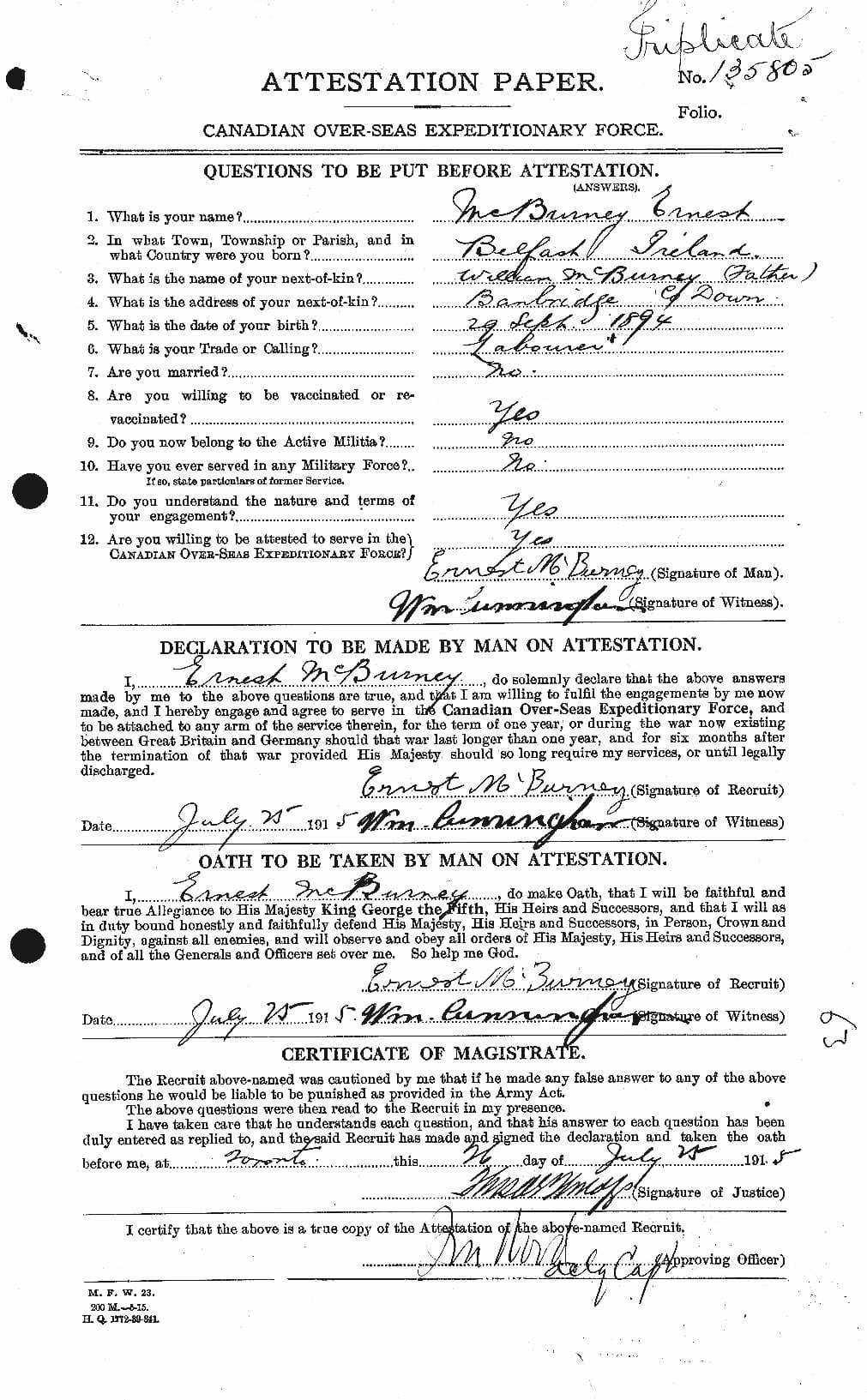
Her brother James followed in 1906. He appears in the 1916 Canadian census living with Jennie at Ituna, Saskatchewan, as her brother, age 29, a farm labourer who had come from Ireland in 1906. His age gives a birth of about 1887, while the 1901 census points to about 1884. That is a small difference that happens often in census work. Later he lived at Moose Jaw with his wife Jeanette and their children, Susie and Jim Jr.
A third child, Ernest McBurney, is named as a son of William and Margaret McBurney on his First World War attestation paper, and again in Canadian records. Ernest is also in a census as a child, and his details fit the family. A parent named on a form is not evidence that the parent was alive or dead, so Ernest tells us who Ernest's parents were and does not tell us what became of them.
Sarah stayed in Ireland. In 1957 she made the long journey to Saskatchewan to see Jennie, the first time the two sisters had been in the same room in more than fifty years. A photograph of the two of them standing together in a field survives from the late 1950s.
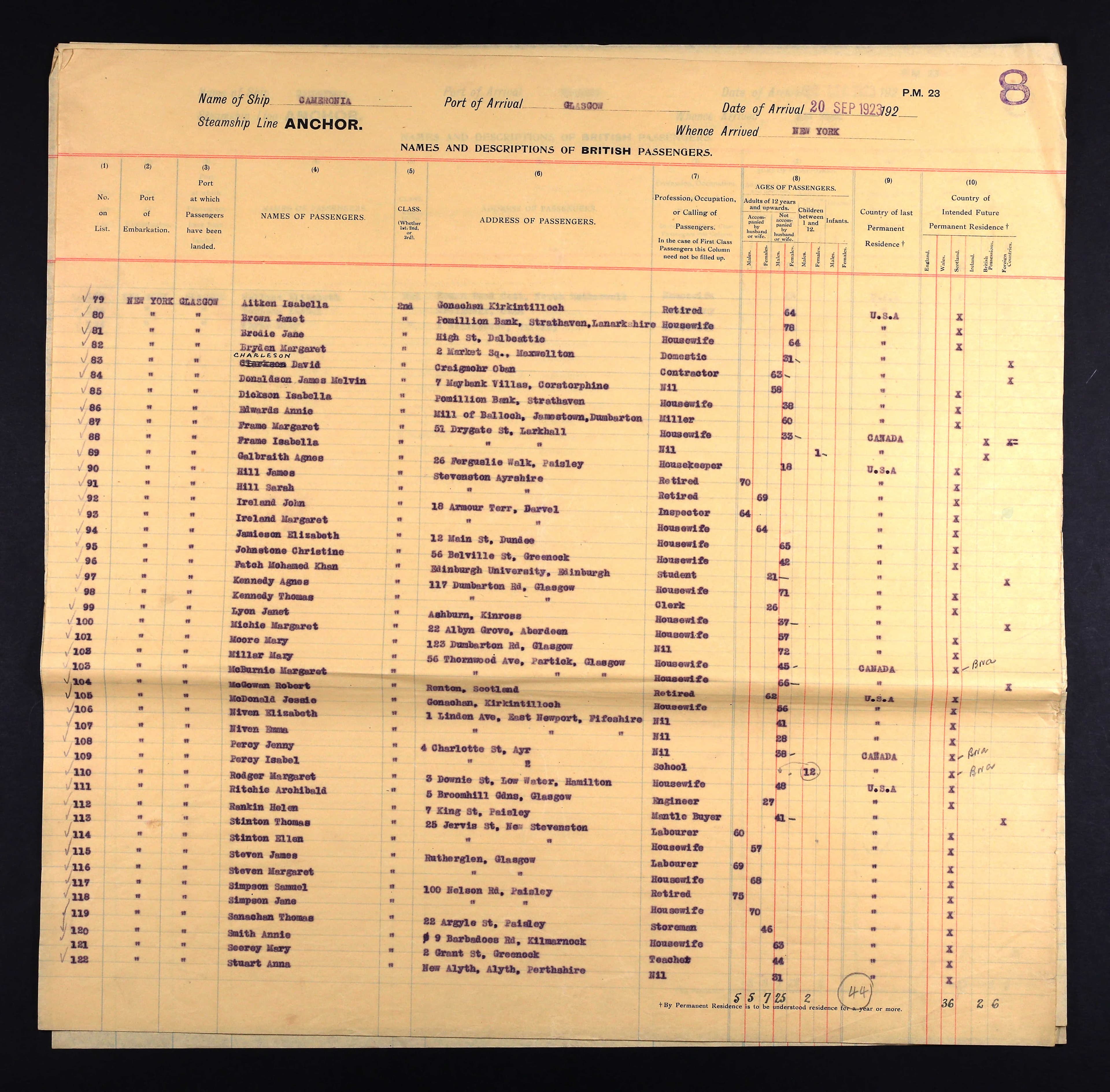
On 20 September 1923 the Anchor Line steamer Cameronia arrived at Glasgow from New York. Its passenger list includes a Margaret McBurnie, age 66, a housewife, travelling second class (not steerage). Her last permanent residence is given as Canada. Her intended permanent residence is Scotland. Her address in Scotland, 56 Thornwood Avenue in Partick, is marked "ditto", meaning it was copied from the passenger listed just above her.
The age fits and the traveling companion fits. A woman born about 1857 would have been 66 in 1923. The spelling McBurnie is a small variant. And Canada is where Jennie, James and Ernest had gone. But nothing on the manifest names a child, a husband or a home in Ireland, so this is a possible match and not a proved one. The passenger above her, whose address she shares, is the best lead there is.
A reader who is used to English or Canadian records may wonder why a family this size leaves so little behind. It is the records that are missing, not the family.
Ireland took a census every ten years from 1821, but almost none of the nineteenth century returns survive. The returns for 1821 to 1851 were mostly destroyed in the fire at the Public Record Office of Ireland in Dublin in 1922, during the Civil War. The returns for 1861 and 1871 were destroyed on purpose in 1877, after the figures had been worked out. The returns for 1881 and 1891 were pulped during the First World War because there was a shortage of paper, again after the figures were gathered. Only 1901 and 1911 survive in full. That is why this family appears in two households and no others, and why we cannot watch them move from parish to parish through the 1880s and 1890s the way an English family can be followed.
The 1922 fire also took about two thirds of the Church of Ireland registers from before 1870, because those registers had been sent to Dublin for safekeeping. Only the third that stayed in local hands survived. Margaret was born about 1857, before civil registration of births began in 1864, so her baptism, if it was ever recorded and survived, would be in a parish register that may be gone.
Some things do help. Non Catholic marriages have been registered by the state since 1845 and all births and deaths since 1864, so a McBurney marriage about 1877 and the births of their children should exist, and can be searched. But Irish records are not digitised, church registers in Northern Ireland are not indexed online, and names like William McBurney and Margaret Cowan appear again and again. A search that turns up a hundred candidates and no way to choose among them is the ordinary experience of Irish research, and it is the reason this page says "not established" so often.