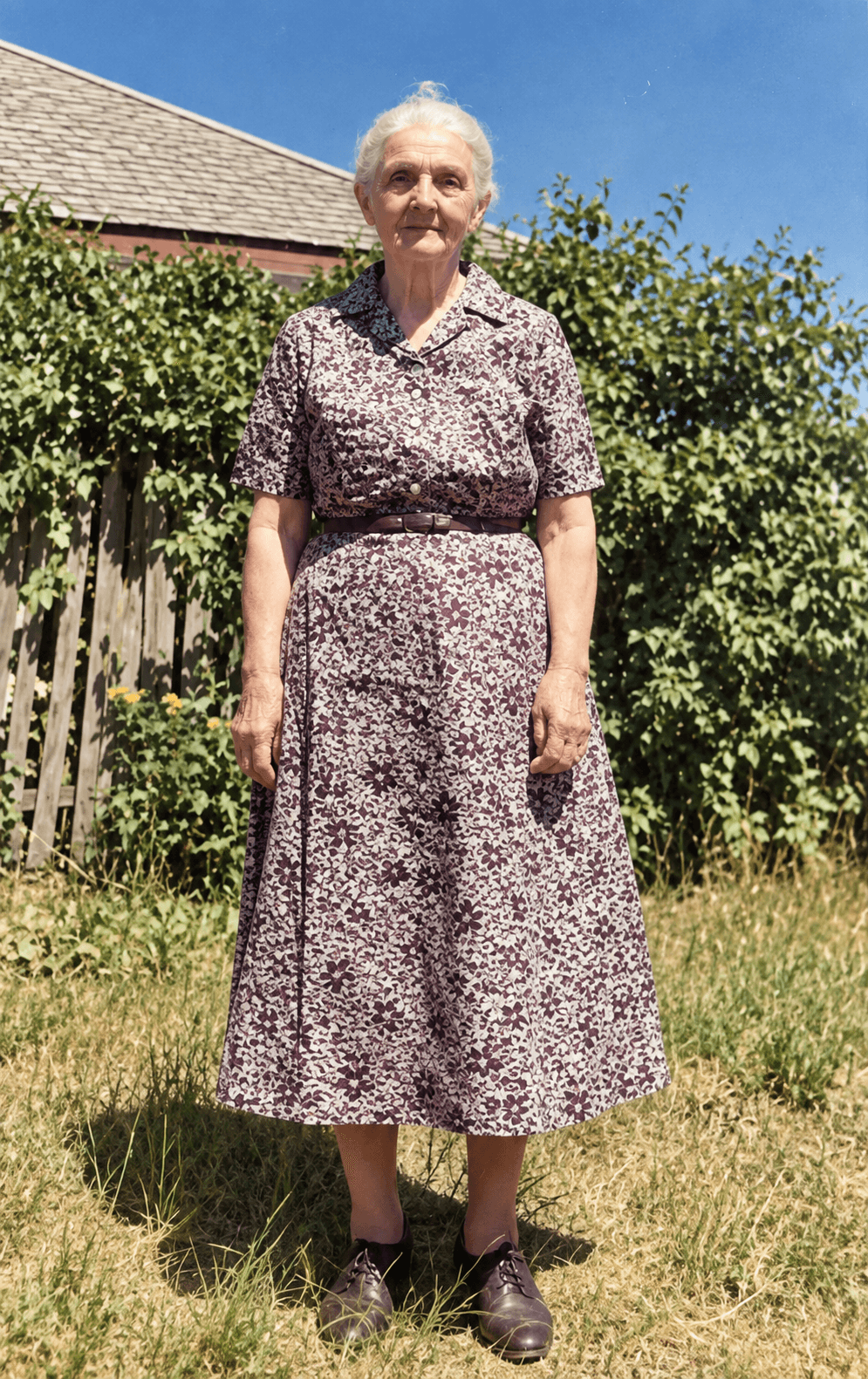
Jane "Jennie" McBurney, Banbridge, County Down, Ireland, July 29, 1877
Died
Lutheran Home, Melville, Saskatchewan, 1975, age about 97–98
Buried
Ituna Cemetery, Saskatchewan
Married (1)
John Frederick "Fred" Martin; widowed June 19, 1915
Married (2)
Thomas "Tom" Haynes, 1918
0:00 / 0:00
Listen to Jennie's storyRecorded account, approx. 45 min
Her Story
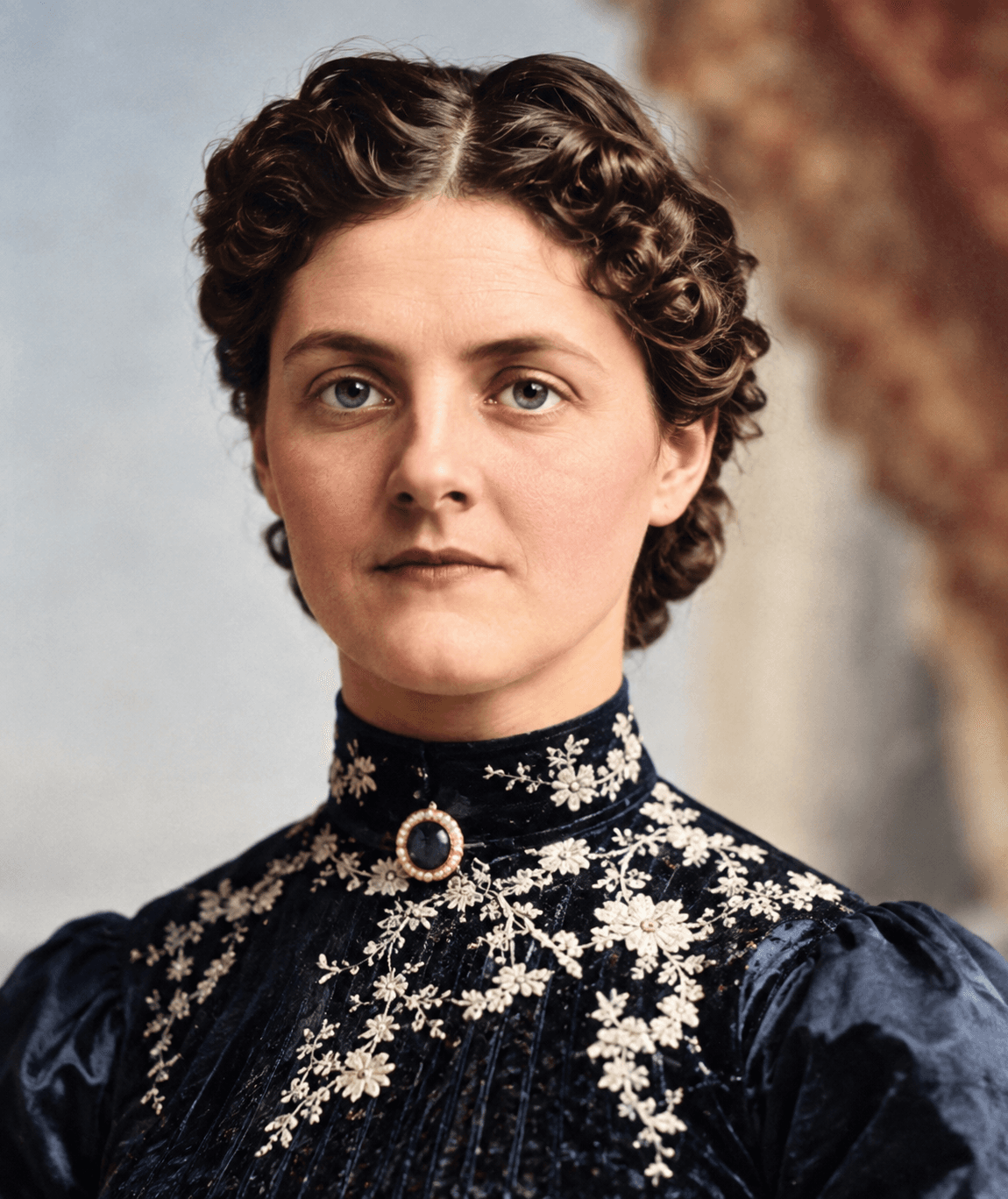
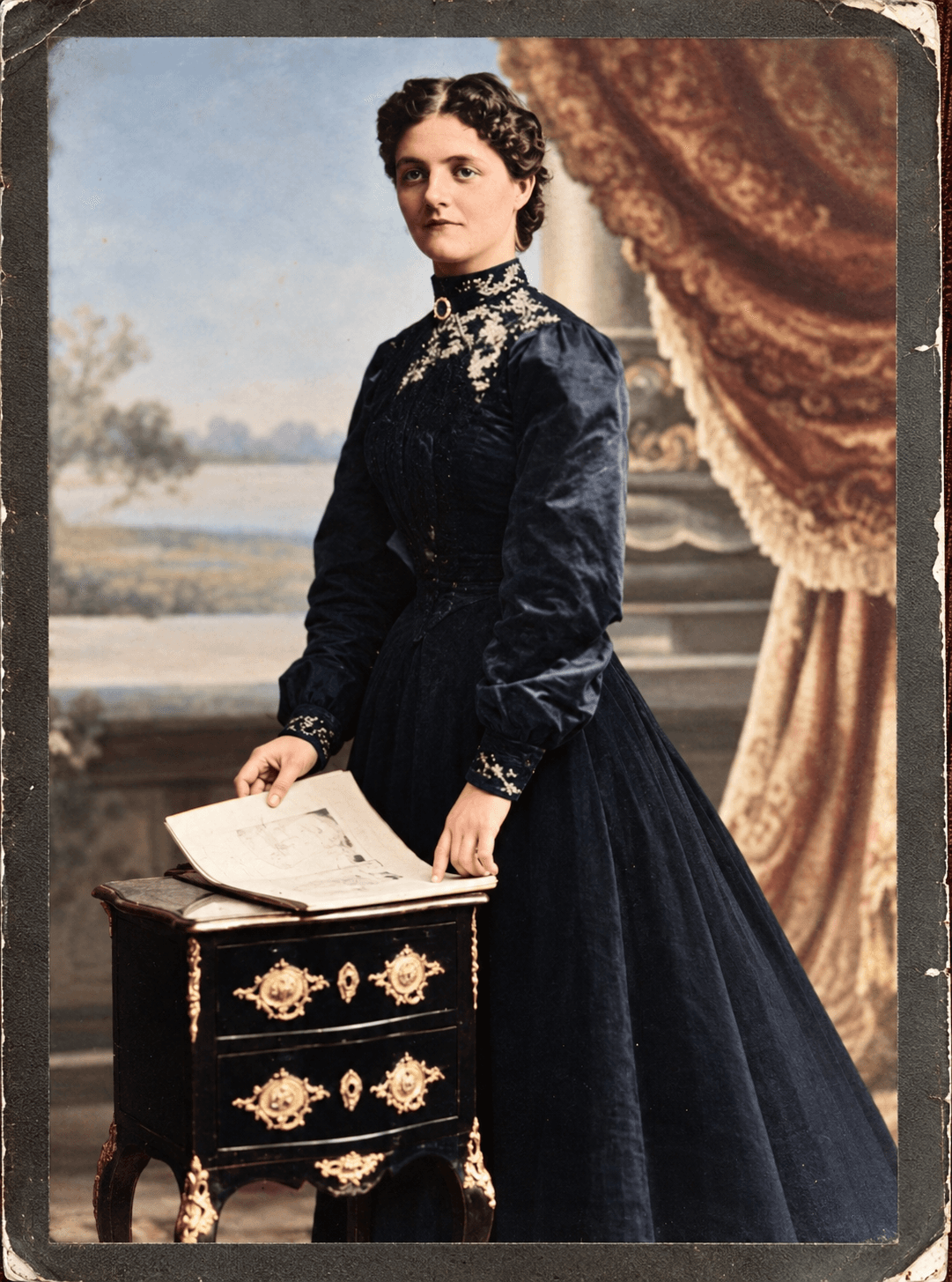
Jennie McBurney was born Jane McBurney on 29 July 1877 in Banbridge, County Down, Ireland, the daughter of William John McBurney, a coach maker who played the pipes, and Margaret "Maggie" Cowan McBurney. She left school young to work in a Banbridge linen mill, sang in her church choir, and loved fashion enough that she once had a dressmaker copy a dress from a Paris pattern book. She married Fred Martin in Ireland and emigrated with him to Canada, arriving on a homestead near what became Ituna, Saskatchewan by 1906, where they lived at first in a sod shack. The years that followed brought heavy loss: twin sons who died young, one during a polio outbreak in Moose Jaw, and then Fred's own death from pneumonia in June 1915, weeks before their youngest child, Violet, was born. Jennie remarried Tom Haynes in 1918, a marriage the family remembers as hard on her older children, and raised a large blended household through it. In 1957 she was reunited with her sister Sarah after fifty years apart, and in 1959 she moved into the town of Ituna itself with two of her sons, turning the town's former United Church into a home where she became known for her rhubarb jam and her open door. She died in 1975 and is buried in the Ituna Cemetery.
Banbridge Ireland: a linen town
Jennie did not come from an isolated rural cottage but from a working industrial town. Banbridge had been at the centre of the Irish linen trade since the 1770s, and by the time Jennie was old enough to work, the town's identity and its economy were still built almost entirely around linen: mills like the Gilford works and firms like Thomas Ferguson & Co. and John England Irish Linen employed a large share of the town's women and girls in spinning and weaving. This is very likely the "linen factory" the family remembered her working in, not a cottage loom, but a real industrial mill job, the kind that gave a teenage girl in Banbridge in the 1890s a wage of her own, a churchgoing town's social life, and, evidently, enough of a taste for fashion that a Paris dress pattern was within reach.
Jennie in her Paris inspired dress, created by Jennie, c. 1898–1902
The town was also solidly Protestant and Orange in its public culture, a lodge tradition, a Twelfth of July calendar, and the same loyal, orange-and-purple regalia that turns up independently in this family's own attic, in an orange collarette belonging to Jennie's husband's side of the family. Jennie's own faith comes through in a much gentler register: a beautiful voice, a place in the church choir, and, much later on the prairie, a granddaughter's memory that she "taught in a church."
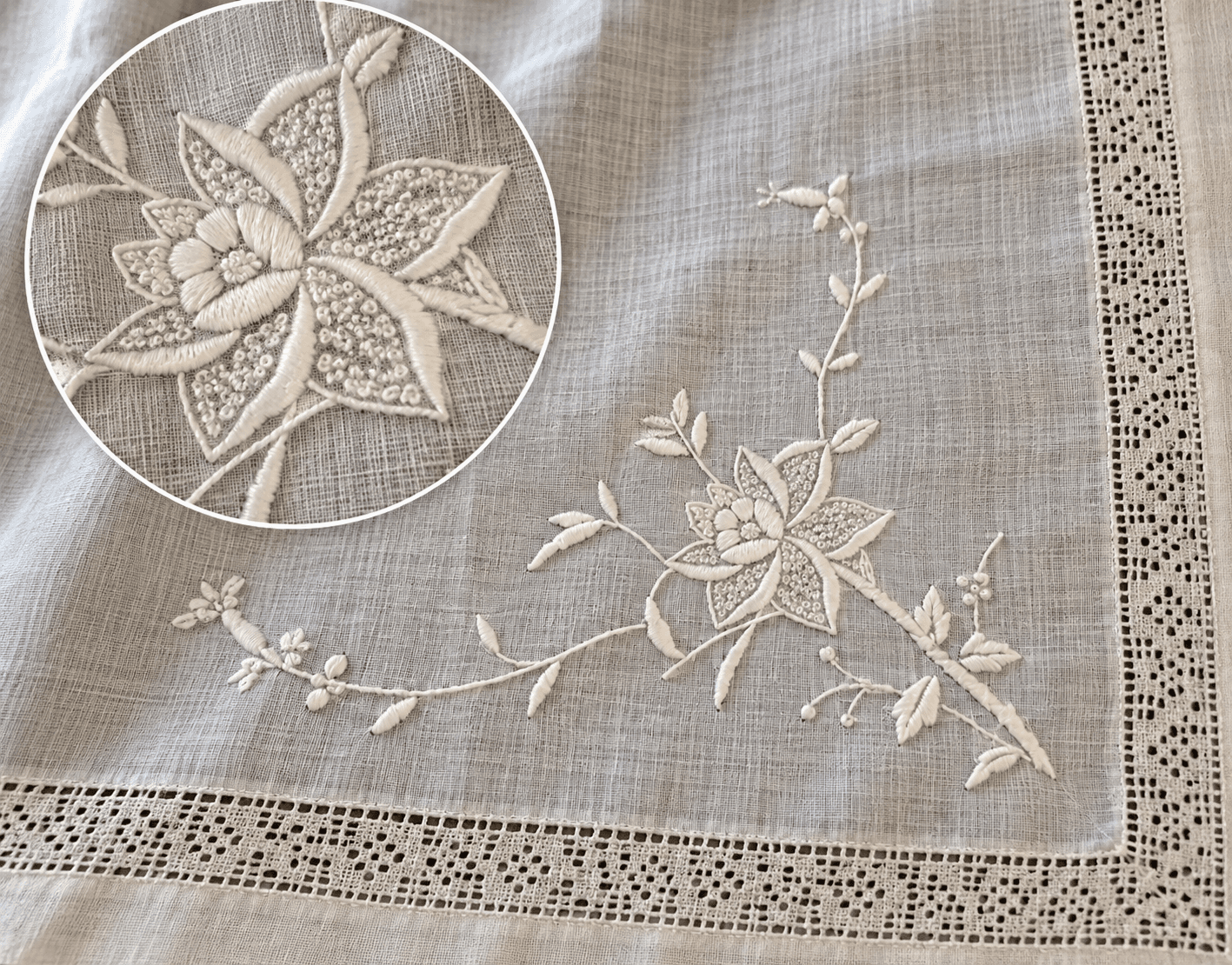
Linen created by Jennie c. 1900
A sod shack on the Beaverside plain
She married Fred Martin, his full name was recorded as John Frederick Martin, in Northern Ireland, and they came out to Canada together at the turn of the century (1904). The Ituna district Jennie and Fred arrived in in 1906 was barely a district at all.
Real settlement in that stretch of Saskatchewan had only begun in the first years of the twentieth century, and the event that turned it into a functioning place, the Grand Trunk Pacific Railway's arrival, was still a year or two away when the Martins broke ground on their quarter section. A post office at Ituna itself did not open until 1909, incorporation not until 1910. The Martins were, in other words, ahead of the wave rather than riding it: they built their sod shack on the Beaverside School district before there was much of anything nearby to call a town.
What that meant in practice was close to the general prairie-homestead experience that has been written up many times since: isolation, brutal seasonal extremes, and, in the words of one standard account of the period, "unbearably hard work," with settlers relying on themselves for food, shelter, clothing and medical care because there was very little else within reach. A sod shack, walls cut from the prairie turf itself, because there was no lumber to build with yet, was the standard first shelter for exactly this kind of homestead, everywhere across the Saskatchewan parkland in this period. Jennie's own verdict on it, as her daughter later told was blunt: she had believed the streets of Canada were paved with gold, and instead found a life far harder than the one she had left in Ireland. For a woman coming out of a wage-earning linen-mill town onto raw, unbroken prairie, that gap between expectation and reality was probably close to universal among the era's immigrant brides.
Loss upon loss: the twins, and a widow at Ituna
The clearest window into how hard those early years were is the run of loss that came before Violet, the youngest child, was even born. Maggie came first, then twin boys; both twins died young, one during a polio outbreak in Moose Jaw, where Jennie had travelled to visit her own brother, Jim McBurney, another Irish immigrant, and his wife Jeanette and their children, and the second on the train home to Ituna, evidently already infected with the same illness. Then came Fred, Joe, Lily, and finally Violet, five living children in the end, which is the number the Ituna history book records, the two dead infants folded silently out of that later count the way infant deaths so often were in the record-keeping of the period.
Fred Martin died in June 1915, weeks before Violet's birth, of pneumonia. The single detail that survives about his death is almost novelistic: a deathbed instruction to Jennie to sell the cattle and take the children back to Ireland, so that the boys could learn a trade there instead of scraping a living from a Saskatchewan quarter section. Jennie did not go. Whatever combination of practicality, resolve or simple lack of means kept her on the prairie, it left her a widow with at least four living children and a newborn on the way, on land she and Fred had only had nine years to establish.
The Haynes years
Jennie's second marriage, to Tom Haynes in 1918, gave her three more children in the record (Tommy, Sandy and Angus) and, in family memory rather than the printed page, a daughter who died at about ten, remembered as Isabel. It was, by every account that has survived in the family's own telling, not an easy household. Tom Haynes is remembered as an unreliable provider, and specifically as harder on Jennie's older Martin children than on his own. Fred Martin the younger was working for neighbouring farmers by the age of twelve; Lily was already a hired girl, doing other families' housework, by thirteen. Jennie herself, through all of this, seems to have been the household's actual centre of gravity, the parent who is remembered, the one whose voice and kindness and hospitality carried down through the family, while Tom Haynes is remembered mainly for what he did not provide.
The 1957 reunion, and Ituna's grandmother
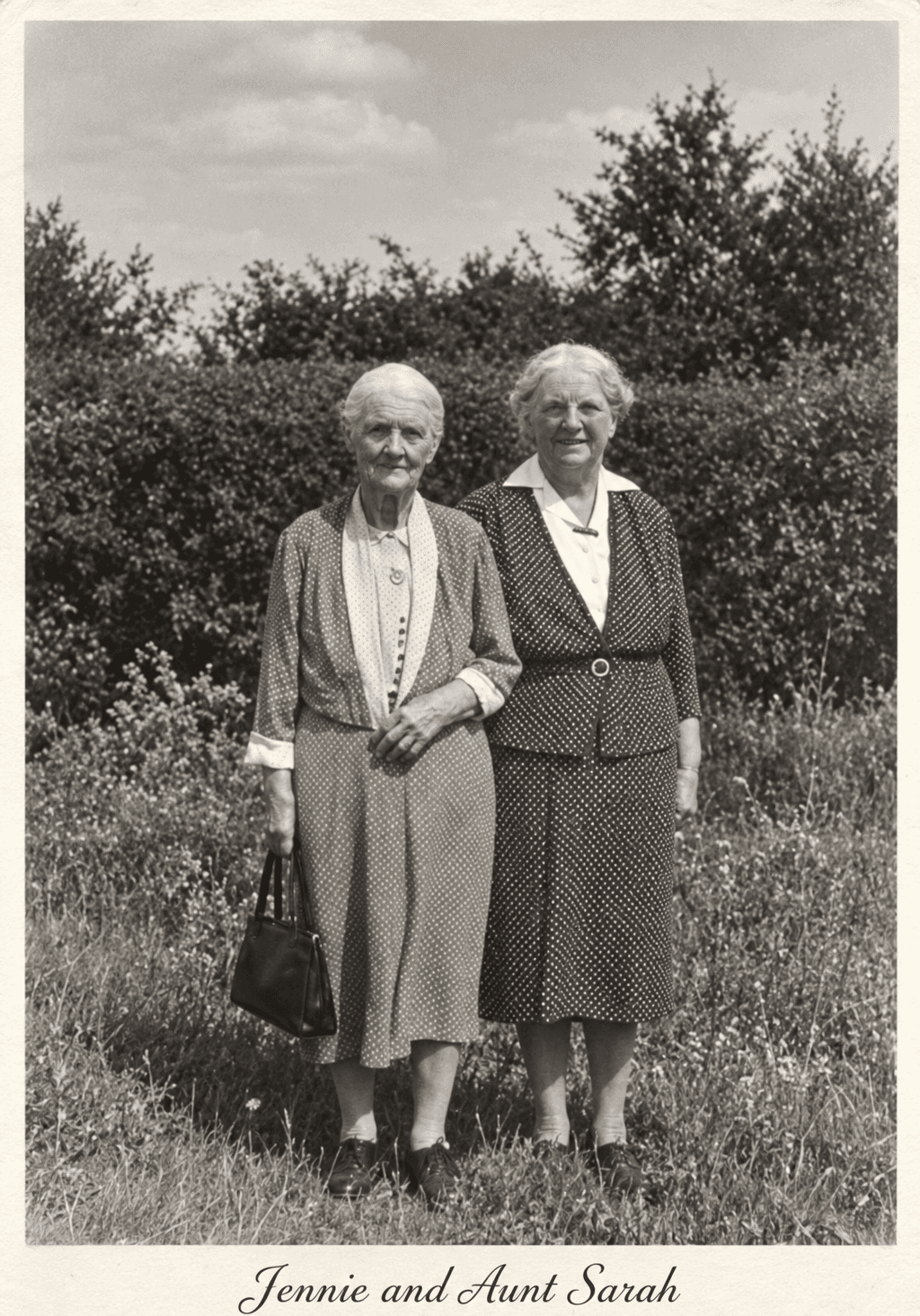
Two things in Jennie's later years survive in enough detail to actually picture. The first is the summer her sister Sarah crossed the Atlantic to see her, apparently in August 1957, fifty years, by the family's own count, since Jennie had left Ireland. It was enough of an event locally that a newsletter wrote it up, and the family made a point of gathering for it; the surviving photograph shows two elderly women, clearly sisters, standing together in a Saskatchewan field in their good clothes, handbag and all, on what looks like a warm, ordinary summer afternoon that both of them had waited half a century for.
Jennie and her sister Sarah
The second is Jennie's move into the town of Ituna itself in 1959, at what would have been about 82 or 83 years old, together with her sons Fred and Joe. The three of them bought the town's first United Church building, by then decommissioned as a church, and turned it into a house. By every account that survives, Jennie made it a genuinely welcoming one: she was known for the best rhubarb jam in the district and for a kettle that always seemed to be on, ready for whoever walked in, and she was remembered, in the plain and generous language of the local history book, as "a friendly person" who "always had a kind word to say about everyone." Her granddaughter Violet photographed the building in 1984, nine years after Jennie's death, captioning the print in her own hand simply: "Grandmothers School House Ituna."
What the censuses add
Five Canadian censuses (1906, 1916, 1921, 1926 and 1931) place this family on the ground decade by decade, and mostly confirm what the Ituna history book and family memory already said. The 1906 census finds Fred and Jenny Martin freshly settled on the homestead with two-month-old Maggie. The 1926 and 1931 censuses both find Thomas and "Jennie" Haynes at Ituna Bon Accord with sons Thomas, Alexander and Angus, and with Jennie's own son Joseph and daughter Violet still in the household as step-children, a nice independent confirmation that Violet grew up inside the blended Haynes household rather than separately from it.
The 1916 census adds a particularly useful detail about Jennie's family connections in Canada. Her brother James "Jim" McBurney was living in her household at Ituna. He was recorded as 29 years old, born in Ireland, having immigrated in 1906, and working as a farm labourer. This places Jim firmly within Jennie's immediate family life in Saskatchewan and shows that the siblings remained closely connected after their separate migrations to Canada.
A Long Life Comes Home to an End
Jennie spent her final years at the Lutheran Home in Melville, Saskatchewan, where she died in 1975, at about 97 or 98 years of age. She was laid to rest at Ituna Cemetery, returning in death to the Saskatchewan community where she had spent so much of her life and raised her family. An exact date and cause of death have not yet been located, but family remembrance paints a gentle picture of Jennie in old age: a welcoming woman remembered for her rhubarb jam and for always having "a kind word to say about everyone."