about 1875, near Warrenpoint, County Down, Ireland
Died
June 19, 1915, Ituna district, Saskatchewan, age about 40
Married
Jane "Jennie" McBurney, June 22, 1904, Belfast
Children
Sarah and Samuel (twins, died in Toronto in 1905), Maggie, a second Samuel (died as an infant), John Frederick "Fred" Jr., Joseph, Lillian, and Violet
0:00 / 0:00
Listen to Fred's storyRecorded account, approx. 19 min
His Story
Fred Martin's own life is the harder one to see clearly. He left fewer traces than Jennie did, and most of what survives about him is a date, a place, or a loss. What follows pulls those pieces into one telling: a Belfast tram driver who married an Ulster linen mill girl, crossed the Atlantic within weeks of the wedding, buried two infant twins in Toronto, broke a homestead out of raw Saskatchewan prairie, buried a third child there who didn't make it their first birthday, and died himself at about 40, leaving Jennie a widow with young children and one more baby still to come.
Warrenpoint and Belfast
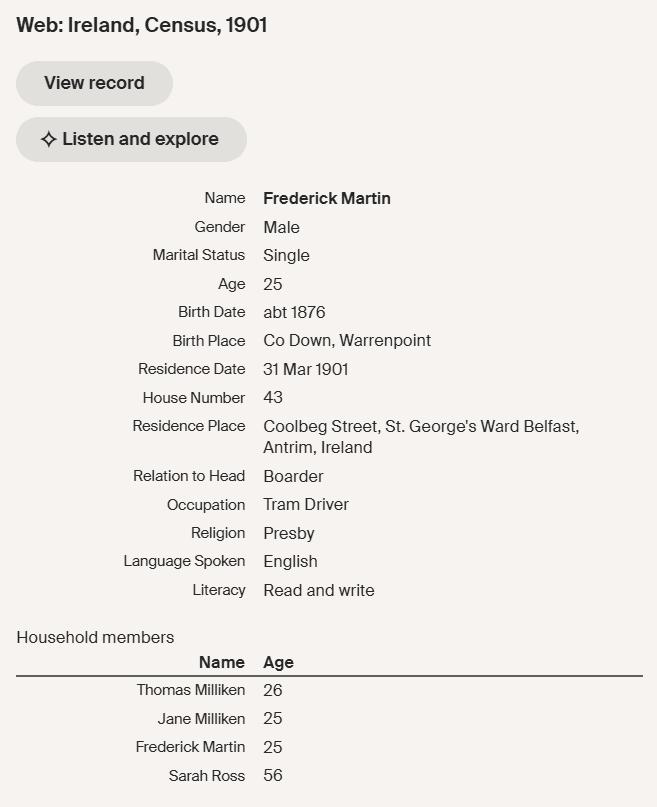
Fred was born about 1875, most likely near Warrenpoint, a small port town on Carlingford Lough at the foot of the Mourne Mountains in County Down. By 1901 he was in Belfast, a single man of 25, Presbyterian, working as a tram driver, and boarding at 43 Coolbeg Street in the city's St George's Ward. A tram driver in Belfast at that date meant horse drawn cars in a city that was about to convert its lines to electric power, a steady working job in a city that ran on linen mills, rope works, and the Harland and Wolff shipyard, then building the great liners that would make Belfast famous.
1901 Belfast Ireland Census
Marriage and the crossing, 1904
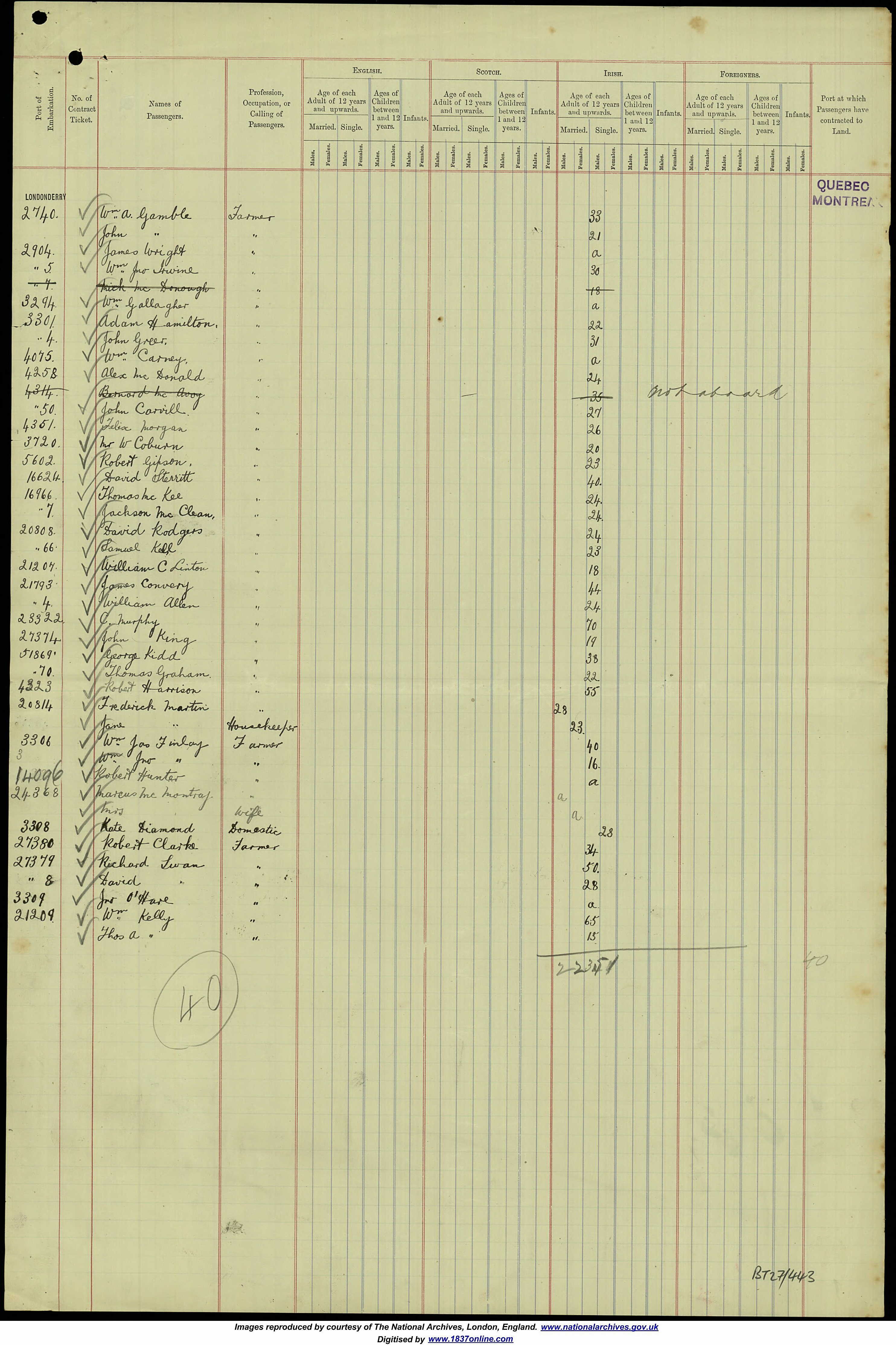
Fred married Jane "Jennie" McBurney in Belfast on 22 June 1904. Jennie was a linen mill girl from the Shankill Road, and the marriage joined two working families from the same Protestant, Orange culture that ran through Ulster's industrial towns. Three weeks later, on 15 July 1904, Fred and Jane sailed from Londonderry on the Allan Line steamer Tunisian, bound for Quebec and Montreal. The passenger manifest lists Frederick Martin, 28, married, contract ticket 20814, with Jane, 23, listed as his housekeeper directly beneath him, travelling on his own ticket. It was a fast decision for a young couple: married in June, at sea within weeks, starting a new life in Canada before the summer was out.
The Tunisian Ship Manifest, Northern Ireland to Quebec
Toronto, and the twins
Fred and Jennie settled in Toronto, where their twins, Sarah and Samuel, were born on 27 April 1905. The family's home is recorded as 2 Poulett Street. That summer, Toronto's heat brought the disease known at the time as cholera infantum, a fast moving summer diarrhoea tied to spoiled milk and poor water that killed many of the city's infants. Samuel died first, on 30 August 1905, aged four months, and Sarah died eleven days later, on 10 September. Both were buried at Mount Pleasant Cemetery, the ground owned by Fred himself. It was the first of the losses that would mark this family's early years in Canada, a year after leaving Ireland, in a city that was meant to be a stopping point rather than a home.
The homestead at File Hills
By September 1906 Fred and Jennie were on a homestead in the File Hills district of Saskatchewan, on the southwest quarter of section 36, township 25, range 11, west of the second meridian, close to where the town of Ituna would later grow up. The 1906 census finds Fred, 29, and Jenny, his wife, with an infant daughter, Maggie, already born on the place, and Jesse Martin, single, farming the same section. The Grand Trunk Pacific Railway would not reach the district until 1907 or 1908, so the Martins arrived ahead of the rail line, hauling everything by wagon and living, as the Ituna history book records, in a sod shack cut from the prairie turf itself. The family attended Beaverside School as the children came along, Maggie first, then a second son named Samuel, born 23 April 1907, and after him Fred Jr., Joseph, and Lillian.
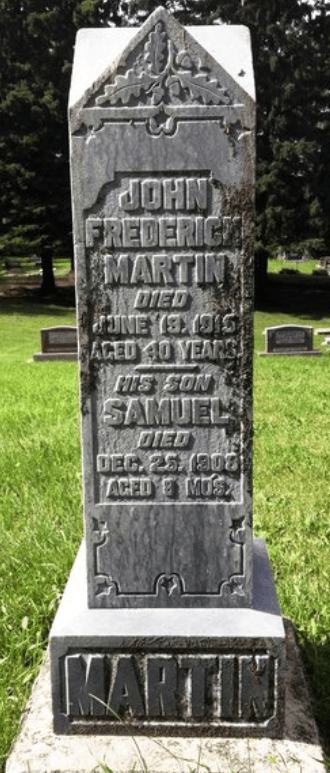
The second Samuel did not survive either. He died as an infant, about eight months old, most likely on Christmas Day 1907, and is remembered on the family headstone alongside his father.
The Orange sash
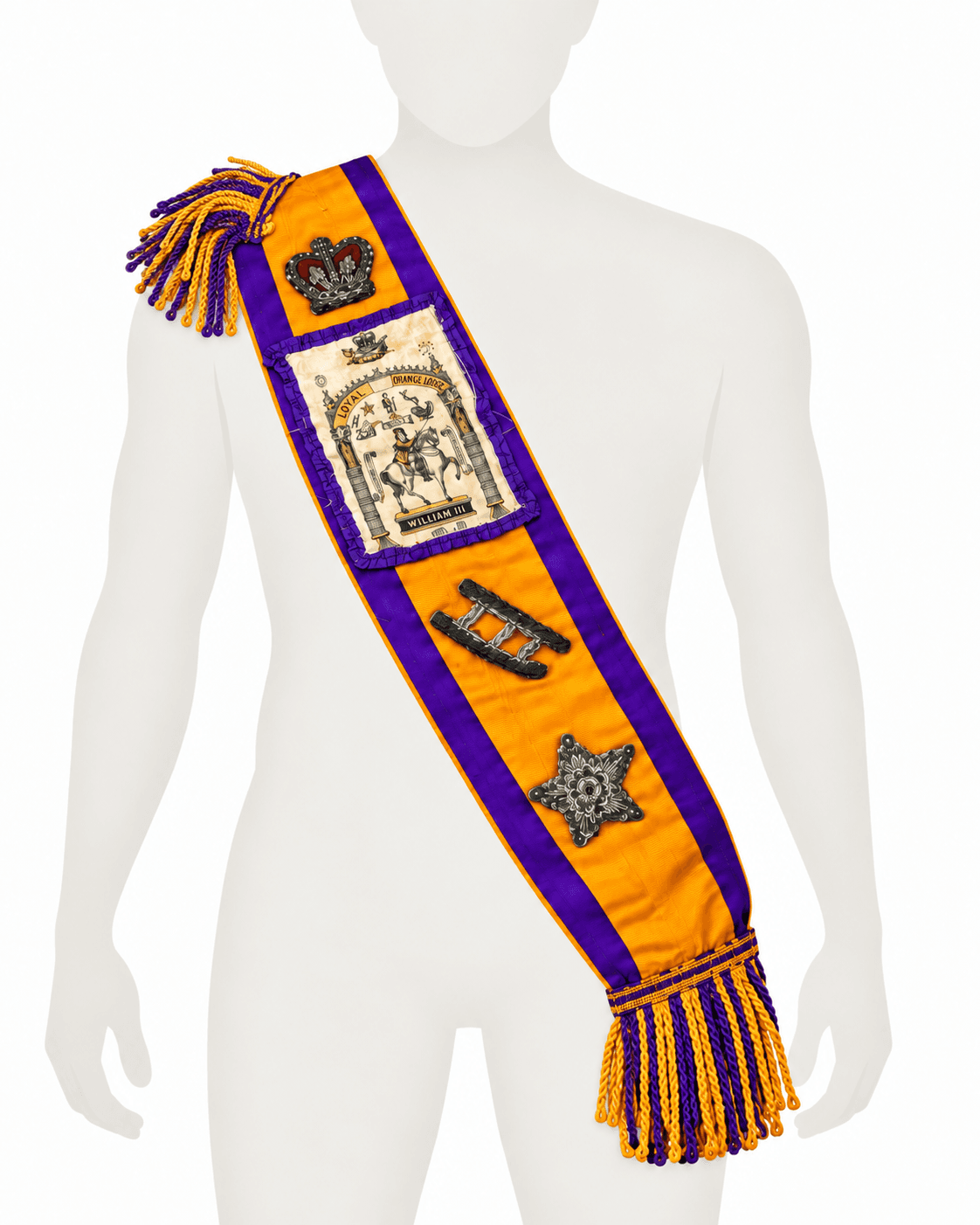
Among the few personal objects that survive from this family is an Orange Order sash, gold with purple edges, carrying a printed silk panel and three silver embroidered badges. The panel shows King William III on horseback at the Boyne, with the names of Derry, Enniskillen, Aughrim, and the Boyne itself, the four great events Ulster Protestants marked every year on the Twelfth of July. The badges, a crown, a ladder, and a five pointed star, are common Orange Order emblems, standing for loyalty to the Crown, Jacob's ladder reaching to heaven, and the star that led the wise men to Bethlehem. The space where a lodge name and number would normally be lettered was never filled in, so which lodge Fred belonged to is not known.
Fred’s Orangeman Sash
Death, June 1915
Fred Martin died on 19 June 1915 in the Ituna district, at about 40 years old, ten weeks before his youngest child, Violet, was born. The cause of his death has not been found. Family memory holds that as he lay dying he told Jennie to sell the cattle and take the children home to Ireland, so the boys could be apprenticed to a trade there. Jennie did not go. She stayed on the prairie, remarried in 1918, and raised the family Fred left behind.